
- Applied Digital's new 150 MW, 18-year lease carries about $5.4 billion in base-term revenue, or $12.7 billion with renewals, lifting total contracted base-term lease revenue above $41 billion from about $16 billion in January.
- Spread evenly over its base term, the lease works out to about $2.0 million per megawatt per year, against about $1.65 million to $1.67 million on the company's four previous hyperscaler leases.
- APLD closed at $13.82 on November 23, up 20.3% on the day yet still 71% below its May month-end close of $47.28, while about 75% of its contracted revenue now comes from investment-grade tenants.
A tier-one hyperscaler has agreed to pay Applied Digital about 20% more per megawatt than any of the AI data center builder's earlier tenants, locking in 150 megawatts of capacity for 18 years from 2028, which shows the price of guaranteed AI compute space still rising even as investors mark down the companies that build it.
Applied Digital's $5.4 billion lease lifts contracted AI revenue above $41 billion
Applied Digital designs, builds and owns large AI campuses and leases them to cloud giants under long take-or-pay contracts. The tenant in Monday's deal is unnamed, described only as a tier-one investment-grade hyperscaler, and the campus is undisclosed. The company says the agreement carries "improved commercial terms" including higher pricing, and that delivery should begin in the first half of 2028, subject to utility arrangements and approvals. With it, the portfolio reaches more than 1.6 GW of contracted critical IT load and 2.2 GW of grid-connected peak load, with total contracted revenue near $100 billion if every renewal option is exercised.
The customer list behind that backlog is short. CoreWeave holds 400 MW at Polaris Forge 1 in North Dakota, a US investment-grade hyperscaler signed Polaris Forge 2, and a second hyperscaler signed Delta Forge 1, Polaris Forge 3 and Delta Forge 2 in the space of seven weeks this spring. Monday's release leaves open whether the new tenant is a third name, and the company has used the same "tier-one investment grade" label for its Delta Forge 1 customer, so repeat business from the spring tenant is plausible. The company has also secured up to 1 GW of potential power in Finland, its first site outside the US, announced in October.
The same morning, 15 minutes before the lease announcement, Applied Digital disclosed a $300 million senior secured bridge facility to keep construction moving at Delta Forge 1, its Louisiana campus. The two releases together describe the business model in one morning: a long contract from a highly rated tenant first, then the debt and equity that contract makes possible.
"We plan to finance this build through our established structure, including first-in equity already funded from our balance sheet and through our $5 billion programmatic equity partnership with Macquarie Asset Management, followed by project financing supported by the long-term lease."
Saidal Mohmand, CFO, Applied Digital, November 23, 2026
The new lease pays about 20% more per megawatt than earlier deals
Applied Digital keeps its rent rates private, yet its own figures allow a consistent comparison. Dividing each lease's base-term revenue by its capacity and term gives an average annual figure per megawatt, and on that basis Monday's deal stands well above every earlier hyperscaler lease the company has announced.
| Lease (announced) | Capacity | Base term | Base-term revenue | Approx. revenue per MW per year |
|---|---|---|---|---|
| Polaris Forge 2 (Oct 22, 2025) | 200 MW | about 15 years | about $5.0B | about $1.67M |
| Delta Forge 1 (Apr 23, 2026) | 300 MW | 15 years | about $7.5B | about $1.67M |
| Polaris Forge 3 (May 20, 2026) | 300 MW | 15 years | about $7.5B | about $1.67M |
| Delta Forge 2 (Jun 8, 2026) | 210 MW | 15 years | about $5.2B | about $1.65M |
| New lease (Nov 23, 2026) | 150 MW | 18 years | about $5.4B | about $2.00M |
Source: Applied Digital press releases. Revenue per MW per year is Santage's simple average of base-term revenue over capacity and term; it ignores escalators and any differences in what each tenant pays for separately. Table: Santage.
| $41B+ | Contracted base-term lease revenue |
| 1.6 GW | Contracted critical IT load |
| ~20% | Higher average revenue per MW than prior leases |
| H1 2028 | Expected start of delivery for the new lease |
A tenant accepting both a longer term and a higher rate for capacity it cannot use until 2028 is a strong demand signal. Hyperscalers are buying future AI infrastructure years ahead because grid connections now set the pace at which new capacity can come online, a constraint Santage tracked when Anthropic reportedly bought $3.4 billion of gas generators for its own sites.
Contracted AI demand rose while the stock fell 76% from May
Applied Digital's backlog has grown about 2.6 times this year, from roughly $16 billion in January to more than $41 billion. Its shares went the other way after May, falling from a $47.28 month-end close to $11.49 on November 20, as the broader AI trade sold off and Taiwan's chip stocks had their worst week since 1990.
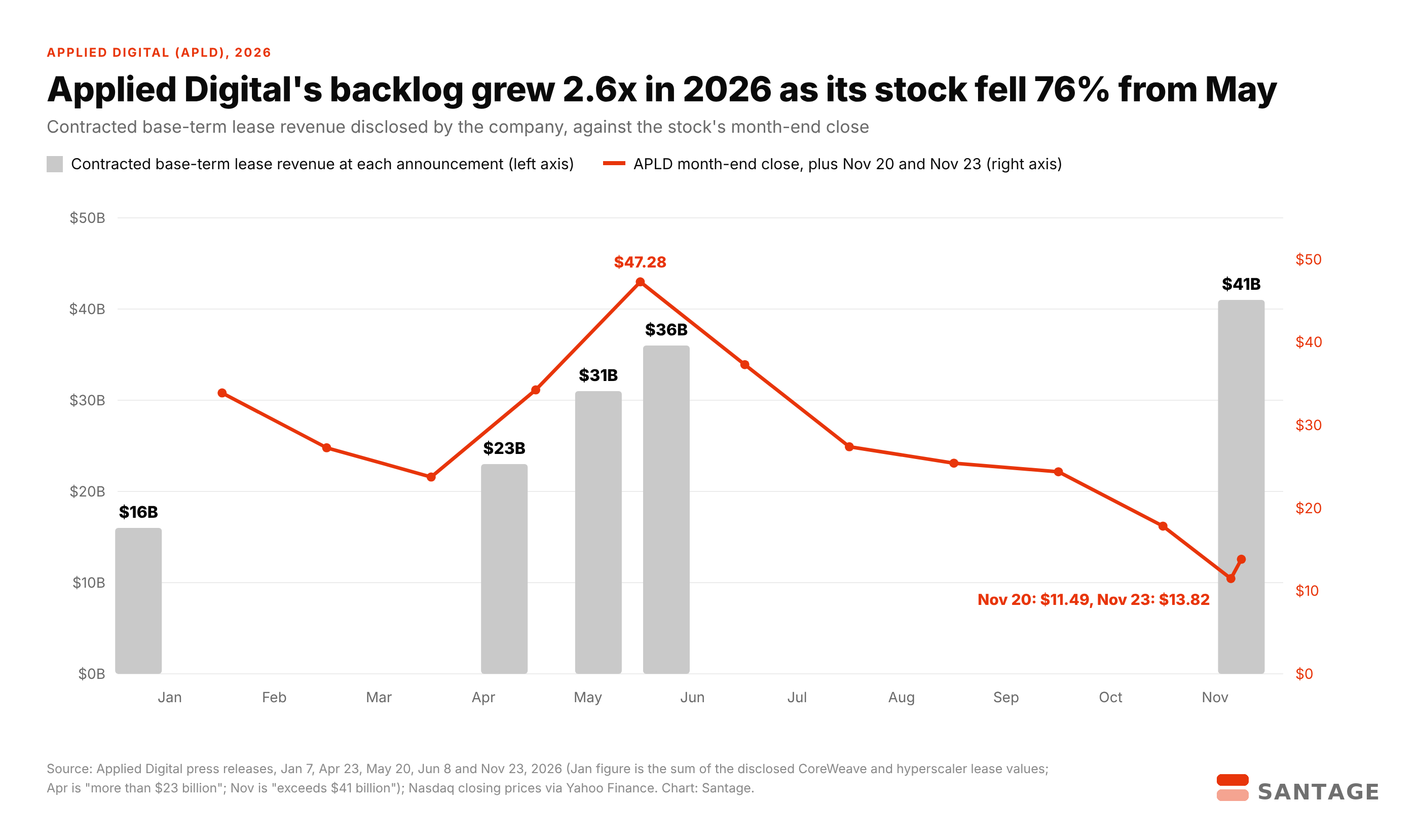
The gap reflects where the risk sits. A lease is income only once the building is finished, powered and handed over, and Applied Digital lists the execution and regulatory approval of related power supply agreements among the conditions for its leases to take effect. Each new campus also needs fresh project finance: the company expects to close the remaining financing for Delta Forge 1 and Polaris Forge 3 in the first quarter of 2027 and for Delta Forge 2 in the second, the same credit markets that absorbed Broadcom's $100 billion of AI chip debt earlier this year. Equity investors are discounting those steps, while the tenants signing the leases are paying more to secure them.
The customers with the best view of future AI demand are paying higher rents for 2028 capacity, while the market is pricing the builders as if that demand might not arrive. One of those two groups is wrong about the next three years.
Rising lease rates set a higher floor for AI compute costs
For AI labs and enterprises that rent compute from these hyperscalers, a 20% step up in what the hyperscaler pays for shell, power and cooling feeds into the price of inference and training capacity from 2028. For investors, Applied Digital is now a clean test of the AI buildout: its revenue is contracted with tenants about 75% investment-grade, so the share price mostly tracks confidence in financing and delivery.
The renewal options show how long these bets run. At about $100 billion including renewals against $41 billion in base terms, the company's tenants hold options worth well over a second full contract, which only pay out if AI workloads still need these buildings in the 2040s and 2050s. A tenant that commits for 18 years at a higher rate is also telling the market how it values that optionality. For a sector worried about overbuilding, the lease points the other way, since the scarce input is land with power already connected, and the companies holding it are now setting the price.
Applied Digital's newest tenant agreed to pay more, for longer, for AI capacity that will not switch on until 2028, and that price is the clearest market signal in this deal. The company's stock has gone the opposite way since May, so the next test is whether the builders can finance and power their campuses on schedule while their customers are still bidding up the space inside them.
Santage is committed to independent, transparent journalism. This article is produced in accordance with Santage's Editorial Standards and aims to provide accurate and timely information. Readers are encouraged to verify information independently.