
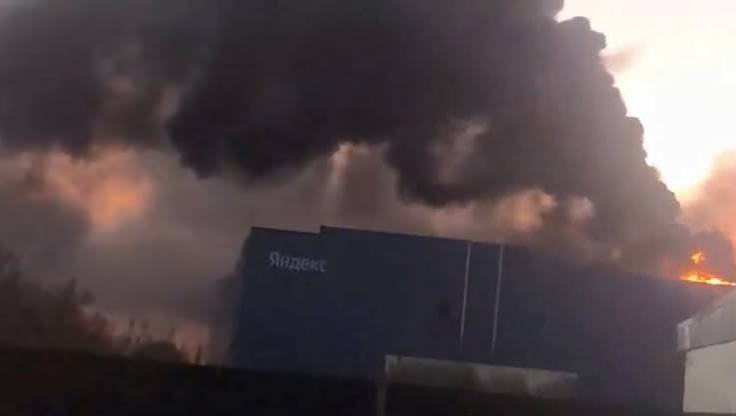
- A strike overnight on October 7 to 8 halted Yandex's Sasovo data center, home to the Chervonenkis and Lyapunov supercomputers, and a second strike on October 9 knocked out several modules at its Kaluga site, leaving 2 of Yandex's 5 large data centers damaged.
- Commercial data centers have now been hit in three conflicts in 2026: Iranian drones struck AWS sites in the UAE and Bahrain from March 1, and Russian drones have damaged sites run by at least eight Ukrainian operators since September 23.
- AWS told customers on September 15 that it cannot restore data held only in its Bahrain region, the first permanent loss of a hyperscale cloud region to military action.
Ukrainian drones on October 8 shut down the Yandex data center that houses two of the three supercomputers Russia's largest tech company uses to train its AI models, the first reported strike of the war on a site built to train AI, and partly disabled a second Yandex site a day later. The two strikes complete a pattern that began in the Gulf in March and reached Kyiv in September, and they expose a gap in how the industry builds for failure: cloud resilience was designed for fires and power cuts, while AI clusters concentrate their most expensive hardware in a handful of buildings.
Two strikes in two days hit the core of Yandex's AI compute
The first attack started a fire at the Sasovo site in Russia's Ryazan region and stopped it completely. Sasovo is where Yandex keeps Chervonenkis and Lyapunov, two machines built on Nvidia A100 accelerators and AMD EPYC processors that the company described in 2021 as the engines for training “neural network models with billions of parameters,” including the language models behind its search and the Alice assistant. Yandex has declined to say whether the supercomputers were damaged. On the morning of October 9, drones hit its Kaluga data center southwest of Moscow and fully disabled several modules there.
| Yandex large data centers hit | 2 of 5: Sasovo on October 8, Kaluga on October 9 |
| Yandex AI supercomputers housed at Sasovo | 2 of 3: Chervonenkis and Lyapunov (Galushkin is in Vladimir) |
| Chervonenkis performance | 21.53 petaflops, 19th on the November 2021 TOP500 list |
| Rival clouds helping move Yandex clients | 3: VK Cloud, Selectel and K2Cloud |
Yandex Cloud, Disk and Documents went down along with services that depend on them, including the Russian Railways website and the property platform Cian. On October 9 Yandex agreed with three domestic competitors to speed up moving affected clients onto their infrastructure.
“It is difficult to say when the operation of the affected data centers will be fully restored.”
Yandex statement, October 9, 2026
President Volodymyr Zelensky described the Sasovo strike as retaliation. “We always respond in kind. You all know that they have been and are striking our data centers, so we responded to them,” he told reporters on October 8.
AWS learned in Bahrain that availability zones do not stop drones
The Gulf supplied the precedent. Iranian Shahed drones struck two AWS data centers in the United Arab Emirates before dawn on March 1, a Bahrain facility was hit days later, and further strikes in April took the whole Bahrain region offline. On September 15 AWS told customers through its Health Dashboard that it “cannot restore resources and data hosted exclusively” in Bahrain, because the damage spanned several availability zones and exceeded what its multi-zone services are built to survive. One zone in the UAE region is also permanently lost.
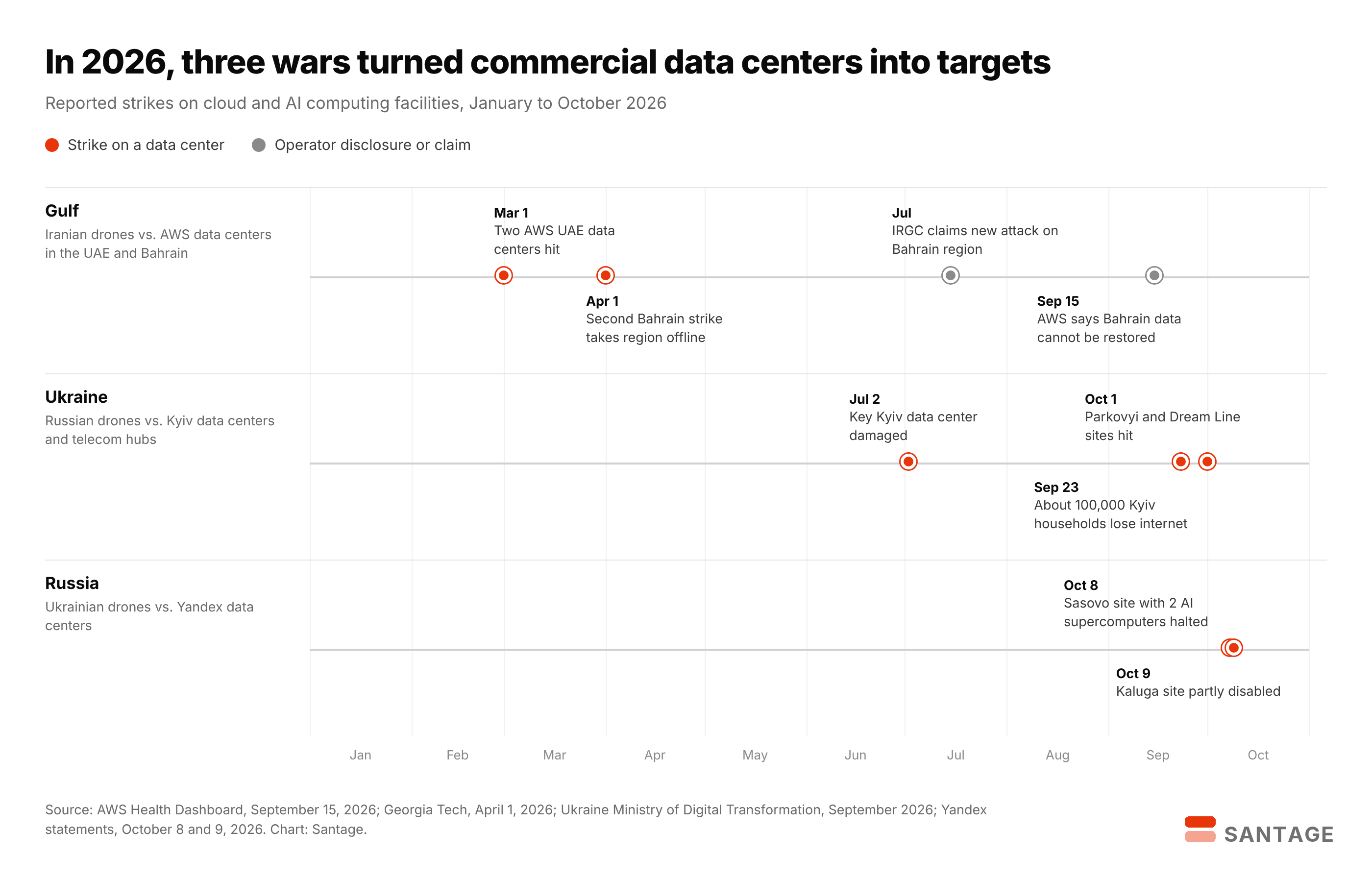
Availability zones sit within about 100 kilometers of each other so that a flood, storm or grid failure cannot take out more than one. That spacing protects against accidents and offers nothing against an adversary with long-range drones who can hit several sites in one night. Russia's campaign against Kyiv since September 23 made the same point at smaller scale, damaging sites run by MiroHost, Parkovyi, Dream Line, Datagroup and others and cutting internet service to about 100,000 households.
| Conflict | Operator hit | What was hit | Outcome |
|---|---|---|---|
| Gulf, from March 1 | AWS | Two UAE data centers and one in Bahrain in March, more Bahrain strikes in April | Bahrain-only data cannot be restored; one UAE zone permanently lost |
| Ukraine, from September 23 | MiroHost, Parkovyi, Dream Line, Datagroup, UTELS and others | Sites run by at least eight operators in Kyiv | About 100,000 households lost internet; MiroHost clients hosted abroad unaffected |
| Russia, October 8 and 9 | Yandex | 2 of 5 large data centers, including the Sasovo AI supercomputer site | Sasovo halted; clients moving to VK Cloud, Selectel and K2Cloud |
Source: AWS Health Dashboard, September 15, 2026; Ukraine Ministry of Digital Transformation and operator statements, September and October 2026; Yandex, October 8 and 9, 2026. Table: Santage.
AI training clusters concentrate the risk that cloud design spreads out
General cloud workloads can be copied and restarted elsewhere, which is what most AWS customers in Bahrain did and what Yandex is now doing with its rivals. Large AI training runs depend on the opposite architecture, thousands of accelerators packed into one building with fast interconnects, because spreading them across distant sites slows training. Yandex put two of its three supercomputers under one roof in Sasovo for exactly that reason, and sanctions mean it cannot easily buy Nvidia hardware to replace them.
The cloud was built to survive the loss of a building. Frontier AI is built around a single building.
The Ukrainian hosting company MiroHost shows what does survive. Its Kyiv data center was destroyed in September, yet roughly 90 to 95 percent of its customers were unaffected because their workloads already ran on infrastructure outside Ukraine. Copies held in another country were the only protection that worked across all three conflicts, and they run straight into data-residency rules that require many governments, banks and hospitals to keep data at home.
Gulf AI campuses and sovereign compute plans now carry war risk
The Gulf is where the next wave of AI capacity is going. AWS is building a $5.3 billion Saudi region due in December, Saudi Arabia's Humain is signing hyperscale deals such as its $5 billion agreement with Together AI, and the UAE hosts the Stargate UAE campus. Each sits in the theater where AWS has already lost a region, and the Yandex strikes show attackers are willing to aim at compute that trains models as readily as at compute that serves customers.
For AI infrastructure planners, the lesson cuts against two current trends. Sovereign AI programs want models trained and stored at home, and the biggest training clusters keep growing in single locations, while the only defense proven in 2026 was distance across borders. Insurers, export-control officials and the customers of this week's other big hardware story, Nvidia's talks over Reflection AI, now have reason to ask where the GPUs physically sit.
Ukraine's strikes on Yandex turned a supercomputer that trains language models into a target of war, and the industry has no defense for that beyond keeping its compute, and its copies, out of range.
Santage is committed to independent, transparent journalism. This article is produced in accordance with Santage's Editorial Standards and aims to provide accurate and timely information. Readers are encouraged to verify information independently.