
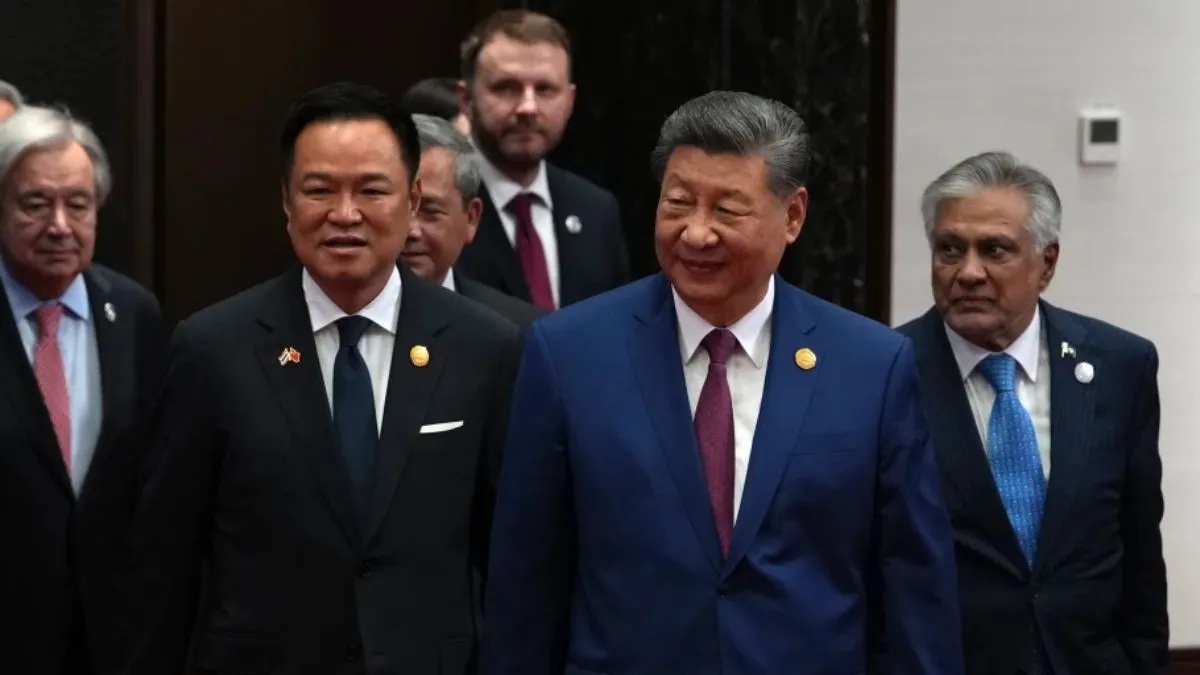
- China launched the World Artificial Intelligence Cooperation Organization (WAICO) with 29 founding countries, headquartered in Shanghai, as the 2026 World AI Conference closed on July 20.
- Xi Jinping delivered his first keynote at the summit and pledged 5,000 AI training placements for developing nations plus free access to a Chinese meteorological warning model for 30 countries.
- The founding roster leans heavily on the Global South, with 12 Asian and 10 African states signing alongside Brazil, Russia, Pakistan, and Indonesia, and no major Western government among them.
China builds a governance body around the Global South, not the G7
China used the closing days of the 2026 World AI Conference in Shanghai to stand up a new intergovernmental body, the World Artificial Intelligence Cooperation Organization, with 29 countries signing the founding agreement. The organization will be headquartered in Shanghai, a deliberate choice that places the institutional center of a global AI governance effort inside China rather than in Geneva, Brussels, or New York.
The founding membership is the story. According to the keynote text published by Xinhua, the bloc is built to answer the call of the Global South, and its 29 signatories include 12 Asian and 10 African nations along with Brazil, Russia, Pakistan, and Indonesia. Absent are the United States, the United Kingdom, Japan, and the European Union member states that have anchored the rival Bletchley and Seoul safety summit process since 2023.
Xi Jinping attended the opening ceremony and delivered a keynote for the first time in the conference's history, a signal of how far AI has climbed on Beijing's priority list. In it, per China's Ministry of Foreign Affairs, he committed China to providing developing countries with 5,000 AI training and seminar placements over five years, to building joint application centers with ASEAN, the Arab League, the African Union, and BRICS, and to giving 30 countries free use of MAZU, an AI-powered meteorological warning system.
| Item | Detail |
|---|---|
| Founding members | 29 countries, including 12 Asian and 10 African states |
| Headquarters | Shanghai |
| Named signatories | Brazil, Russia, Pakistan, Indonesia |
| Training pledge | 5,000 AI placements for developing nations over five years |
| Applied tool | MAZU meteorological warning model, free to 30 countries |
| Absent | United States, United Kingdom, Japan, EU member states |
Why a Shanghai-based bloc reshapes the governance map
For two years, AI governance has been organized around Western-led venues that pair safety commitments with access to frontier labs. WAICO reframes the question from safety to development, offering compute partnerships, training, and applied tools to countries that were spectators in that process. That is a lower bar to entry than a safety pledge, and it is aimed squarely at governments deciding whose standards, and whose chips, their national AI strategies will run on.
The World Artificial Intelligence Cooperation Organization has come into being to answer the call of the Global South and unite the international community to promote AI development and governance.Xi Jinping, keynote at the 2026 World AI Conference
The move also gives China an institutional answer to export controls. Rather than competing head to head for the most advanced Nvidia hardware, Beijing is assembling a coalition that can standardize around Chinese models, tooling, and domestic compute. Huawei used the same conference floor to demonstrate its Atlas 950 SuperPoD system, underlining that the offer to the Global South is a full stack, not just a treaty.
Whether WAICO becomes a functioning standards body or a diplomatic showpiece will depend on what its members actually adopt over the next year. But the framing is now set. The contest over AI governance is no longer only about how to make frontier models safe. It is about who writes the rules for everyone else, and China has just planted that institution on its own soil.
Santage is committed to independent, transparent journalism. This article is produced in accordance with Santage's Editorial Standards and aims to provide accurate and timely information. Readers are encouraged to verify information independently.