
- SpaceX's Super Intelligence segment, home to xAI, Grok and Cursor, grew revenue from $813 million to $7.56 billion year over year and posted $431 million of operating income after a $1.26 billion loss in Q2.
- AI capital spending was $16.44 billion in the quarter, 2.2 times AI revenue, down from 6.2 times in Q2 and 9.4 times in Q1.
- SpaceX guided to $35 billion to $40 billion of total capex in Q4 and $33 billion to $37 billion of revenue in Q1 2027, and its CFO said new compute pays back in under a year at current prices.
SpaceX's artificial intelligence business earned $7.56 billion in the third quarter of 2026, more than Starlink for the first time and nine times what it made a year earlier, and the segment turned an operating profit while still spending more than twice its revenue on new compute. The figures, in SpaceX's third-quarter results filed on October 20, put the rocket company's AI arm in the same revenue tier as the leading AI labs, eight months after it folded in xAI.
SpaceX's AI segment booked $7.56 billion and an operating profit
The Super Intelligence segment grew 195% from the second quarter and now supplies just over half of SpaceX's $14.58 billion in revenue. Connectivity, the Starlink business, grew 69% to $5.25 billion, while launch and spacecraft revenue was $1.77 billion. Group net income was $4.4 billion against a $1.1 billion loss a year earlier.
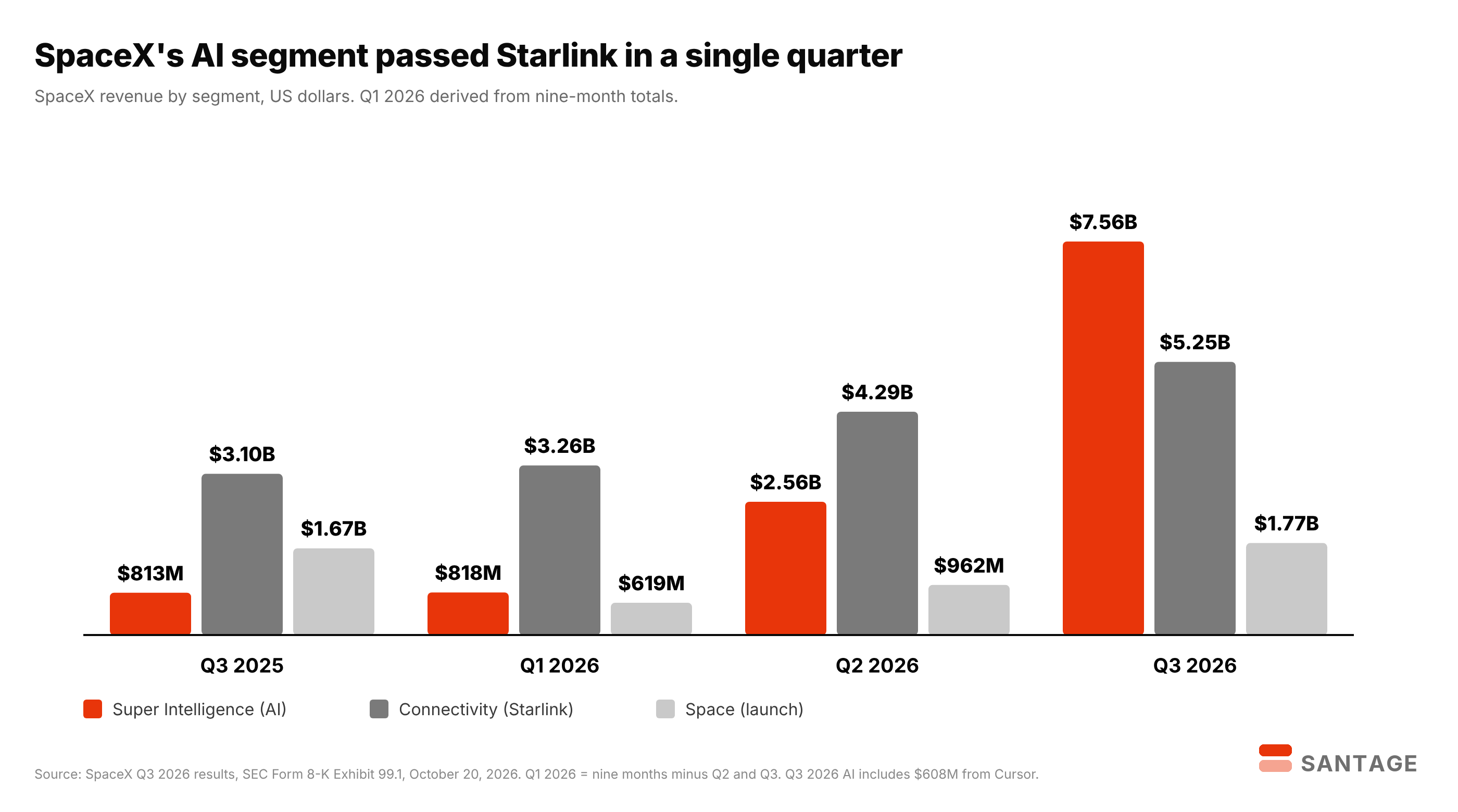
SpaceX attributes the jump to three things: new cloud services agreements that rent its compute to outside customers, the August acquisition of Cursor, and wider use of Grok by businesses and consumers. Cursor, bought at an implied $60 billion, added $608 million of revenue in its first seven weeks inside the company, which leaves roughly $6.95 billion from compute rental, Grok and X. The $431 million operating profit also absorbed $1.2 billion of share-based pay tied to the Cursor deal. Stripping out depreciation and stock pay, the segment's adjusted EBITDA of $4.95 billion works out to a 66% margin, level with Starlink's 67%, which suggests the AI unit's rental and subscription revenue now earns cash at roughly the same rate as SpaceX's most mature business.
| AI segment revenue | $7.56 billion |
| AI segment adjusted EBITDA | $4.95 billion |
| Nameplate compute | 1.7 GW, up from 0.6 GW a year ago |
| AI segment capex in the quarter | $16.44 billion |
“Revenue grew an impressive 161% year-over-year, fueled by continued momentum in Connectivity and a clear inflection in our Super Intelligence business.”
CFO commentary, SpaceX Q3 2026 results, October 20, 2026
Renting compute to rivals is now SpaceX's fastest-growing AI business
The cloud services line matters most for the rest of the industry, because it turns the Colossus build-out into supply that other labs can buy. On the earnings webcast, Elon Musk said SpaceX could “rent out our compute several times over if we said yes to everyone” and described a goal of splitting capacity roughly evenly between Grok and outside customers. CFO Bret Johnsen said new compute deployments are generating “a payback of less than a year” at current pricing, a claim that, if it holds, makes AI infrastructure one of the highest-return assets in the market.
That scale puts SpaceX in the top tier of AI revenue. Anthropic told prospective IPO investors its third-quarter revenue reached $16.8 billion, and OpenAI told investors its run rate was nearly $50 billion, or about $12.5 billion a quarter. SpaceX's segment is the only one of the three disclosed in public securities filings, and it includes a social network and a coding tool that the two labs do not have.
| Company | Latest disclosed AI revenue | Basis |
|---|---|---|
| Anthropic | $16.8 billion | Q3 2026, told IPO investors |
| OpenAI | About $12.5 billion a quarter | Nearly $50 billion annualized run rate, told investors in October |
| SpaceX (Super Intelligence) | $7.56 billion | Q3 2026, SEC filing, includes Cursor, Grok and X |
Source: SpaceX SEC filing, October 20, 2026; Santage reporting, October 9 and 15, 2026. Quarterly OpenAI figure derived by Santage from the run rate.
SpaceX now spends $2.20 on AI compute for every $1 of AI revenue
The capex ratio is the number to watch. In the first quarter SpaceX spent $9.40 on AI capital projects for every dollar of AI revenue, and by the third quarter that had fallen to $2.20, even as quarterly AI capex doubled to $16.44 billion. The gap is closing because revenue is finally scaling faster than the build-out, which eases the funding pressure behind SpaceX's plan to borrow $40 billion to buy Nvidia chips, announced earlier this month.
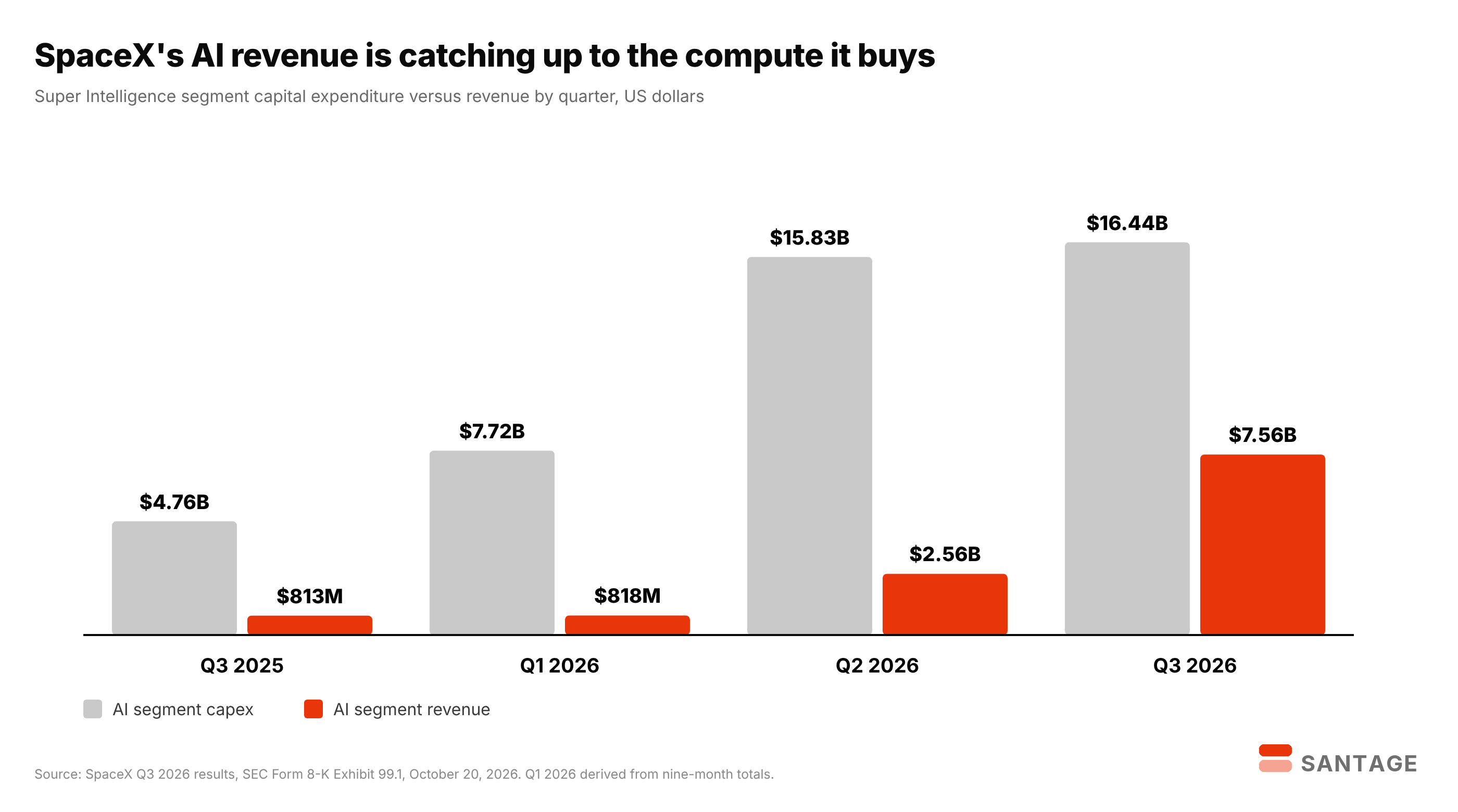
The fourth quarter will test it. Total capex is guided to $35 billion to $40 billion, about double the third quarter, and Musk said he “would be surprised if we brought on less than 13 gigawatts of compute by the end of next year,” against 1.7 GW today. Revenue guidance of $33 billion to $37 billion for the first quarter of 2027 implies the company expects the new capacity to be rented out almost as fast as it comes online.
Eight months after the merger, SpaceX has answered the question public investors asked when the company listed with xAI inside it: the AI business is now the largest part of the company and covers its own operating costs. The open question has moved to the balance sheet, because a business that pays back compute in under a year only stays that way while every new gigawatt finds a tenant, and SpaceX plans to add roughly seven times its current capacity within 15 months.
Santage is committed to independent, transparent journalism. This article is produced in accordance with Santage's Editorial Standards and aims to provide accurate and timely information. Readers are encouraged to verify information independently.