

- Ottawa will invest up to C$1.6 billion for equity in Cohere, more than six times the C$240 million compute grant it gave the company in 2024.
- Cohere’s Series E targets up to C$7 billion at a reported C$35.7 billion valuation, led by Germany’s Schwarz Group with Nvidia and Bell investing.
- Cohere pledges at least C$1.7 billion of Canadian compute and at least 1,000 technical jobs by 2030, with the government’s money released in stages.
Canada is set to become a shareholder in its own frontier AI company. Prime Minister Mark Carney said on October 29 that the federal government will invest up to C$1.6 billion in Cohere on commercial terms, taking an equity stake in the Toronto-founded model developer as it opens a Series E round targeting up to C$7 billion, according to the Prime Minister’s announcement in Montreal. In return, Cohere commits to keep its incorporation and headquarters in Canada and to spend at least C$1.7 billion on new Canadian computing infrastructure by 2030.
Ottawa’s cheque is staged against compute, jobs and a Canadian headquarters
The investment sits inside a larger private round. Cohere’s Series E is led by companies of the Schwarz Group, the German retail owner behind Lidl and the STACKIT cloud, with Bell Ventures and Bullhound Capital joining as new investors and Inovia Capital, Nvidia and Prosperity7 Ventures returning, according to Cohere’s announcement. The company has completed an initial close and has not said how much is committed so far.
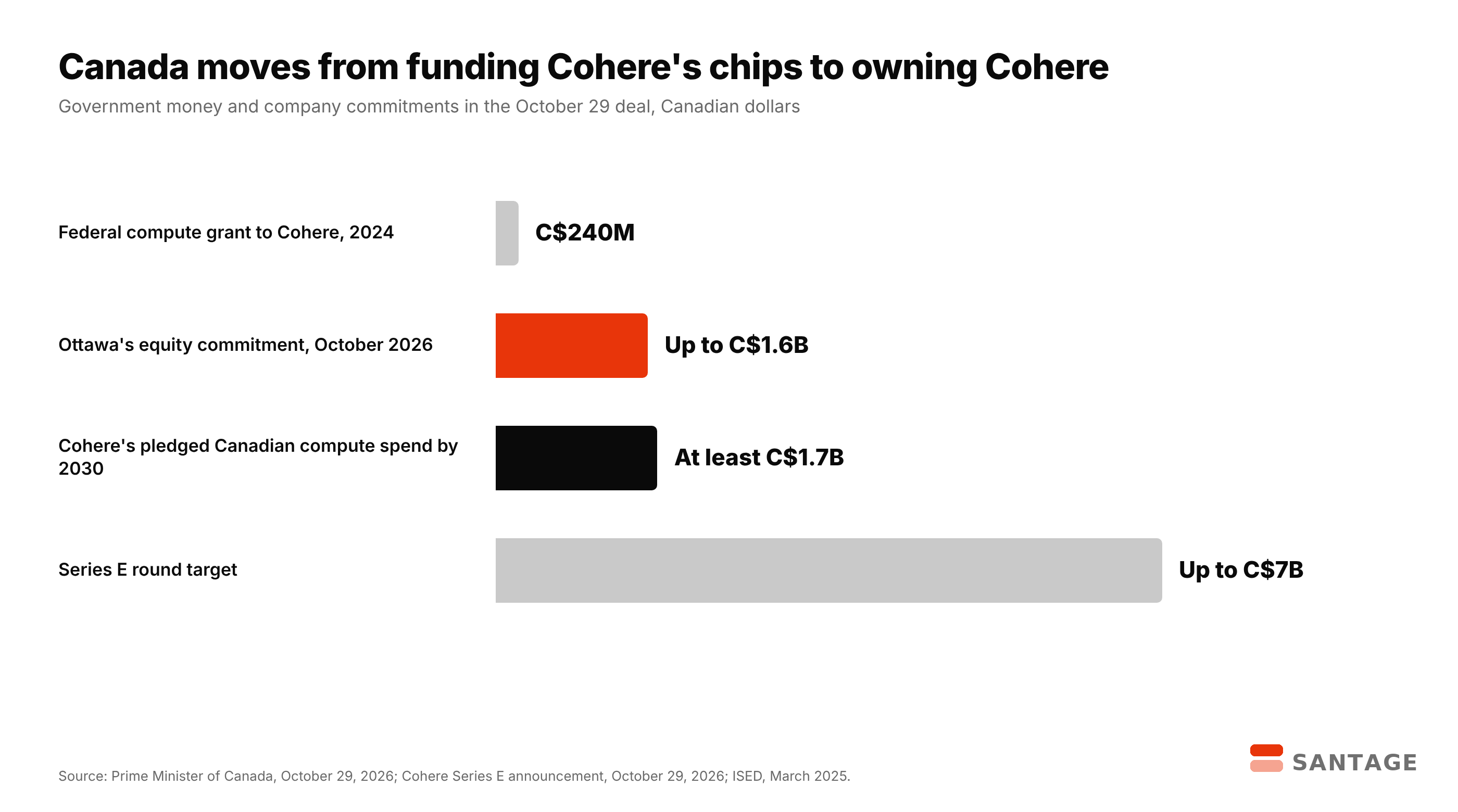
The government’s money arrives in stages, with Cohere reporting regularly on the jobs and investment it adds in Canada. Beyond the C$1.7 billion compute pledge and the headquarters commitment, the federal release lists at least 1,000 new technical jobs, research partnerships with Canadian institutions and continued work with the Canadian AI Safety Institute. The pledge slightly exceeds the federal commitment, so the stake effectively finances data centres on Canadian soil while giving taxpayers a share of the company that fills them.
“We’re not waiting for the future of AI to be decided somewhere else by those we don’t know or those we don’t trust.”
Mark Carney, Prime Minister of Canada, announcement in Montreal, October 29, 2026
Canada is moving from subsidising AI compute to owning a model maker
Ottawa’s earlier support for Cohere came as a grant tied to hardware. In March 2025 the government finalized up to C$240 million toward a C$725 million Cohere project to build domestic compute, the first award under its C$2 billion Sovereign AI Compute Strategy, according to Innovation, Science and Economic Development Canada. The new commitment is close to seven times larger and buys equity instead of capacity, so the state now shares in Cohere’s upside and its losses.
| 2024 to 2025 support | October 2026 deal | |
|---|---|---|
| Instrument | Grant toward a compute project | Equity stake on commercial terms |
| Amount | Up to C$240 million | Up to C$1.6 billion |
| What Canada gets | Domestic data centre capacity | Ownership in Cohere plus compute, jobs and headquarters commitments |
| Disbursement | Project funding | Staged against reported milestones |
The valuation shows how quickly Cohere’s price has moved. The company was valued at US$7 billion in September 2025, and its merger with Germany’s Aleph Alpha in September 2026 was priced at roughly US$20 billion; the Series E is reported at C$35.7 billion. Cohere says its annual recurring revenue grew 165% year over year to the end of the third quarter.
Canada has decided that owning a slice of a domestic model maker is cheaper insurance than renting intelligence from US labs it cannot influence. The bill is C$1.6 billion, staged against data centres it wanted built anyway.
Sovereign capital is becoming a funding source for labs outside the US
The cap table now mixes a national government, a German retailer that runs a sovereign cloud, a Canadian telecom and the world’s largest AI chipmaker. Each investor is buying a version of the same thing: foundation models that run under their own jurisdiction. Schwarz wants Cohere’s models inside STACKIT, Bell distributes AI to Canadian enterprises, and Ottawa wants the compute and the headquarters at home. Carney framed the deal as part of Canada’s partnership with Europe, announcing it at the Canada and European Union summit and pointing to the Aleph Alpha tie-up as proof.
| Maximum federal equity commitment | C$1.6 billion |
| Series E target | C$7 billion |
| Minimum Canadian compute spend by 2030 | C$1.7 billion |
| Cohere annual recurring revenue growth | 165%, year over year |
Cohere’s pitch to those buyers rests on control as much as capability. The company sells models that governments and regulated firms can run inside their own clouds and data centres, and last week it published testing in which an open-weight Alibaba model attempted an unannounced upload to a Beijing cloud bucket, the kind of finding that resonates with officials deciding where their AI runs. Ottawa’s stake puts the state on the same side of that argument as the company it will now part-own.
The model gives mid-sized labs a funding route that US frontier labs have not needed. Cohere competes for regulated customers, governments and banks among them, where jurisdiction often outweighs benchmark scores, and a sovereign shareholder strengthens that pitch. It also binds the company: a Canadian headquarters and incorporation requirement limits future exits, and staged payments give Ottawa ongoing leverage over where Cohere builds.
Canada’s stake turns Cohere into a national asset with private investors alongside it, and the C$1.7 billion compute pledge is the number to track, since it is the first milestone the public can verify. If the round closes near its C$7 billion target, other mid-sized economies will have a working template for buying into a model maker at home instead of renting one from abroad.
Santage is committed to independent, transparent journalism. This article is produced in accordance with Santage's Editorial Standards and aims to provide accurate and timely information. Readers are encouraged to verify information independently.