
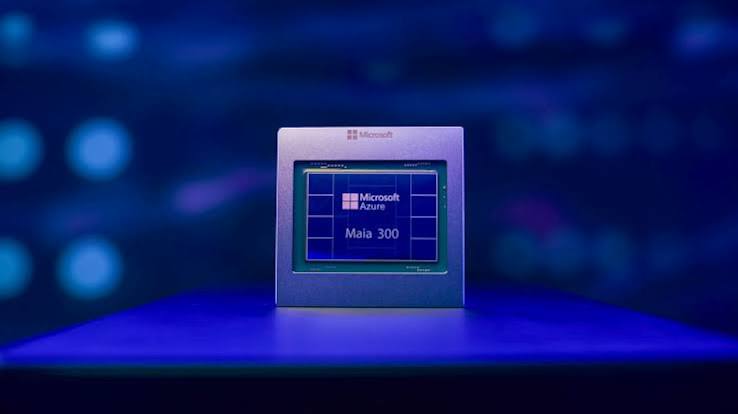
- Maia 300 pairs TSMC N2P compute chiplets with eight HBM4 stacks, giving each accelerator 288 GB of memory and 18 TB/s of bandwidth inside a 950-watt power budget.
- A full rack holds 96 accelerators in 167 kilowatts, and Microsoft says it delivers up to 7x the token throughput of a Maia 200 rack.
- Production deployments begin in 2027, when Microsoft says Maia becomes “the primary inference system for Microsoft products and services.”
Microsoft will make its own Maia chips the main engine for running AI across its products from 2027, after unveiling Maia 300 on October 12, a third-generation inference accelerator the company says delivers 40% more tokens per megawatt than leading GPU-based systems. The announcement turns Maia from a side project into the default home for Copilot, GitHub and Foundry traffic, with deployments planned at multi-gigawatt scale.
Maia 300 doubles rack density and lifts memory bandwidth 2.5 times
Microsoft designed the chip around the workloads that now dominate its bill: long-context reasoning, conversational products that must answer quickly, and agents that run multi-step tasks for minutes at a time. Those jobs spend more time moving data than computing it, so Microsoft spent its gains on memory. According to the Azure architecture post, Maia 300 has 2.5 times the memory bandwidth of Maia 200, 33% more memory capacity, about twice the HBM bandwidth per watt and a comparatively modest 36% increase in compute.
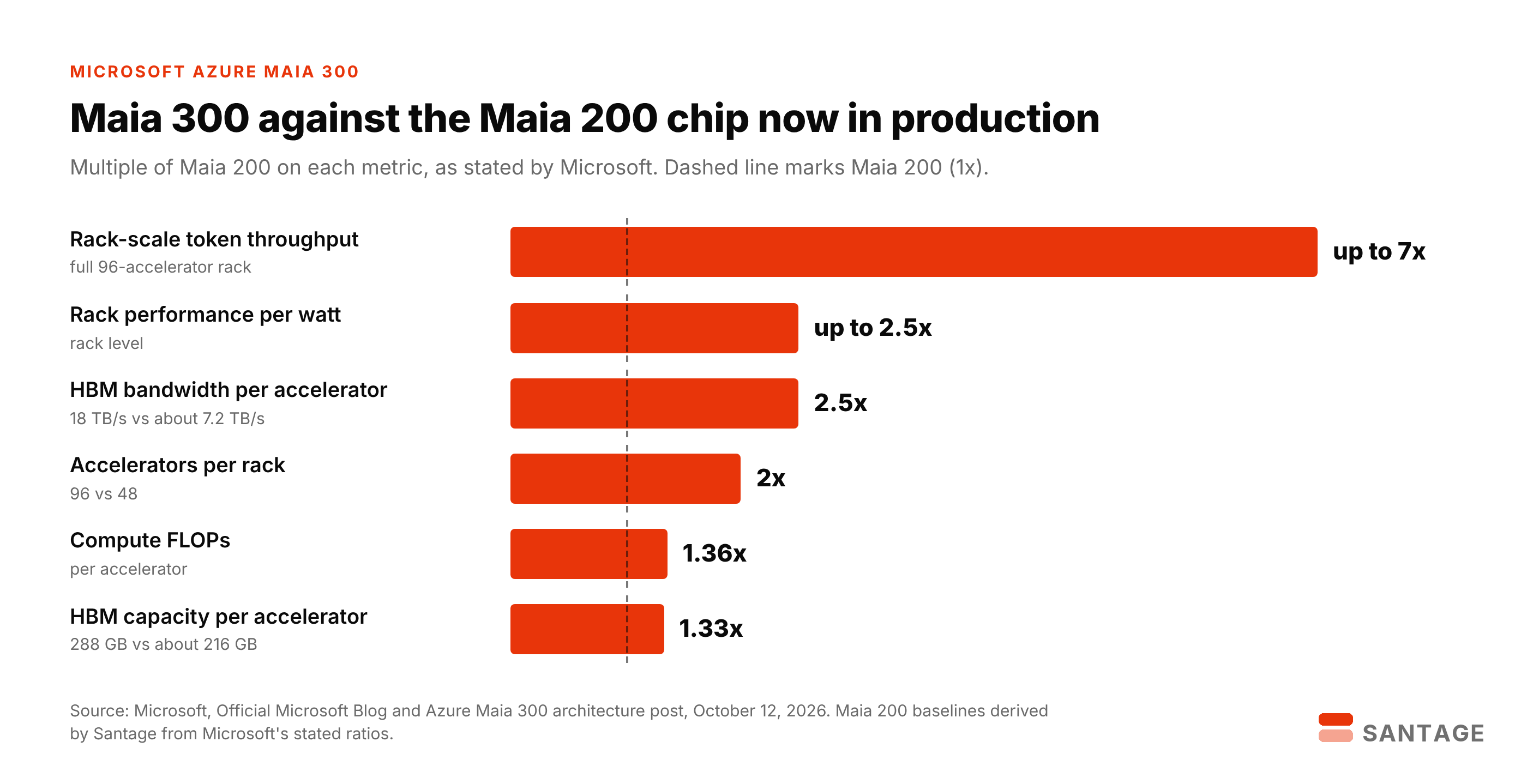
The rack design carries the rest. Twenty-four trays of four accelerators each fit into a single 167-kilowatt rack with 27.6 TB of HBM and 1.7 PB/s of aggregate bandwidth, double the accelerator count of a Maia 200 rack. Microsoft also uses low-precision formats, including an enhanced MXFP4, to shrink the memory footprint of the KV cache that long conversations build up, which is how it claims larger context windows within the same power envelope.
| More tokens per megawatt than leading GPU systems (Microsoft estimate) | 40% |
| Accelerators per rack | 96, within 167 kW |
| HBM4 bandwidth per accelerator | 18 TB/s |
| Start of multi-gigawatt production deployments | 2027 |
Microsoft is moving its own AI traffic off rented GPU economics
Maia 200 already serves production traffic. Microsoft says it runs Copilot, OpenAI models, its own MAI models and open-source model families, is deploying across the United States, Europe and Australia, and delivers up to 1.7 times more tokens per watt than leading GPU infrastructure on features inside Teams and Copilot. GitHub Copilot and Microsoft Foundry move onto it by the end of 2026.
“We will scale our Azure Maia family to multi-gigawatt deployments starting in 2027, making Maia the primary inference system for Microsoft products and services.”
Scott Guthrie, Executive Vice President, Cloud + AI, Microsoft, Official Microsoft Blog, October 12, 2026
The 40% figure is Microsoft's own projection, and the company did not name the GPU system it measured against, so independent benchmarks will matter once racks ship. Microsoft has promised more detail at Ignite in San Francisco next month. The direction is consistent with the model independence Santage tracked when Microsoft launched its MAI models at Build: owning both the models and the inference silicon lets Microsoft set its own cost per answer.
Inference is the part of AI that grows with every user and every agent, and it is where cloud margins will be won or lost. By committing gigawatts of capacity to a chip it designs itself, Microsoft is betting that tokens per megawatt, more than raw compute, will decide who can afford to run AI at the scale of hundreds of millions of daily users.
Santage is committed to independent, transparent journalism. This article is produced in accordance with Santage's Editorial Standards and aims to provide accurate and timely information. Readers are encouraged to verify information independently.