
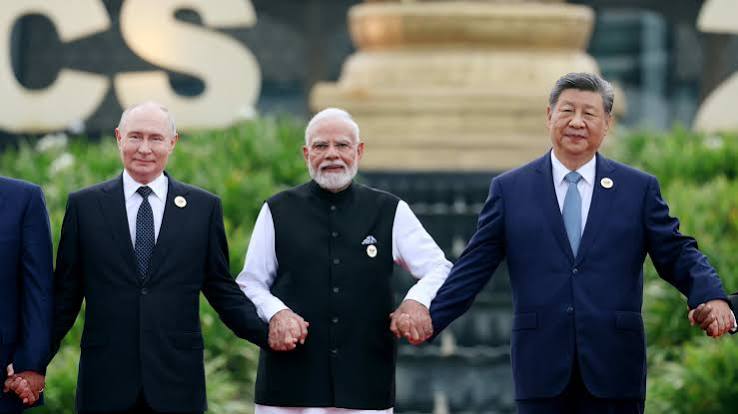
- Xi used the New Delhi BRICS summit to propose a bloc-wide open-source AI community, positioning China's free-weight models against the closed systems sold by OpenAI and Anthropic.
- The open-source plan leads a five-point package and would pool large language model development, training programs, and a shared AI ecosystem across 11 nations that hold 40 percent of global GDP.
- The pitch lands 11 days before Xi meets President Trump in Washington on September 24, framing open weights as China's opening bid in the next round of US-China AI competition.
Xi puts open-source AI at the top of a five-point BRICS plan
Speaking to leaders of the 11-nation BRICS bloc in New Delhi on September 13, Xi Jinping placed artificial intelligence at the center of China's pitch for the group's next decade. The first of five initiatives he announced was a BRICS open-source AI community, a coordinated effort to develop and deploy large language models across member states, run shared AI seminars and training courses, and build what he called an open ecosystem for the technology.
China will be a pioneer in establishing a BRICS AI open-source community, support cooperation in developing and applying large language models, hold specialised AI seminars and training courses, and build an open ecosystem for AI.Xi Jinping, 18th BRICS Summit, New Delhi, via CGTN, September 13, 2026
The remaining four points extended the same logic into trade, industry, and talent: BRICS special economic zones with intelligent portals, a shared digital cloud platform, assistance building smart factories with common manufacturing standards, and an engineer cultivation alliance for younger researchers. Taken together, the package reads less as a technical roadmap and more as an offer, with China supplying the models, the training, and the standards.
| 11 nations | Full BRICS membership after the bloc's expansion |
| 40% | Share of global GDP the members represent |
| ~49.5% | Share of the world's population inside the bloc |
| ~30 countries | Already aligned with China's World AI Cooperation Organisation |
Why open weights are China's wedge against American AI
The choice of open source is the entire strategy. The most capable American models ship as closed APIs that member states would rent rather than own, while China's leading labs have released their strongest systems as open weights that any government can download, inspect, and run on domestic hardware. For countries priced out of frontier compute or wary of depending on US vendors, that difference decides the question of control. Xi is offering sovereignty over the large language model itself, which is the one thing OpenAI and Anthropic structurally cannot sell.
The proposal also formalizes a bloc China has spent a year assembling, giving its roughly 30-nation World AI Cooperation Organisation a summit-level mandate and a recurring home inside BRICS.
The BRICS AI stance heading into the Trump summit
The timing is deliberate. Xi travels to Washington for a state visit and meeting with President Trump on September 24, arriving with a large business delegation and, now, a bloc-wide AI platform already announced. The two governments are pursuing opposite theories of how AI should spread. Washington treats open Chinese models mainly as a security problem, focusing on distillation and export control, an approach detailed in Santage's coverage of the NSA warning on Chinese distillation. Beijing is reframing those same open models as a development offer to the countries that will drive most of the world's adoption growth.
The trajectory points one direction. China has moved from participating in AI governance forums to building its own, first through the World AI Cooperation Organisation and now through BRICS, with open weights as the connective tissue. On that terrain, free and downloadable is a stronger opening bid than powerful and proprietary, and it is the position Xi will carry into the room with Trump.
Santage is committed to independent, transparent journalism. This article is produced in accordance with Santage's Editorial Standards and aims to provide accurate and timely information. Readers are encouraged to verify information independently.