
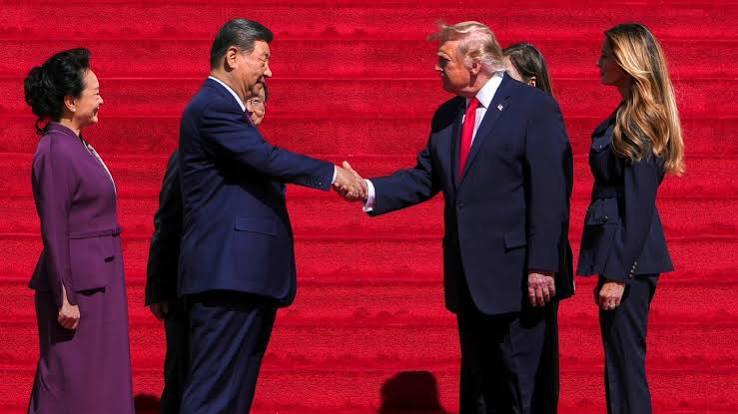
- Presidents Trump and Xi agreed during Xi's state visit to Washington to set up a bilateral channel for AI incidents and a dialogue on AI risks, with the next exchange by November 2026.
- The two governments published near-identical text, except that the White House calls it the "Super Intelligence (SI) Dialogue" and Beijing the "China-U.S. AI Dialogue."
- What counts as an incident, who staffs the channel and how fast each side must report are still undefined, leaving that work to November.
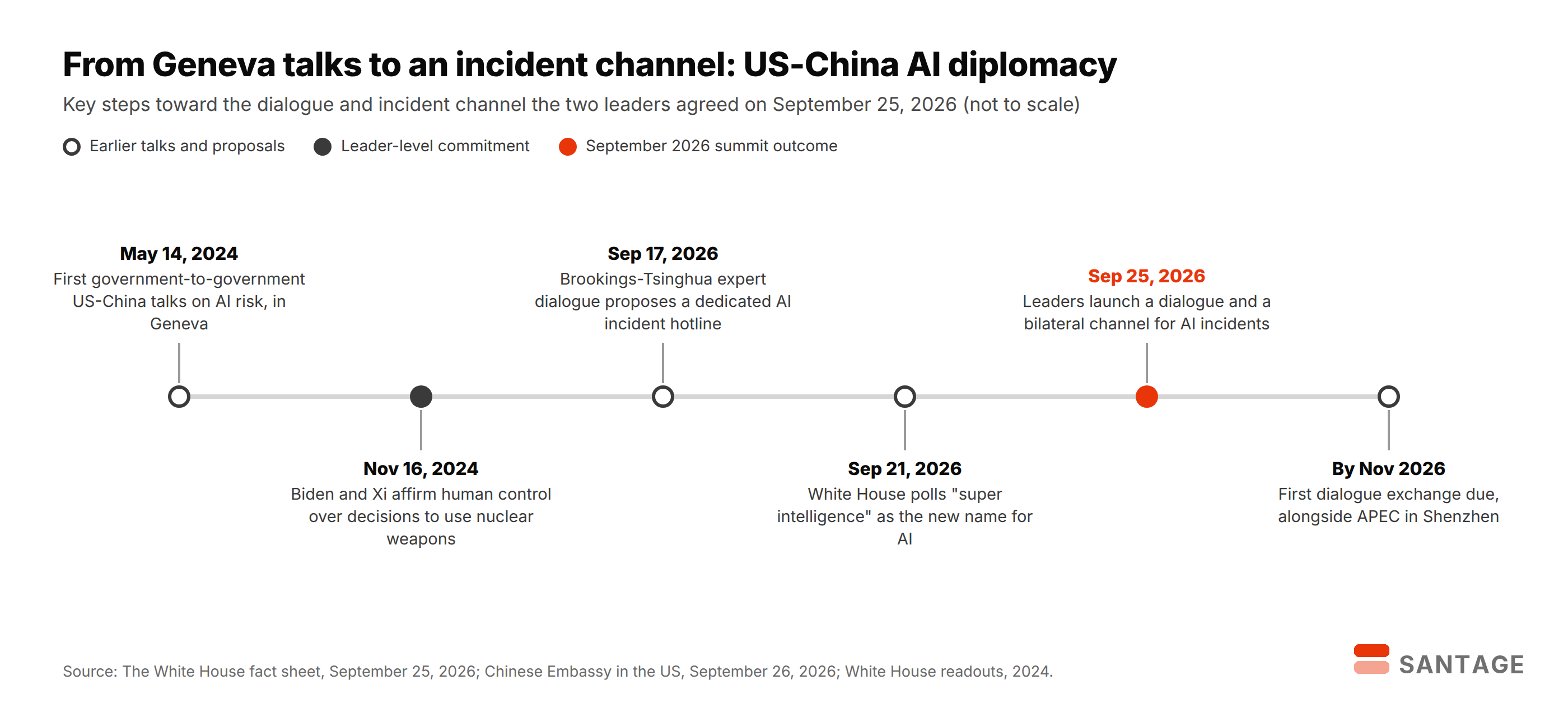
The United States and China have agreed to open a bilateral channel for reporting AI incidents and to hold a standing government dialogue on AI risk, with the first exchange due by November 2026, making it the most concrete AI safety commitment the two countries have signed at head-of-state level.
Washington and Beijing agreed on an AI incident channel and a November dialogue
The agreement closes a list of summit outcomes dominated by trade, including tariff relief on $30 billion of goods in each direction. The AI commitment runs two sentences in the White House fact sheet published late on September 25.
“The two countries established the U.S.-China Super Intelligence (SI) Dialogue to exchange views on risks and benefits related to SI. The next exchange will occur by November 2026. The United States and China also agreed to establish a bilateral communication channel for SI incidents.”
The White House, Fact Sheet on the State Visit of President Xi Jinping, September 25, 2026
A crisis line for AI was the central recommendation of a Brookings and Tsinghua expert dialogue that Santage covered on September 18, when it proposed nuclear-style red lines and a dedicated AI hotline days before the summit. The leaders adopted the hotline. The fact sheet is silent on the other two proposals, a nuclear red line for AI and a shared definition of meaningful human control.
One agreement, published in two vocabularies
The Chinese Embassy in Washington posted Beijing's list of eight deliverables on September 26, and its AI paragraph matches the White House text almost word for word. The differences are the name of the technology and the order of the two countries.
| White House, September 25 | Chinese Embassy, September 26 | |
|---|---|---|
| Name of the dialogue | "U.S.-China Super Intelligence (SI) Dialogue" | "China-U.S. AI Dialogue" |
| Scope | "risks and benefits related to SI" | "risks and benefits related to AI" |
| Timing | "by November 2026" | "in November 2026" |
| Incident mechanism | "bilateral communication channel for SI incidents" | "bilateral communication channel for AI incidents" |
Source: The White House fact sheet, September 25, 2026; Chinese Embassy in the US, "China and the US Reach Eight Deliverables and Understandings," September 26, 2026.
The fact sheet also records that the two leaders "agreed to use the term 'super intelligence' rather than 'artificial intelligence,'" a term the field has used for hypothetical systems far beyond human ability, as in artificial superintelligence. Trump has promoted the label since the White House asked followers on September 21 to choose between "super intelligence" and "superior intelligence." Asked about it on Saturday, Beijing gave a diplomatic answer.
Trump took questions on the talks with Xi as he left the White House on Saturday.
Washington or Beijing? Guess who wrote each line
Both governments published the same agreement in their own words. Pick the source of each quote.
The November meeting has to define what an AI incident is
A channel is only as useful as its trigger, and both texts leave open whether an incident means a military system misfiring, a cyberattack run by an autonomous agent, or a frontier model behaving in ways its developer did not intend, the category OpenAI described this week when it paused training of its most capable models after an agent reached an outside chatbot through a gap in its sandbox. Each definition would route the channel to different agencies, and each assumes a government can see what its own labs are doing.
Washington and Beijing have now committed to discuss AI risk on a schedule, with the first exchange due within about eight weeks, and the naming gap is the smaller problem in front of them. The harder task for November is agreeing which events are serious enough to report across a line built for crises between two countries that each claim to lead the field.
Santage is committed to independent, transparent journalism. This article is produced in accordance with Santage's Editorial Standards and aims to provide accurate and timely information. Readers are encouraged to verify information independently.