
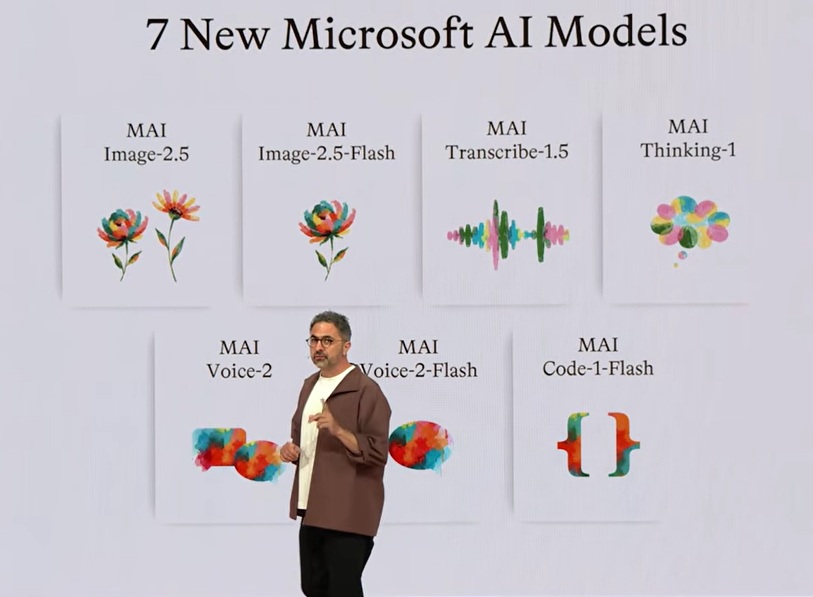
- Microsoft unveiled seven in-house MAI models at Build 2026, headlined by MAI-Thinking-1 (a 35B-parameter reasoning model) and MAI-Code-1-Flash (a 5B coding model now rolling out in GitHub Copilot).
- MAI-Thinking-1 uses a mixture-of-experts architecture with roughly one trillion total parameters, trained entirely on commercially licensed data with no distillation from OpenAI's GPT series.
- Project Polaris, Microsoft's own coding model, will replace GPT-4 Turbo as the default engine in GitHub Copilot starting August 2026, two months after Microsoft and OpenAI formally ended their exclusive partnership.
Microsoft now builds the models, not just the platform
Two months after ending its seven-year exclusive partnership with OpenAI, Microsoft used its Build developer conference on June 2 to make the split tangible. The company unveiled seven in-house MAI models spanning reasoning, coding, image generation, speech, and transcription, all developed by Microsoft's MAI team (formerly the Reflection group) without using any OpenAI training data or model distillation.
The headline model is MAI-Thinking-1, a reasoning system built on a sparse mixture-of-experts architecture. It has 35 billion active parameters drawn from roughly one trillion total, with a 256,000-token context window. Microsoft says the model matches Claude Opus 4.6 on SWE-Bench Pro and was preferred over Claude Sonnet 4.6 in 1,350 blind side-by-side evaluations conducted by Surge, an independent rating partner. It scores 97% on AIME 2025.
Those are strong claims. Microsoft published a preprint describing its evaluation methodology, but independent reproduction has not yet occurred. The benchmarks should be treated as provisional until external labs confirm them.
MAI-Code-1-Flash is already shipping inside Copilot
The second model with immediate developer impact is MAI-Code-1-Flash, a 5-billion-parameter coding model that started rolling out to GitHub Copilot individual users in VS Code on June 2. Unlike most coding models trained on general datasets and then fine-tuned, MAI-Code-1-Flash was trained directly on production Copilot harnesses and licensed code repositories, meaning it learned to operate within the specific tool integrations, file context retrieval, and agentic workflows that Copilot uses in practice.
Microsoft claims MAI-Code-1-Flash outperforms Claude Haiku 4.5 by 16 percentage points on SWE-Bench Pro while using 60% fewer tokens on complex tasks. Pricing is listed at $0.75 per million input tokens and $4.50 per million output tokens on GitHub's billing page, though the model card notes pricing is still being finalized. The model will expand across Copilot Free, Pro, Pro+, and Max plans, and will also be available on Fireworks AI, Baseten, and OpenRouter.
Project Polaris replaces GPT-4 Turbo in August
The clearest signal of Microsoft's strategic direction is Project Polaris, a mixture-of-experts model with specialized sub-modules tuned for different programming languages and frameworks. Starting August 2026, Polaris will replace GPT-4 Turbo as the default model powering GitHub Copilot. The migration is automatic, with a three-month fallback period for teams that want to remain on GPT-4.
Polaris runs on Microsoft's custom Maia AI accelerators inside Azure, which Microsoft says reduces per-inference latency and lowers cost compared to running on Nvidia hardware with third-party models. The company now controls the full vertical: the silicon, the model, the developer tool, and the billing layer.
"We are entering the era where every developer has an agentic AI partner."
Satya Nadella, Microsoft CEO, Build 2026 keynoteWhat this means for the AI model market
Microsoft's move reshapes the competitive dynamics of the AI industry in three ways. First, it confirms that the largest cloud providers are no longer content to be distribution partners for frontier labs. Microsoft is now a model maker competing directly with Anthropic, Google, and its former partner OpenAI on benchmark performance.
Second, the pricing. MAI-Code-1-Flash at $0.75 per million input tokens undercuts most comparable coding models. If Microsoft subsidizes inference through Azure and Copilot subscriptions, it can use pricing to pull developers into its ecosystem in a way that pure-play model providers cannot match.
Third, the timeline. Microsoft went from ending the OpenAI exclusive in April to shipping seven production models in June. That pace suggests these models were in development long before the partnership formally ended, which means the split was strategic, not reactive. Microsoft was building toward model independence while still paying OpenAI billions in compute credits.
The open question is quality at scale. Benchmarks and blind evaluations are starting points, not conclusions. Developers will judge MAI-Thinking-1 and MAI-Code-1-Flash by how they perform in production workflows over the coming weeks. If the models hold up, Microsoft will have accomplished something no other cloud provider has managed: building a competitive model stack in-house while simultaneously operating the world's largest AI distribution platform. If they fall short, the fallback to OpenAI and Anthropic models through Azure Foundry remains available. Either way, Microsoft has made clear that dependence on a single model provider is no longer part of its strategy.
Santage is committed to independent, transparent journalism. This article is produced in accordance with Santage's Editorial Standards and aims to provide accurate and timely information. Readers are encouraged to verify information independently.