

- Venture investors put about $48 billion into robotics and physical AI companies between January and early October 2026, PitchBook data shows, against $27.6 billion across 1,009 deals in all of 2025.
- The 2026 total is roughly 3.5 times the $13.7 billion the sector raised in 2024 and more than ten times its 2019 level of $4.2 billion.
- Labs including Physical Intelligence, Skild AI, NEURA Robotics and Generalist are spending on human demonstration data, and NEURA alone plans five training “Gyms” across Europe, the US and China by the end of 2026.
Robotics and physical AI startups have raised close to $48 billion so far in 2026, according to PitchBook data reported by the Financial Times on October 11, already 74% more than the $27.6 billion the sector raised in the whole of 2025. A growing share of that money is going into a resource that cannot be scraped from the internet: recordings of people doing physical work, which robot makers now pay to collect in purpose-built “robot gyms,” factories, offices and homes.
Robotics venture funding nearly doubled 2025's total in nine months
The 2026 figure caps a rise that began when general-purpose robot models started to work outside the lab. PitchBook's full-year 2025 report recorded $27.6 billion of deals last year, double 2024's $13.7 billion, with the largest early-stage round going to Physical Intelligence, which raised $600 million at a $5.4 billion valuation in November. Defense and drones took the biggest slice of 2025 money at about $8 billion, while industrial robotics grew fastest, up 70% to $5.9 billion.
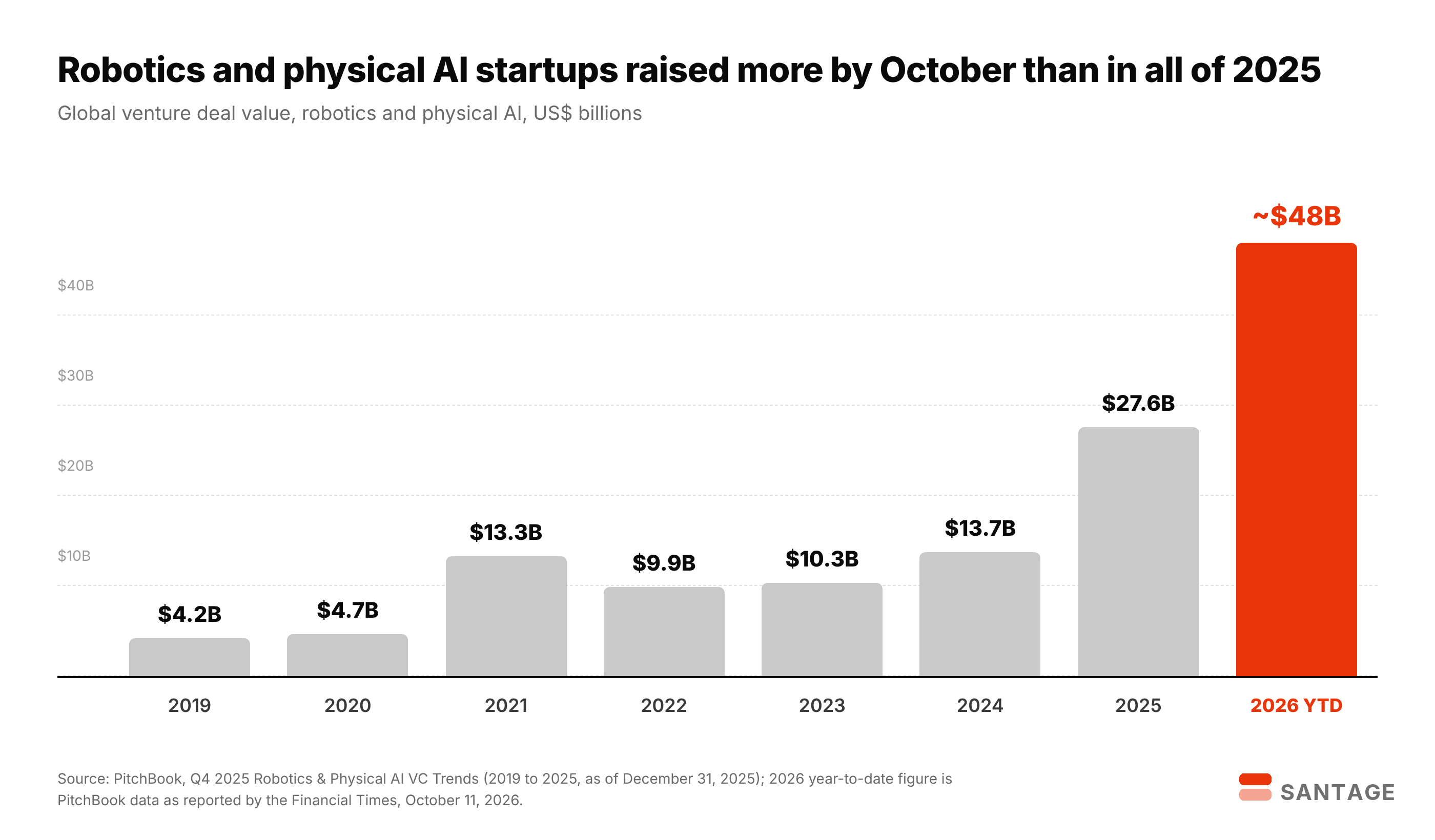
| Raised by robotics and physical AI startups, 2026 to early October | About $48 billion |
| Raised in all of 2025 | $27.6 billion across 1,009 deals |
| 2026 so far versus all of 2025 | +74% |
| NEURA robot Gyms due to open by end of 2026 | 5, across Europe, the US and China |
Robot makers are paying to record how people move, grip and push
Language models learned from text that already existed online, while a robot model needs examples of hands applying force to objects, and almost none of that exists in usable form. Companies are now commissioning it. Teams run gyms where workers guide robotic arms through tasks, and they place recording rigs in homes, offices and factories to capture motion, touch and pressure, footage that then has to be labeled frame by frame before it can train a foundation model for robots.
NEURA Robotics shows how much infrastructure this takes. The German company said in July that it has ten Gyms under development, including a 3,000-square-meter site at RWTH Aachen linked to about 20 university institutes and a 2,300-square-meter Munich facility with the Technical University of Munich backed by a €17 million commitment.
“The biggest bottleneck in Physical AI is no longer intelligence, it's experience.”
David Reger, founder and CEO, NEURA Robotics, July 21, 2026
Simulation is the other route to the same data, which is why world-model startups that generate training environments are drawing buyers as well as investors, including Decart, the real-time video company that Amazon is in talks to acquire for about $7 billion. Santage tracked the same pull toward simulated experience in its report on world-model startup General Intuition.
Venture money in physical AI is buying data before it buys revenue. At $48 billion in nine months, investors are funding the collection of human demonstrations at industrial scale, and the companies that own the largest libraries of recorded physical work are likely to set the pace for robot models in the same way web-scale text set the pace for chatbots.
Santage is committed to independent, transparent journalism. This article is produced in accordance with Santage's Editorial Standards and aims to provide accurate and timely information. Readers are encouraged to verify information independently.