
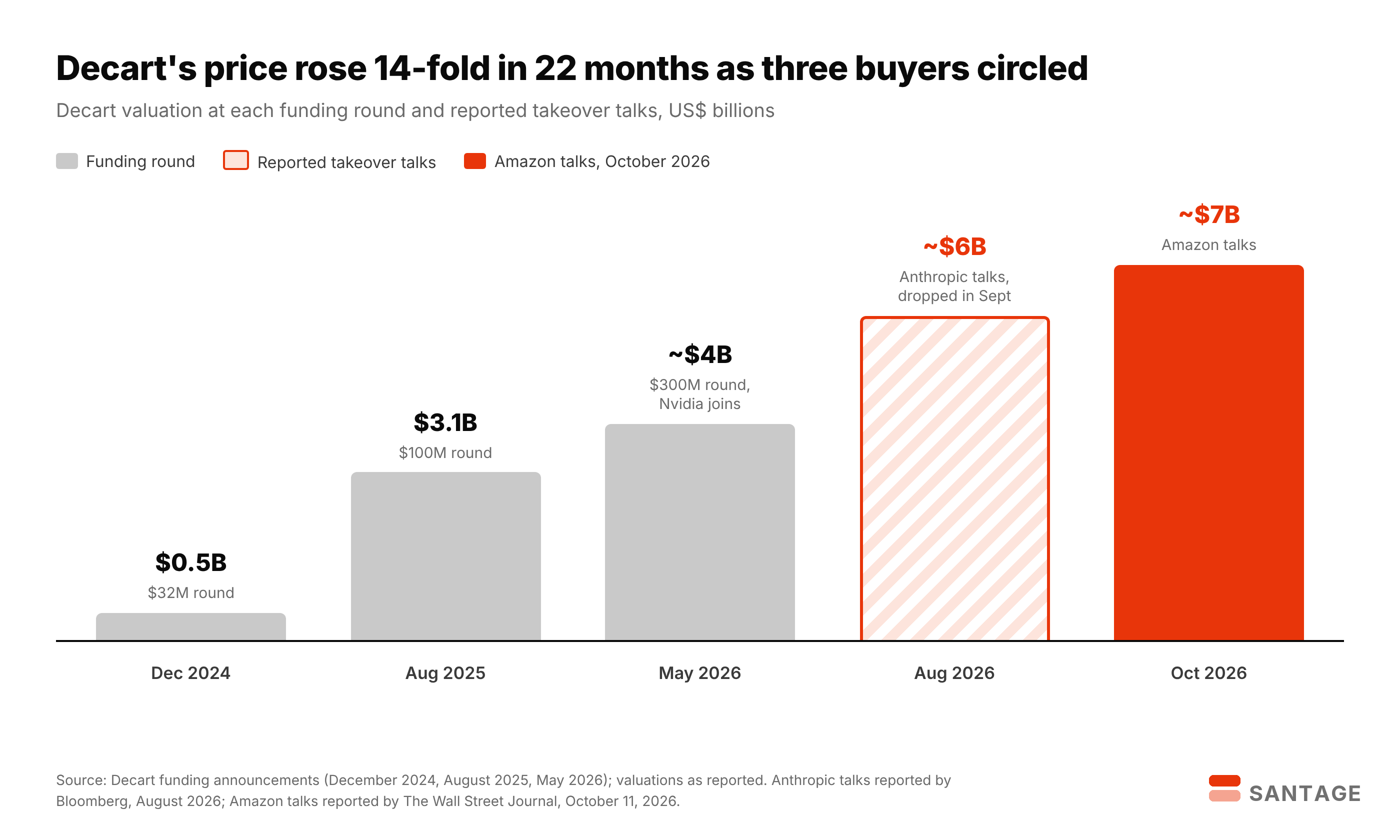
- Amazon's talks would value Decart at about $7 billion, roughly 14 times the $500 million valuation the startup carried in December 2024 and about 75% above the near $4 billion of its May 2026 round.
- Anthropic had been in talks to buy Decart for about $6 billion in August and dropped the deal after due diligence in September, while Nvidia, an investor since May, had pursued an acquisition before that.
- A deal at $7 billion would be the third multibillion-dollar bid by a chip owner for an AI model company in six weeks, after AMD's $8.2 billion World Labs purchase and Nvidia's talks with Reflection AI.
Amazon is in talks to acquire Decart, a three-year-old startup that builds real-time video and world models and software that moves AI workloads between chip makers, in a deal that could value it at about $7 billion, The Wall Street Journal reported on October 11. Amazon is the third suitor for Decart since the summer, after Nvidia and Anthropic, and the talks make it the latest chip owner to bid for an AI model company in six weeks.
Amazon is negotiating to buy Decart at about $7 billion
The talks could produce a signed deal soon, though they could still collapse or draw another bidder, according to the Journal, which cited people familiar with the matter. Amazon declined to comment and Decart did not respond. Founded in 2023 by Dean Leitersdorf, Orian Leitersdorf and Moshe Shalev, Decart has raised more than $450 million, including a $300 million round in May led by Radical Ventures, in which Nvidia joined as a new investor alongside Sequoia, Benchmark and Andrej Karpathy.
Amazon already knows the company from the inside. Decart counts Amazon as a strategic customer, has a commercial and joint go-to-market agreement with Amazon Web Services, and runs its Lucy 2 video model on Trainium3, Amazon's in-house AI chip. In its May announcement Decart cited an Amazon executive's assessment that Lucy 2 uses more than 80% of the chip's available compute.
Three bidders in three months priced Decart's chip-switching software
Decart's products face two markets. Lucy edits and generates live video with under 30 milliseconds of response time, aimed at gaming, streaming and advertising, and Oasis generates interactive simulated worlds for training robots, cars and drones. The third product explains the buyers. The Decart Optimization Stack, or DOS, speeds up model inference and training and runs the same workloads on Nvidia GPUs, Google TPUs and Amazon Trainium, and Decart says clouds, AI labs and hyperscalers license it to cut compute costs.
| Valuation in Amazon talks, October 2026 | About $7 billion |
| Total funding since 2023 | More than $450 million |
| Agentic inference speed Decart claims | 1,600 tokens per second, against an industry average of about 200 |
| Lucy's response time to user input | Under 30 milliseconds |
Each bidder valued that portability for a different reason. Nvidia, which pursued Decart first, would have absorbed a tool that eases customers' moves away from its GPUs. Anthropic, which emerged as the preferred bidder in August at about $6 billion and walked away after due diligence, runs Claude across all three chip families and stood to cut its own compute bill. For Amazon the attraction is Trainium: software that makes models run well on non-Nvidia silicon is worth most to the company trying to sell the alternative.
“World models are the key to moving AI from the virtual world into the physical world.”
Dean Leitersdorf, co-founder and CEO, Decart, May 18, 2026
Chip owners are buying the model companies that fill their silicon
Decart fits a pattern that has formed since the start of September, as companies that sell AI chips pay for the model makers whose workloads decide which chips get bought.
| Buyer | Target | What the target builds | Price | Status |
|---|---|---|---|---|
| Nvidia | Hugging Face | Open model hub and tools | $12.93 billion | Signed September 3 |
| AMD | World Labs | 3D world models | $8.2 billion, all stock | Signed September 28 |
| Nvidia | Reflection AI | Open-weight frontier models | Not disclosed | Talks reported October 10 |
| Amazon | Decart | Real-time video, world models, chip-portability software | About $7 billion | Talks reported October 11 |
Source: company announcements; Financial Times (Reflection AI, October 10, 2026); The Wall Street Journal (Decart, October 11, 2026). Table: Santage.
Santage covered the earlier moves as AMD bought Fei-Fei Li's World Labs and Nvidia weighed a takeover of Reflection AI. The logic is the same in each case: a chip designer that owns a leading model team sees the next workloads early and can tune both sides of the model and hardware stack. Amazon would add a twist, since its target's main selling point is helping models leave the dominant chip platform, and simulation-heavy world models are also central to the $48 billion robotics funding wave that Decart's Oasis serves.
Revenue is the number nobody has disclosed
Decart has never published revenue, and Israeli business daily Calcalist reported that its commercial business is far smaller than the valuation under discussion. At about $7 billion, Amazon would be paying roughly 15 times the capital Decart has raised, for a company whose price has been set twice in three months by acquirers rather than by customers. Anthropic's decision to walk away after examining the books is the one data point outsiders have on what diligence found, and neither company has explained it.
Amazon would be buying software that makes AI models cheaper to run on any chip, and its bet is that inside AWS that software will mostly make them cheaper to run on Trainium. If the deal closes near $7 billion, the price of a startup that can move workloads off Nvidia will have risen 75% since May, and the companies competing with Nvidia will have shown how much they are willing to pay for an exit route.
Santage is committed to independent, transparent journalism. This article is produced in accordance with Santage's Editorial Standards and aims to provide accurate and timely information. Readers are encouraged to verify information independently.