
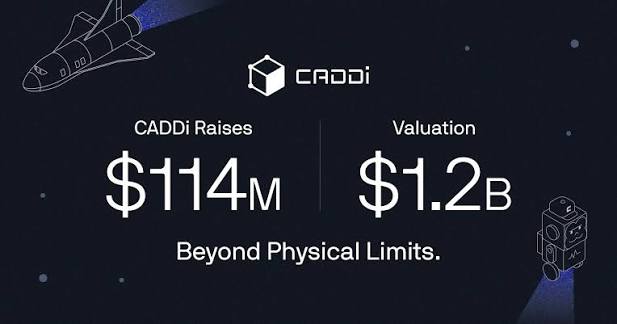
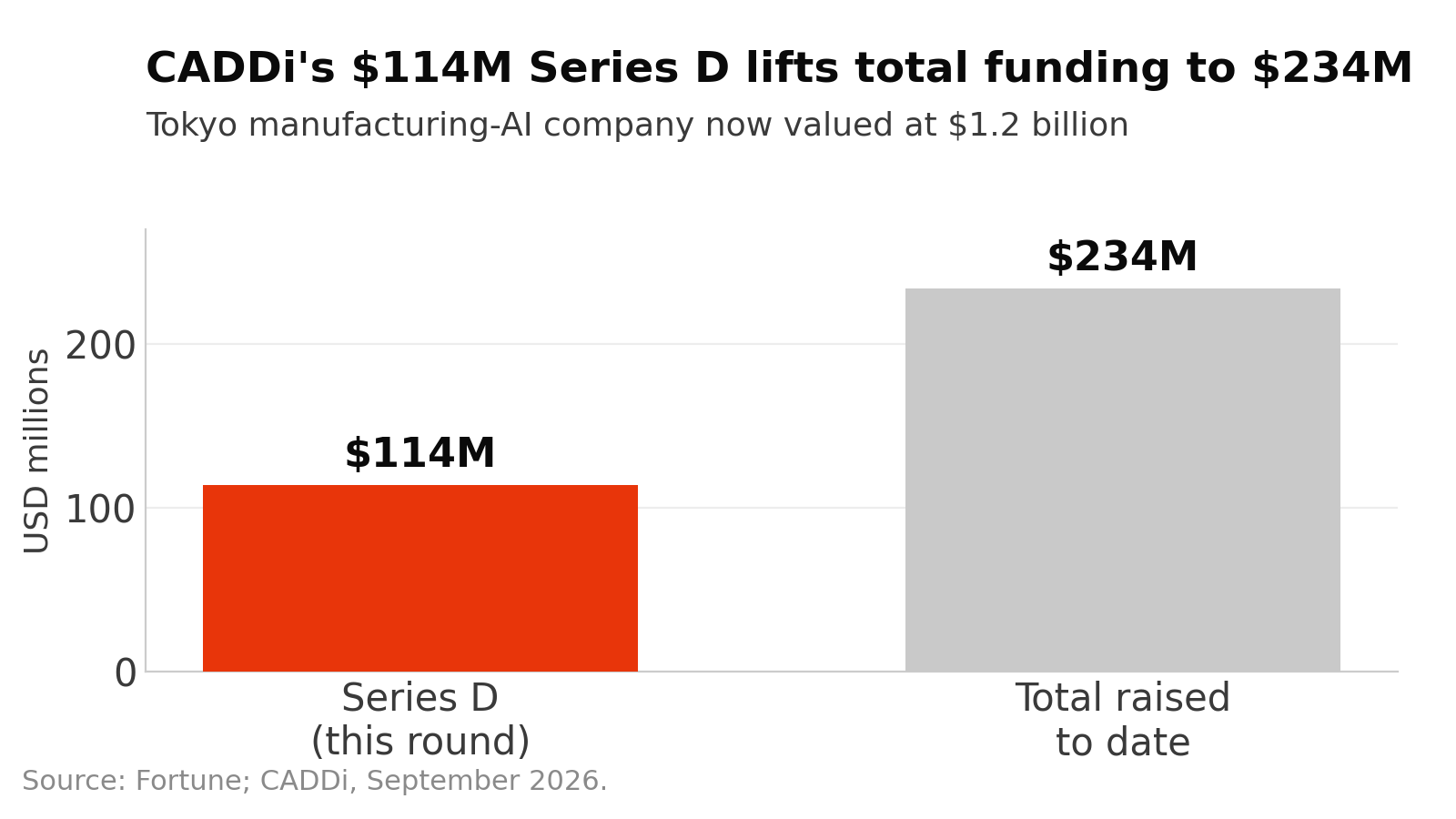
- CADDi raised $114 million in a Series D on September 15 at a $1.2 billion valuation, bringing total funding to $234 million.
- The company counts more than half of Japan's 100 largest manufacturers as customers, operates in 22 countries, and grew headcount from about 600 in early 2025 to roughly 900.
- Sales are more than doubling year over year as CADDi turns CAD files, drawings and ERP records into data both engineers and AI agents can act on.
The money is chasing manufacturing data, not another chatbot
CADDi closed a $114 million Series D on September 15 at a $1.2 billion valuation, its first billion dollar mark, according to Fortune, which reported the round. The raise takes the Tokyo founded company to $234 million in total funding. The investor list is the signal inside the signal: eight participants including Toyota's Woven Capital, Salesforce Ventures, the Recruit Holdings HR Tech Fund and Moore Strategic Ventures, alongside returning backers Atomico, Globis Capital Partners and JPS Growth.
That mix of a carmaker's venture arm and an enterprise software giant points at where industrial AI value is settling. CADDi is not selling a model. It sells the layer underneath one. Its platform ingests the messy, proprietary records that run a factory, from CAD drawings to enterprise resource planning systems, and organizes them so both people and AI agents can query and act on them. In a sector where the useful data is locked in decades of engineering files, the company that structures that data owns the on ramp for every AI feature built on top of it.
Why heavy industry is a harder, stickier AI market
Manufacturing has been slow to adopt generative AI for a concrete reason. The knowledge that matters is not on the open web. It sits in part drawings, tolerances, supplier histories and quality records that never leave a company's servers and are rarely machine readable. CADDi's products attack that directly. CADDi Explorer, formerly called Drawer, finds duplicate parts across supplier databases, and CADDi Agent handles parts standardization and quality assessment. The company now lists six workflow products, including a design review tool that flags errors in engineering drawings.
The traction numbers show the wedge working. More than 50 percent of Japan's 100 largest manufacturers are customers, the platform runs in 22 countries, and revenue is more than doubling year over year. Headcount climbed from roughly 600 in early 2025 to about 900, a build out that tracks a company scaling into demand rather than manufacturing it.
The investor composition sharpens the point. Toyota's Woven Capital does not write checks for novelty, and a carmaker backs a supplier data platform because duplicate parts, slow quality checks and untraceable drawings are line items on its own balance sheet. Salesforce Ventures brings the enterprise software distribution playbook. The presence of both signals that CADDi is being treated as infrastructure for industrial buyers, not a point tool. The 22 country footprint matters here too, since a company that began by digitizing Japanese manufacturing drawings is now exporting that system to factories where the same problem, unstructured engineering data, exists in a different language.
| $114M | Series D round |
| $1.2B | Valuation, first billion dollar mark |
| $234M | Total funding to date |
| 22 | Countries of operation |
| 50%+ | Of Japan's 100 largest manufacturers are customers |
| ~600 to ~900 | Headcount since early 2025 |
| More than 2x | Revenue growth year over year |
| Metric | Figure |
|---|---|
| Series D raised | $114 million |
| Valuation | $1.2 billion |
| Total funding to date | $234 million |
| Notable investors | Toyota Woven Capital, Salesforce Ventures, Recruit HR Tech Fund, Moore Strategic Ventures |
| Countries of operation | 22 |
| Japan top 100 manufacturers as customers | More than 50 percent |
| Headcount | About 600 to about 900 since early 2025 |
| Revenue growth | More than 2x year over year |
What shifts when AI reaches the physical bottleneck
CEO Yushiro Kato frames the target as the physical bottleneck, the slow path from a concept to a physically produced part, and says the aim is to cut that cycle tenfold by 2035. That is a different clock from software AI, where a product can ship in a sprint. In hardware, the constraint is the industrial data pipeline, and compressing it is where AI can produce measurable dollars rather than demos.
The strategic read for the wider market is that the durable industrial AI businesses may not be the model labs at all. They may be the companies that own a specific vertical's proprietary data and workflows, the way CADDi owns manufacturing drawings. A frontier model is a commodity input to that business, while the data structure and the customer relationships are the moat. This is the same lesson Santage traced when Thomson Reuters built a frontier model on its own proprietary data, and when drug discovery startup Chai raised $400 million to design molecules the frontier labs could not.
The number that should hold an investor's attention is not the $1.2 billion valuation. It is that half of Japan's largest manufacturers already run CADDi, in a sector famous for rejecting software it does not trust. Enterprise AI that sticks in heavy industry does not win on model benchmarks. It wins by becoming the system of record for data no general model will ever see.
Santage is committed to independent, transparent journalism. This article is produced in accordance with Santage's Editorial Standards and aims to provide accurate and timely information. Readers are encouraged to verify information independently.