
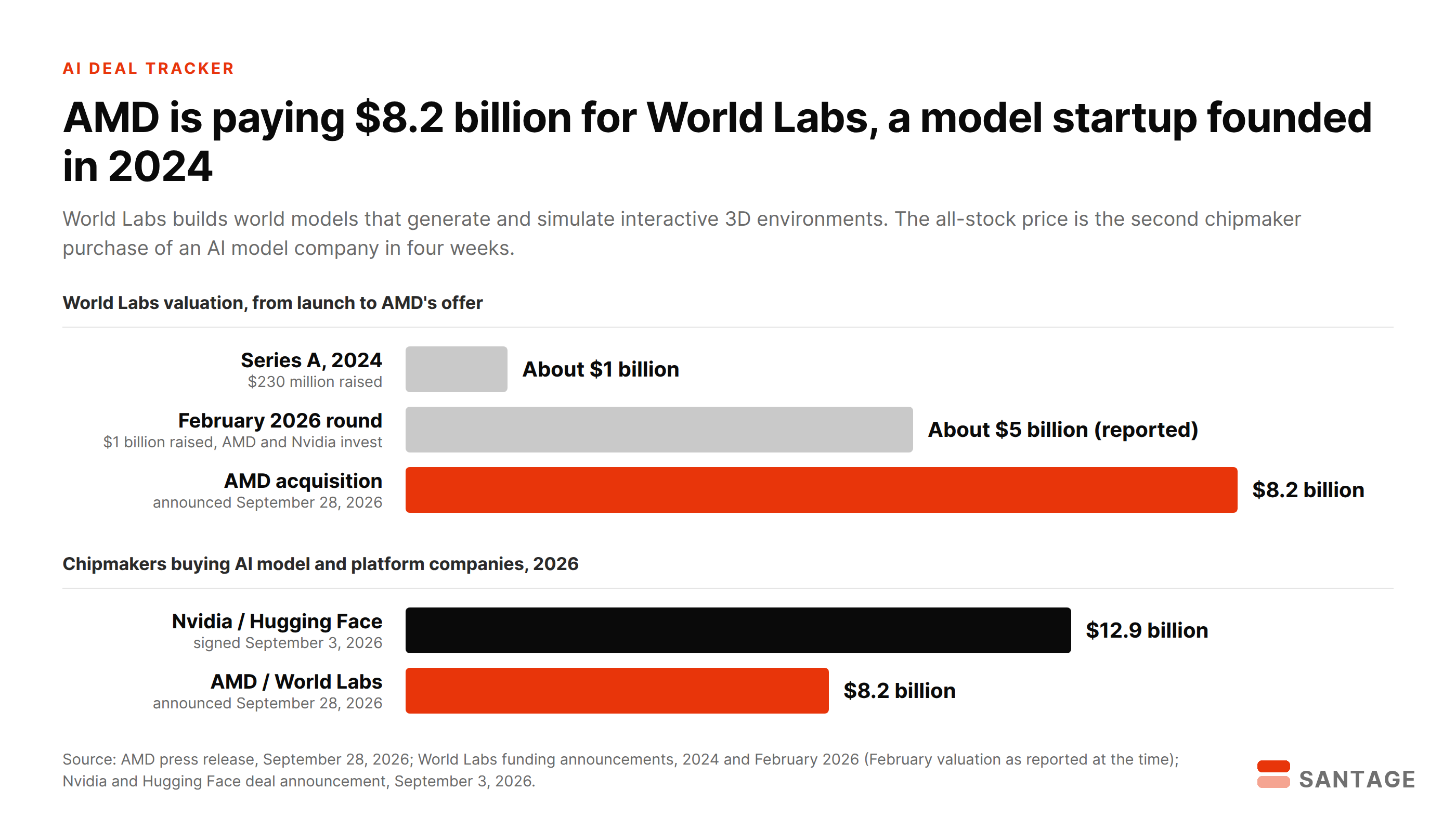
- AMD announced the $8.2 billion all-stock acquisition on September 28, with closing expected by the end of 2026 subject to regulatory approval.
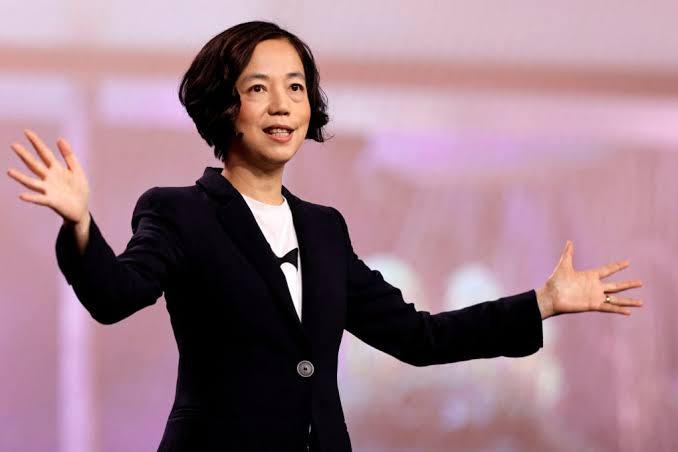
- Fei-Fei Li becomes AMD's executive vice president and chief scientist, reporting to CEO Lisa Su, while World Labs keeps building models inside AMD.
- The price is roughly 64% above the valuation of about $5 billion reported when World Labs raised $1 billion in February from investors including AMD and Nvidia.
AMD has agreed to buy World Labs, the two-year-old AI startup founded by Stanford computer scientist Fei-Fei Li, in an all-stock deal valued at about $8.2 billion, making it the second chipmaker in four weeks to pay billions for an AI model developer.
AMD is paying $8.2 billion in stock for a startup that makes 3D world models
World Labs builds what the industry calls world models: systems that generate, reconstruct and simulate interactive 3D environments from text, images and video, along with tools for training robots in simulation. Its commercial product, Marble, turns a prompt or a photo into an explorable 3D scene. According to AMD's announcement, Li will report directly to Su once the deal closes, and co-founders Justin Johnson and Ben Mildenhall will keep leading the research team, World Labs said.
“Building the compute platforms for the next generation of AI requires a deep understanding of how models are evolving.”
Lisa Su, Chair and CEO, AMD, AMD to Acquire World Labs to Advance the Future of AI Compute, September 28, 2026
| Deal value | About $8.2 billion, all stock |
| Announced | September 28, 2026 |
| Expected close | End of 2026, subject to regulatory approval |
| Fei-Fei Li's new role | AMD executive vice president and chief scientist |
| World Labs funding before the deal | About $1.23 billion ($230 million in 2024, $1 billion in February 2026) |
A chipmaker is buying early sight of the next AI workloads
AMD designs accelerators years before customers run them, and the risk in that cycle is building for the wrong kind of model. Text large language models set the design targets for the current generation of AI chips. World models that render video and 3D scenes, and the robotics simulations built on them, stress memory and bandwidth differently, and AMD now gets to watch those workloads take shape inside its own research group. World Labs already ran a technical partnership on AMD GPUs before the deal, which Li cited as a reason to join.
The purchase also mirrors Nvidia's. Nvidia signed its $12.93 billion deal for Hugging Face on September 3 to keep the largest open-model hub close to its hardware, and it has its own world-model family, Cosmos. With AMD now owning a world-model lab, both leading GPU makers hold a model research arm in the category investors expect to drive physical AI and robotics.
Because AMD is paying in shares, World Labs' backers, a group that includes Nvidia from the February round, stand to be paid in AMD stock. For Li, whose ImageNet dataset helped start the deep learning era, the move puts one of the field's best-known researchers in the chief scientist seat at the company trying hardest to break Nvidia's hold on AI compute.
Santage is committed to independent, transparent journalism. This article is produced in accordance with Santage's Editorial Standards and aims to provide accurate and timely information. Readers are encouraged to verify information independently.