
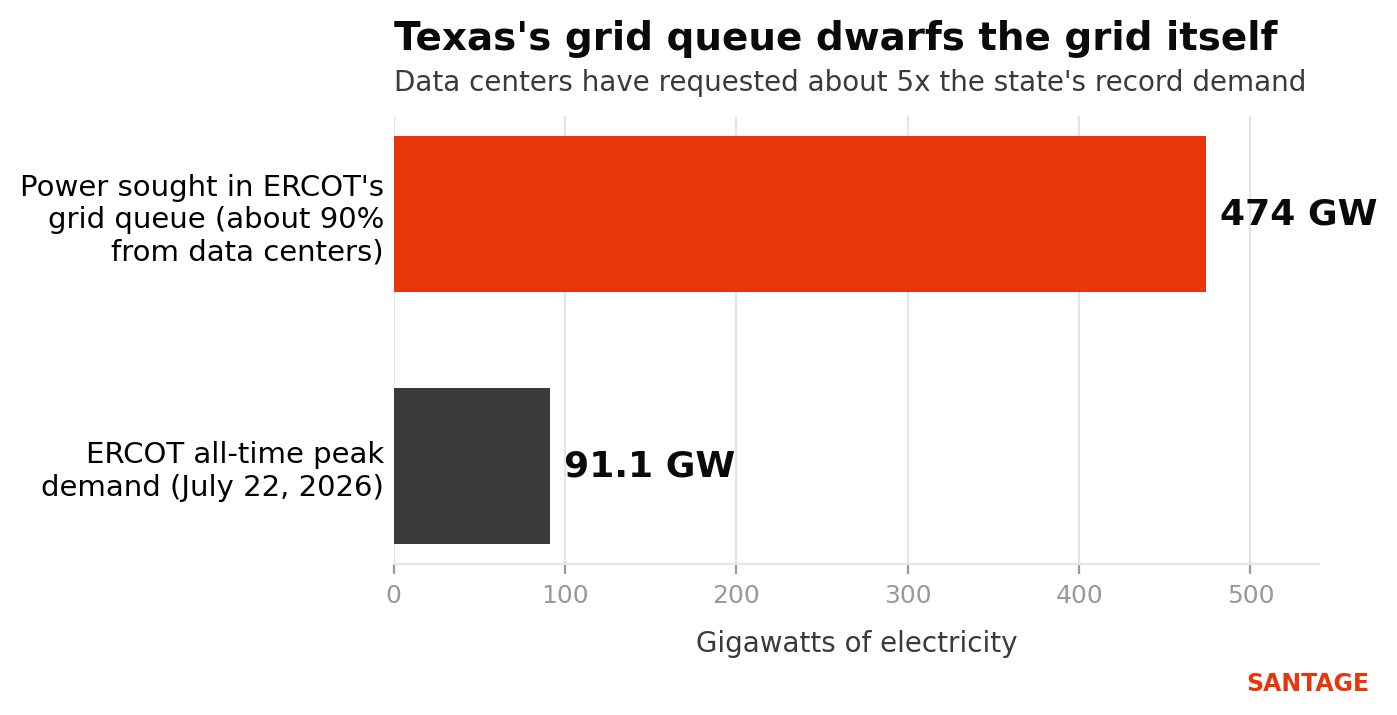
- Projects waiting to connect to Texas's grid have requested about 474 gigawatts of power, roughly five times the state's all-time demand record of 91,089 megawatts, and about 90 percent of that new demand comes from data centers.
- Governors who spent two years courting AI data centers are now restricting them: Pennsylvania's Josh Shapiro signed an order on August 18 forcing them to pay their own grid costs, and Texas's Greg Abbott ordered an audit of every project in the queue.
- In 2026 the buildout's binding constraint is shifting from chips and capital to electricity and public consent, and it has become a live issue in the governor's races in Pennsylvania, Texas, and Ohio.
Governors are fencing off the data centers they used to court
For two years, a data center was something a governor cut a ribbon for. This month the posture reversed. On August 18, Pennsylvania Governor Josh Shapiro signed an executive order, according to the Commonwealth of Pennsylvania, requiring new data centers to win local approval before permitting, to pay the full cost of the grid upgrades they trigger rather than spreading that cost to other customers, to prove advanced water conservation, and to accept curtailment when the grid is strained. Shapiro called them the strictest guardrails in the nation.
Texas moved first and harder. Governor Greg Abbott ordered the state's grid operator and utility regulator to audit every data center sitting in the interconnection queue, froze a planned transmission study, and said projects that fail the review should be denied a connection. He also signaled he would push next year to end the state tax break for these facilities, worth more than a billion dollars a year. Ohio's two nominees for governor, one Democrat and one Republican, have each released competing plans to tighten the rules. The same infrastructure that states raced to attract has become something their leaders now compete to control.
Why the grid, not the chip, is becoming AI's ceiling
The scarce input in artificial intelligence is quietly changing. For two years it was graphics chips, then it was the capital to buy them. The constraint now hardening is electricity, and the numbers in Texas show why. Projects in the state's connection queue have asked for roughly 474 gigawatts, more than five times the record 91,089 megawatts the grid actually delivered at its July peak, and about nine in ten of those new requests are data centers. Not all of that queue will get built, but even a fraction of it rewrites a state's entire generation plan.
The pressure is national. The United States Department of Energy's Lawrence Berkeley National Laboratory projects that data centers could consume up to 12 percent of American electricity by 2028, more than double their 2023 share, according to the Department of Energy. When load on that scale arrives, someone has to pay for new transmission lines and new power plants. Increasingly, that cost has landed on the monthly bills of households who never asked for the buildout, and a rising electricity bill is the most reliable way to turn an abstract technology story into a kitchen-table grievance.
These are the strictest guardrails in the nation.Governor Josh Shapiro, on signing Pennsylvania's data center executive order, August 18, 2026
The number that put data centers on the 2026 ballot
The detail that made this political is not the size of the buildout but the split of the bill. A data center consumes the power of a small city, yet the transmission and generation it forces onto the system are paid for across every ratepayer on the grid unless a regulator intervenes. That cost shift, private demand and socialized expense, is why the backlash does not sort neatly by party. A Democratic governor in Pennsylvania and a Republican governor in Texas are running the same play, and Ohio's candidates are competing over who guards the grid more tightly. The fault line is no longer left against right. It is ratepayers against hyperscalers.
| 474 GW | power sought in Texas's grid queue, about five times the state's record demand |
| ~90% | share of new Texas interconnection requests coming from data centers |
| $1B+ | annual Texas tax break for data centers that the governor now wants to end |
What a consent constraint does to AI capital plans
Every large capital plan in the industry, from hyperscaler build-outs to the multi-gigawatt financing deals now being structured for frontier labs, rests on a quiet assumption: that when the concrete is poured and the servers arrive, the grid will connect them. That assumption is what just became negotiable. Requirements to ring-fence grid costs, to accept curtailment first, and to bring your own generation all raise the real cost of a data center and stretch its timeline, and they do so at exactly the sites near cheap power and population that operators most want. The likely response is migration toward jurisdictions that can still promise firm power on demand, and a growing premium on self-supplied electricity, whether that means behind-the-meter gas, dedicated nuclear, or going off-grid entirely.
For two years the AI race was scored in chips, dollars, and benchmark points. The variable no one put on the leaderboard was the power bill of a voter in Pennsylvania or Texas, and that number is now setting the pace. The companies that win the next phase will not simply be the ones with the most compute on order. They will be the ones that can prove, to a skeptical governor and the people who elected her, that their data center pays its own way.
Santage is committed to independent, transparent journalism. This article is produced in accordance with Santage's Editorial Standards and aims to provide accurate and timely information. Readers are encouraged to verify information independently.