
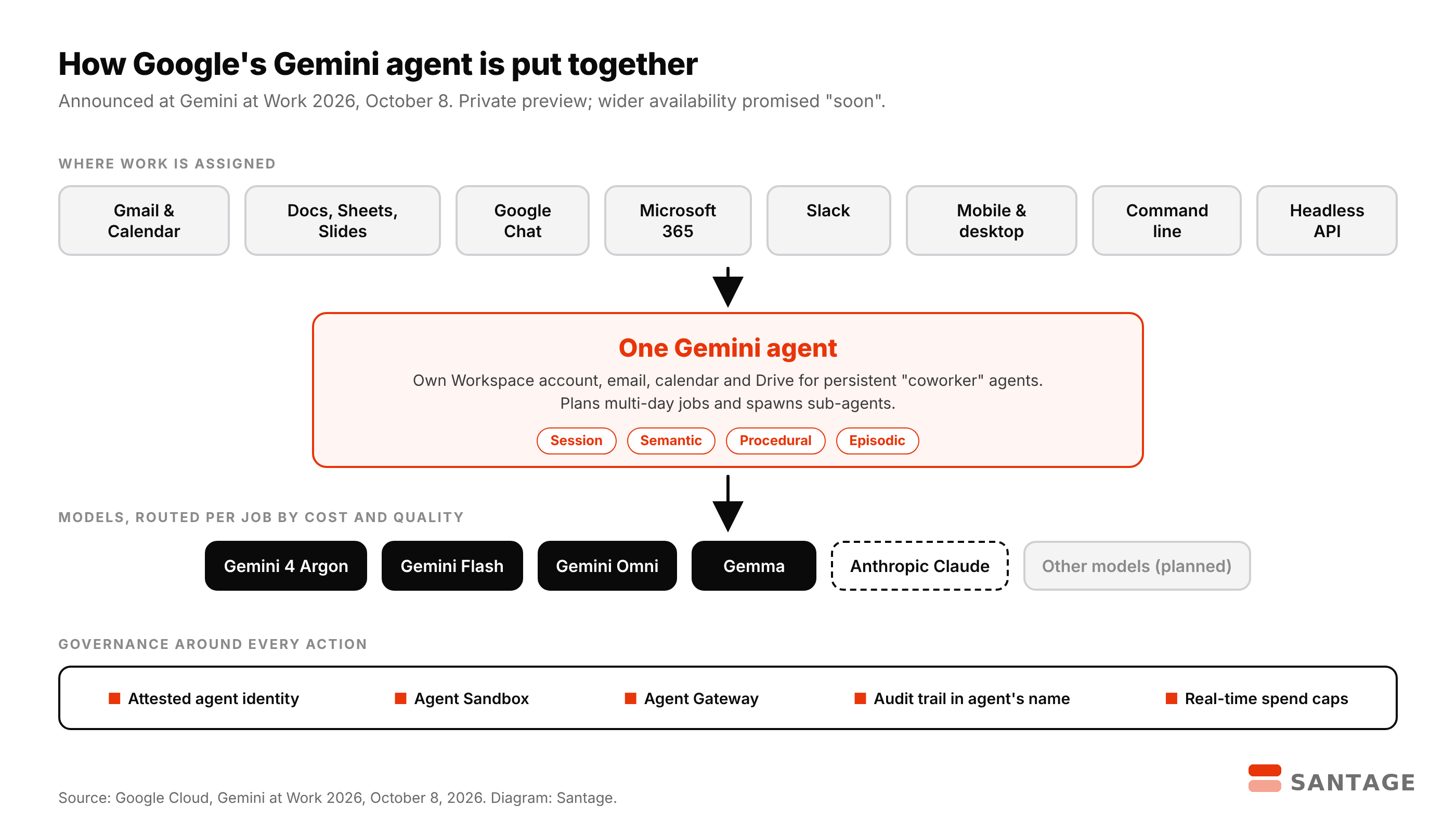
- Google's Gemini agent, in private preview since October 8, can run tasks for hours or days, spin up sub-agents, and act as a persistent coworker with its own Workspace account, email and calendar.
- The agent routes each job to the model it judges best, starting with Gemini and Anthropic's Claude, with spend caps and an audit trail attributed to the agent itself.
- Google says nearly 90% of the Fortune 100 already use Gemini Enterprise, which gives it a large installed base on which to make the agent, rather than the model, the product companies standardize on.
Google has started treating its AI agent as a member of staff. The Gemini agent that Google Cloud unveiled on October 8 can be given its own Workspace account, email address, calendar and Drive storage, its actions are logged under its own name, and the work it does can be routed to Anthropic's Claude as easily as to Gemini. Taken together, those choices move the enterprise AI contest away from which model is smartest and toward who controls the agent's identity inside a company.
Google's Gemini agent runs multi-day work under its own Workspace account
Google Cloud CEO Thomas Kurian presented the product at Gemini at Work 2026 as a single, universal agent for work. “You give it objectives, not instructions,” he wrote in Google's launch post. It answers questions, handles knowledge work, makes images and media, and writes and runs code, and it can be reached from the web, phone and desktop apps, a command line, inside Gmail, Docs, Sheets, Slides and Chat, and inside Microsoft 365 and Slack. For long jobs it plans the work, delegates pieces to temporary sub-agents running in parallel or in sequence, and keeps going after the user closes the laptop.
The detail that separates it from earlier assistants is the persistent coworker. A manager describes a role and Gemini creates an agent that holds its own Workspace account, with an @agents.company.com email address, calendar, Drive storage and a place in the company directory. Colleagues assign work by adding it to a chat space or mentioning it in a document comment, its edits appear under its own name in version history, and it sees only what has been shared with it.
| Fortune 100 using Gemini Enterprise | Nearly 90% |
| Google Cloud customers using its AI products | Nearly 80% |
| Customers that each processed over 1 trillion tokens | Nearly 500 in the last year |
| Custom agents built by insurer SOMPO | Over 10,000, across 34,000 employees |
Routing work to Claude turns the model into a component
Google lets the agent pick a model per job, or lets a user or administrator choose, and Claude is the first outside family on the list, ahead of other private and open models that Google says will follow. A cost-based router decides when a cheaper model is good enough, and real-time spend caps pause an agent once a project's budget runs out. Google's own framing of the design is unusually direct for a company that sells a frontier model of its own.
“Gemini is the agent, and the model underneath it is a separate choice.”
Thomas Kurian, CEO, Google Cloud, October 2026
A company selling Gemini 4 Argon has built its flagship work product so that a rival's model can sit inside it. That only makes sense if Google believes the durable advantage lies in the layer that holds the agent's memory, permissions and audit history. A customer can swap the model underneath in an afternoon. Replacing an agent that has its own mailbox, a directory entry, months of procedural memory about how a team works, and a security record attributed to its identity takes far longer.
Once an agent has its own email address and a work history logged under its name, the company that issues that identity matters more than the model doing the thinking.
Anthropic and Google now compete inside the same documents
Two days before Google's event, Anthropic put Claude directly into Google Docs, Sheets and Slides as a public beta on all paid Claude plans. Claude now reaches a Workspace document by two routes: as Anthropic's own assistant, billed by Anthropic, and as one of the engines the Gemini agent can call, billed through Google. Anthropic gains distribution through the second route and gives up the customer relationship, which stays with whoever owns the agent the employee talks to.
For Anthropic, whose revenue depends heavily on enterprise buyers, being a selectable engine inside one of the two dominant office suites is valuable volume. It also places Claude one layer below the interface, where the platform owner sets defaults and routing rules. Santage noted the same pressure from the buyer side when Microsoft and Meta cut their Claude coding spend: large customers are learning to treat models as interchangeable inputs priced against each other.
| Chat assistant (2024 to 2025) | Gemini coworker agent (October 2026) | |
|---|---|---|
| How work is assigned | User prompts in a chat window | Add to a chat space, mention in a comment, delegate an objective |
| Identity | Acts as the signed-in user | Own Workspace account, email, calendar, Drive |
| Task length | One exchange at a time | Hours to days, with sub-agents |
| Model | Fixed to the vendor's model | Routed per job across Gemini and Claude |
| Audit trail | Logged to the human user | Logged to the agent's attested identity |
| Cost control | Per-seat licence | Project spend caps and model routing |
Source: Google Cloud, Gemini at Work 2026, October 2026. Table: Santage.
Agent identity becomes the next enterprise lock-in point
Identity is where enterprise software has always been stickiest, which is why the directory and the email system are the hardest products to displace in any large company. Microsoft has been moving toward agent identities in its Entra directory, and Google's move answers it on Google's home ground. The practical questions for IT teams now resemble HR questions: how many agent accounts to create, who approves what each one can see, and which department pays when an autonomous agent runs for three days on a frontier model.
Pricing is the open variable. Google has not published a price for the agent or a date for general availability, and a company spokesperson described the launch as a private preview with wider release coming soon. How persistent coworker accounts are charged will determine whether companies deploy them by the dozen or by the thousand.
Google is betting that the most valuable seat in enterprise AI is the agent's own account, and by letting Claude run inside it, Google is telling customers it would rather own that seat than win every model comparison.
Santage is committed to independent, transparent journalism. This article is produced in accordance with Santage's Editorial Standards and aims to provide accurate and timely information. Readers are encouraged to verify information independently.