

- Microsoft is steering staff toward GitHub Copilot and trimming internal Claude spending by more than one-third from a projected $1 billion-plus, while Meta halved Claude Code seats to about 30,000 in favor of its MetaCode and Muse Code tools.
- Ramp's September AI Index shows the same squeeze across US businesses: frontier models fell from a 53% peak to 45% of token volume as companies set cheaper models as defaults.
- Anthropic's draft prospectus says two customers supplied nearly a quarter of 2025 revenue, which makes in-house substitution by the largest buyers the most direct risk to its growth story.
Two of Anthropic's largest enterprise customers are moving their own engineers off Claude and onto AI coding tools they control. Microsoft has cut its expected internal Claude bill, which was tracking toward at least $1 billion a year, by more than a third, and Meta has reduced the number of employees using Claude Code from about 60,000 to roughly 30,000, as first reported by The Information on October 5. The cutbacks are the clearest sign yet that the companies best placed to build their own models have decided frontier coding agents cost too much to run at full scale.
Microsoft and Meta are moving engineers onto AI coding tools they own
The two companies made the same decision from different starting points. Microsoft sells Claude to outside customers through its Foundry platform on Azure and expanded its Anthropic partnership last November, yet internally a spokesperson said it is steering employees to GitHub Copilot, which runs largely on OpenAI models that Microsoft has deep commercial rights to, while engineers keep the option to pick other models. Meta's drop from 60,000 to 30,000 Claude Code users partly reflects spring layoffs, and it coincides with the internal rollout of MetaCode, now used by more than 30,000 staff, and Muse Code, which runs on the same Muse models behind the Muse agent Meta launched in September.
| Microsoft's projected annual internal Claude bill before the cut | At least $1 billion |
| Share of that spending Microsoft has removed | More than one-third |
| Meta Claude Code users | About 30,000, down from about 60,000 |
| US businesses paying Anthropic in August | 43.8%, against 39.8% for OpenAI |
| Company | Claude change | In-house replacement | Models behind it |
|---|---|---|---|
| Microsoft | Internal spend cut by more than one-third | GitHub Copilot | Mostly OpenAI, with model choice retained |
| Meta | Claude Code users cut from about 60,000 to about 30,000 | MetaCode, Muse Code | Meta's own Muse models |
Source: company statements and reporting, October 5, 2026. Compiled by Santage.
Ramp's spending data shows the same squeeze across US business
What Microsoft and Meta did by decree, smaller companies are doing through defaults. Ramp, which tracks card and invoice spending across tens of thousands of US firms, found that frontier models such as Claude Opus, Claude Fable and GPT-6 Sol fell from a 53% share of business token volume in August to 45% in September. Monthly AI spending per employee at the heaviest-using 1% of firms dropped 9.7%, from $7,976 to $7,205, and the average price paid per million tokens has fallen 41% since March.
“We've heard from businesses who are imposing company-wide defaults that reduce usage of frontier models, saying standard models are still highly performant and also more cost effective.”
Ara Kharazian, Lead Economist, Ramp AI Index, September 9, 2026
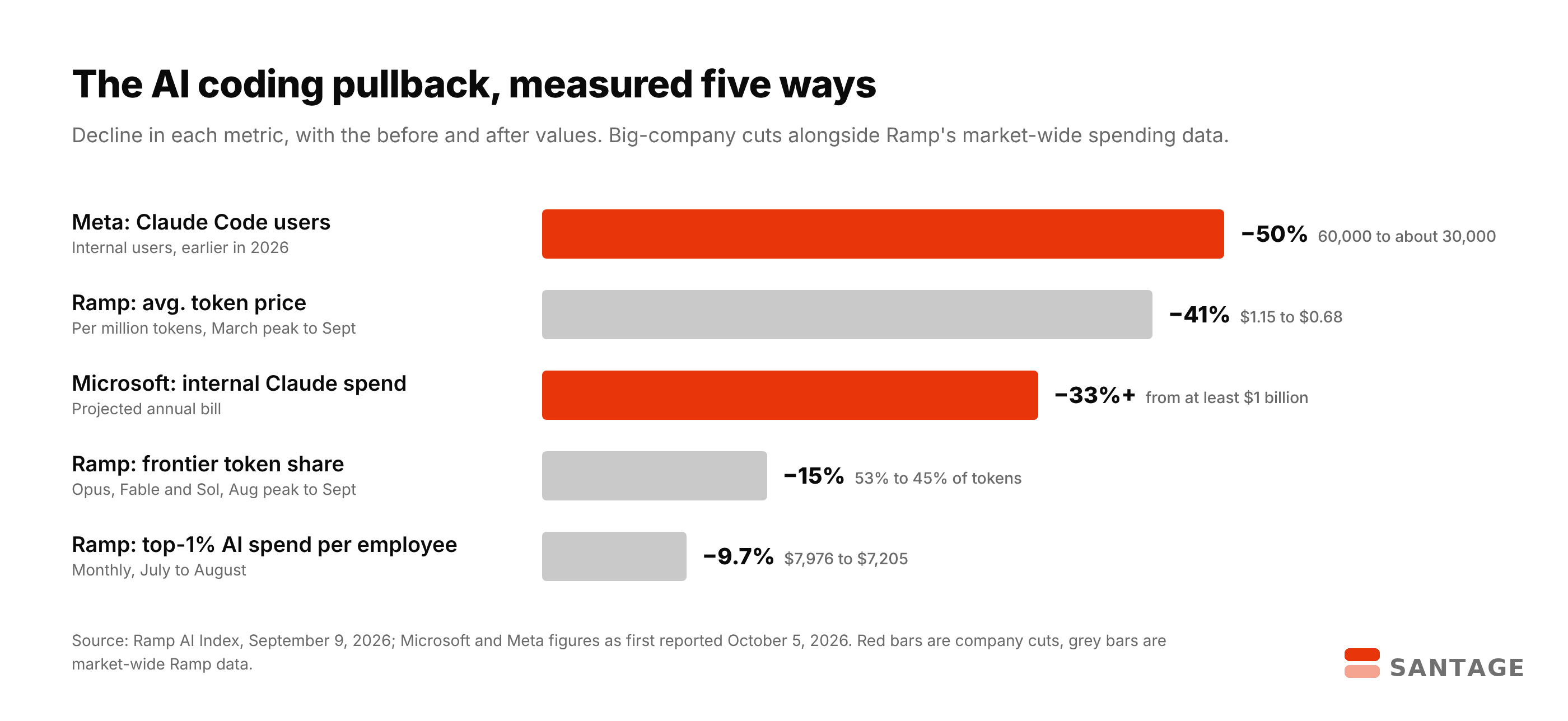
Agentic coding is where this pressure lands first because it consumes tokens at a rate chat never did. A coding agent that reads a repository, runs tests and retries failures can burn through millions of tokens on a single task, so a per-seat bill that looked trivial for 5,000 engineers becomes a line item the CFO reviews at 60,000. Anthropic and OpenAI cut model prices by up to 50% on the same day in September, and Meta's reduction began earlier in the year, which suggests the largest buyers were already building alternatives before list prices came down.
Buyers who own a model have leverage no other customer has
Microsoft and Meta can do something most Claude customers cannot: replace it with a model they already pay to train. For Meta, every engineer moved to Muse Code is internal usage that improves its own model and costs only compute it already owns. For Microsoft, routing Copilot traffic to OpenAI models feeds a partner in which it holds a large stake. The calculation for these two companies weighs Claude's quality edge against a supplier margin they would rather keep in-house, and a modest quality gap no longer justifies a billion-dollar invoice.
The customers most able to replace Claude are also among the largest paying for it, and that makes Anthropic's best accounts its most fragile ones.
That pattern sharpens a risk Anthropic disclosed itself. Its draft IPO prospectus states that two customers supplied nearly a quarter of 2025 revenue and that many large clients buy without long-term contracts. The filing does not name those customers, and nothing public ties them to Microsoft or Meta. Even so, the structure of the exposure is clear: Anthropic's revenue leans on a small number of very large technology buyers, and several of them now ship competing coding tools.
Anthropic's growth now depends on customers that cannot build their own
Anthropic still leads US business adoption, with 43.8% of companies on Ramp's index paying for its products in August against 39.8% for OpenAI, and losing half of Meta's seats does little to that breadth. The shift is in where growth has to come from. Banks, insurers, retailers and mid-sized software firms cannot train a Muse or lean on an OpenAI stake, so they will keep buying the best available coding agent, and they will keep pushing on price through the defaults Ramp is already recording.
Claude's grip on enterprise coding was built by the biggest engineering organizations in the world adopting it first. Those same organizations are now the first to leave, because they are the only ones with a model of their own to leave for, and Anthropic's path to its IPO now runs through the long tail of companies that have no such option.
Santage is committed to independent, transparent journalism. This article is produced in accordance with Santage's Editorial Standards and aims to provide accurate and timely information. Readers are encouraged to verify information independently.