
- The $22.6 billion price ($23.7 billion including debt) values PTC at 21 times its expected 2027 operating profit, or 13 times after Schneider's projected €250 million in annual cost savings.
- Combined with AVEVA and the pending $3.1 billion Cognite purchase, software and services will make up about 24% of Schneider's revenue, with 50,000 software customers.
- Schneider is funding the deal with €16 to 17 billion of new debt and €5 to 6 billion of new shares, backed by data centers that made up 30% of its 2025 end-market orders.
Schneider Electric agreed on October 5 to buy PTC, the US maker of Creo, Windchill and Onshape design software, for $205 a share in cash, an equity value of $22.6 billion and the largest acquisition in the French group's history. The company is paying a 42.3% premium to put the engineering records of 30,000 manufacturers under the same roof as the power and cooling equipment that has made it one of the biggest suppliers to AI data centers.
Schneider is paying 21 times profit for 40% margins and 10% growth
PTC brings €2.4 billion of 2025 revenue at an adjusted operating margin near 40%, more than 7,000 employees and guidance of about 10% annual growth in revenue and recurring revenue through 2029. Schneider expects around €800 million in revenue synergies on top of the cost savings, low single-digit earnings accretion in the first year and a return on capital above its cost of capital by year five, according to its deal announcement. Closing is targeted for the third quarter of 2027, subject to PTC shareholders and regulators.
| Cash price per PTC share | $205 |
| Premium to PTC's last close | 42.3% (46.1% to 30-day average) |
| Equity value | $22.6 billion |
| Enterprise value | $23.7 billion |
| Financing | €16 to 17 billion new debt, €5 to 6 billion new shares |
| Synergies | €250 million cost by year three, about €800 million revenue |
| Expected closing | Third quarter of 2027 |
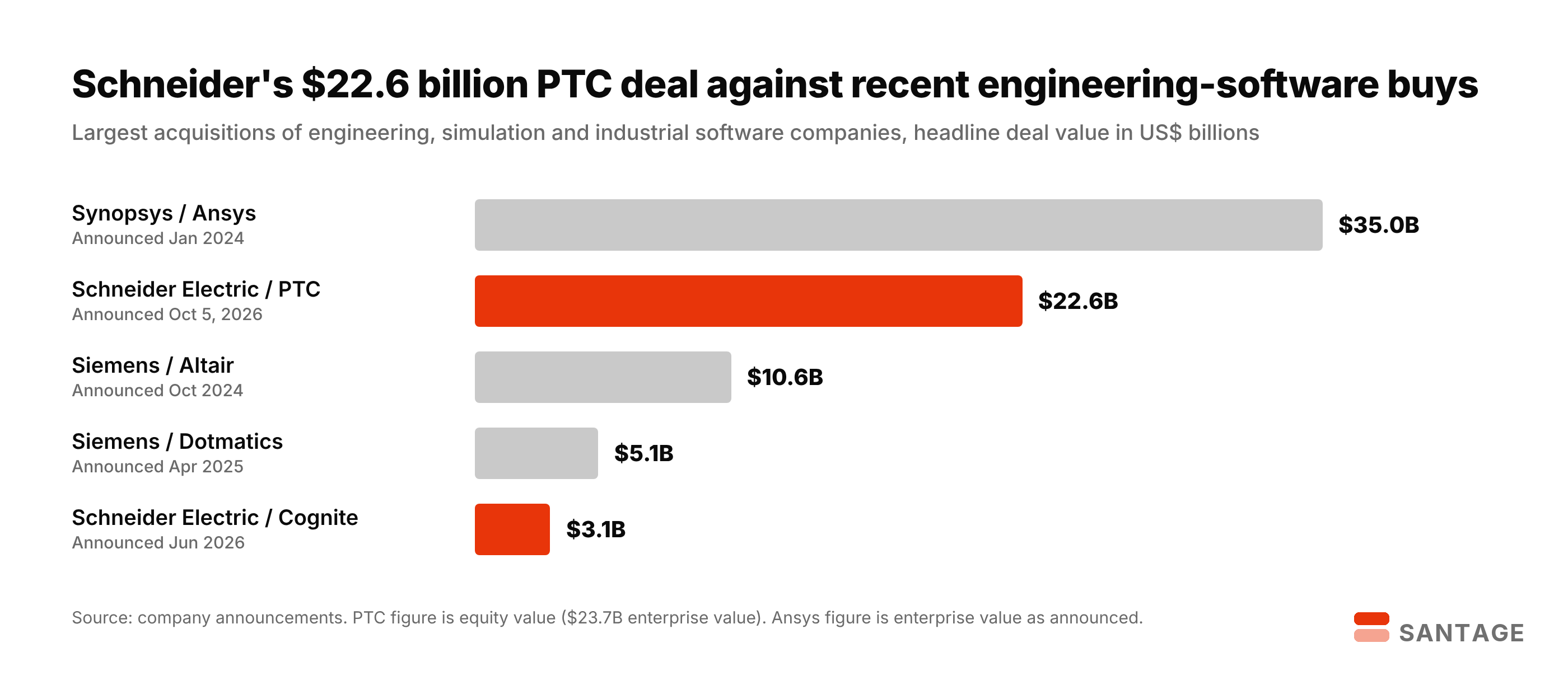
The deal sits among the largest ever struck for engineering software. It is more than double Siemens' $10.6 billion purchase of simulation firm Altair and trails only Synopsys' $35 billion takeover of Ansys.
Engineering data is the input industrial AI has been missing
Large language models learned from the open web, while industrial AI lacks any comparable public corpus to learn from. The specifications, part geometries, bills of materials and change histories that describe how a turbine or a car is built live inside product lifecycle management systems like Windchill, and PTC's customers have spent decades filling them. Schneider's own pitch centers on that data.
“Together, we are creating the industry's most complete Software & AI powerhouse and highest-quality portfolio bridging the physical and digital worlds.”
Olivier Blum, CEO, Schneider Electric, deal announcement, October 5, 2026
The release describes a “contextualized AI Data Foundation across products & machines and processes & energy systems.” Read plainly, that means Schneider wants one data model covering how a product is designed (PTC), how a plant runs (AVEVA) and how operational data is cleaned and connected for AI (Cognite, the Norwegian industrial data company it agreed to buy in June). An AI agent that schedules maintenance or redesigns a part is only as useful as the context it can retrieve, and Schneider is assembling the largest store of that context outside Siemens.
| Schneider software asset | What it holds | Status |
|---|---|---|
| AVEVA | Plant operations and process data | Fully owned since 2023 |
| Cognite | Industrial data platform and AI layer | $3.1 billion deal agreed June 2026, pending approval |
| PTC | Product design, lifecycle and engineering data | $22.6 billion deal agreed October 5, 2026 |
Source: Schneider Electric announcements. Compiled by Santage.
PTC's portfolio is narrower than it was a year ago, which sharpens the logic. The company sold its Kepware connectivity and ThingWorx IoT businesses to TPG earlier in 2026, leaving Schneider with the design and lifecycle core: Creo for 3D design, Windchill for product lifecycle management, Onshape for browser-based CAD and Codebeamer for managing the software that now runs inside most machines. Those are the systems where an engineer's intent is recorded, and Schneider already owns the systems that record how the finished equipment behaves in the field.
AI data center cash is now buying AI software
The financing tells the second half of the story. Schneider closed 2025 with record revenue of €40.2 billion, according to its full-year results, and data centers accounted for 30% of end-market orders as hyperscalers bought switchgear, power distribution and liquid cooling for AI clusters. That cash flow is what lets the company carry €16 to 17 billion in new debt, finish a €600 million buyback this year and then pause repurchases in 2027 and 2028. The data center business has also taught Schneider how AI customers buy. Hyperscalers increasingly design facilities in simulation before pouring concrete, using tools such as Nvidia Omniverse alongside Schneider's own electrical design software, and they reward suppliers that hand over a digital model with the hardware. Schneider is applying the same pattern to factories, where a design model, a live operations feed and an AI layer on top become one product.
Schneider is turning the hardware boom of AI's build-out into ownership of the data AI will need to run factories.
The move also changes PTC's position in the market. Manufacturers that run Siemens automation alongside PTC's Windchill chose PTC partly because it was neutral. Schneider promises an “open and interoperable” franchise, and customers now have about a year before closing to negotiate price caps, change-of-control terms and data-export rights while PTC still operates independently. Siemens, which pairs its Teamcenter software with its own automation hardware, has shown that integrated stacks win large accounts; Schneider is betting it can do the same with a heavier AI pitch.
The number to watch is €800 million in revenue synergies
Cost savings of €250 million are within Schneider's control. The €800 million revenue target depends on PTC's 30,000 customers buying AI-driven products across design and operations that are still being built. If industrial buyers treat AI as an add-on to existing CAD and PLM seats, that figure slips and the 21 times multiple looks expensive. If they pay for agents that act on the combined data, Schneider will have bought the plumbing for industrial AI at a fraction of what AI model companies command, a contrast worth holding against the capital circling AI model companies.
Schneider has spent the AI boom selling the physical infrastructure that frontier models run on. With PTC, it is spending that windfall on the data layer that decides whether AI can run the industrial economy, and the €800 million revenue line will show within three years whether customers agree.
Santage is committed to independent, transparent journalism. This article is produced in accordance with Santage's Editorial Standards and aims to provide accurate and timely information. Readers are encouraged to verify information independently.