
- From October 1, 2026, every arXiv submitter is limited to two submissions per calendar month and three active submissions at once, across all subject categories.
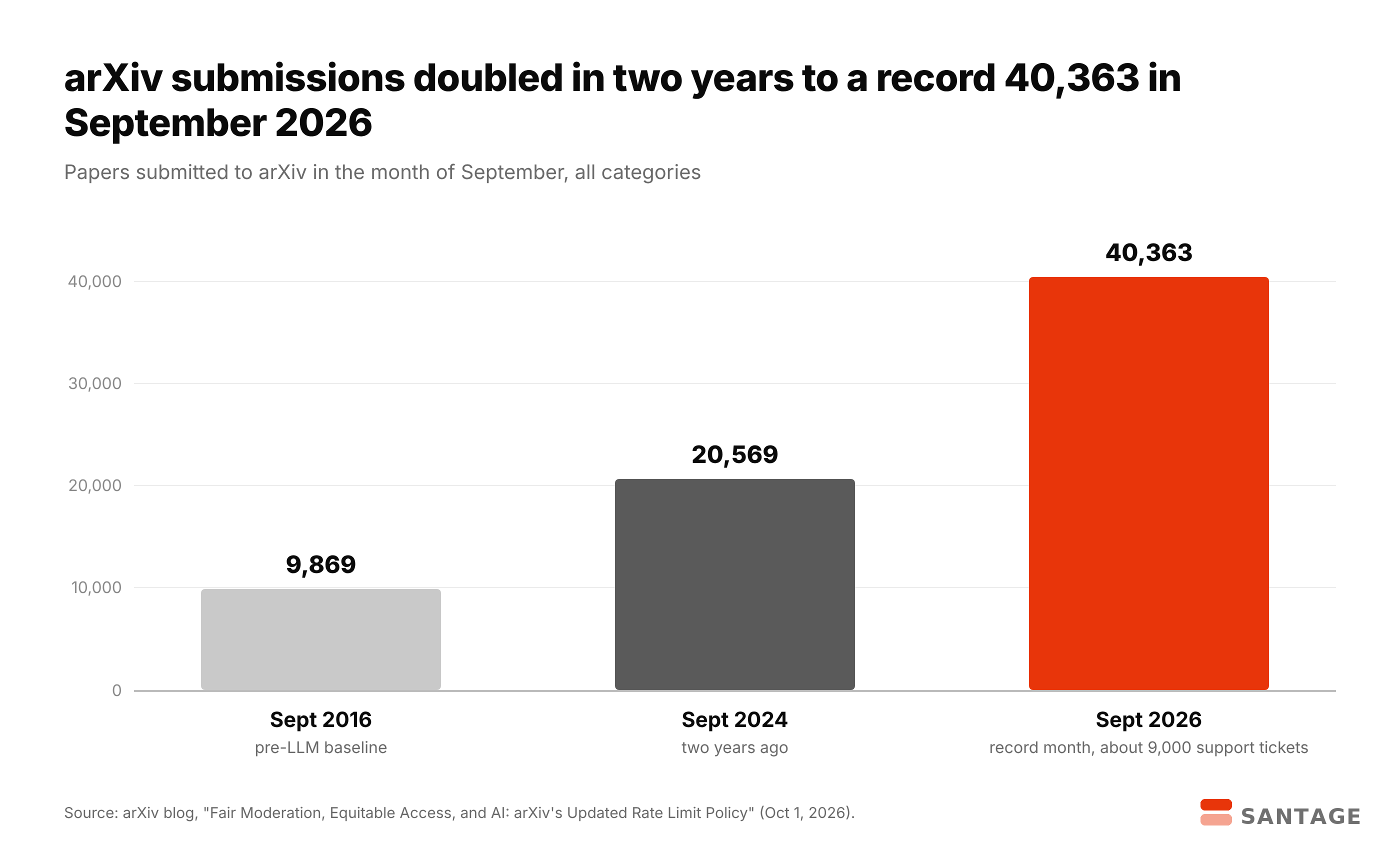
- Monthly submissions doubled in two years, from 20,569 in September 2024 to 40,363 in September 2026, and the September volume generated almost 9,000 support tickets.
- The cs.AI category grew more than sixfold over the same two years, and arXiv says moderators are seeing more thin papers, split “salami” papers and dense AI-written papers.
arXiv, the open preprint server where most AI research first appears, now allows each submitter only two papers per calendar month, after AI writing tools helped push September 2026 submissions to a record 40,363 and left volunteer moderators unable to keep pace.
arXiv limits every submitter to two papers a month across all categories
The rule took effect on October 1 and applies to whoever presses submit, so co-authors keep their own allowance. Rejected papers still count toward the monthly total because, in arXiv's words, it is submissions that consume moderator time. Papers withdrawn before announcement do not count, and papers still on hold from a previous month count only against the three-paper active limit, a cap arXiv has enforced since 2024.
arXiv describes the change as a stopgap while it works out new norms for authors using advanced AI tools and upgrades its moderation tooling. Its policy already allows AI assistance when it is disclosed and the paper meets scholarly standards. The announcement by arXiv's Kat Boboris says many recent submissions miss that bar.
A small group of high-volume authors is consuming moderator time
Thomas Dietterich, distinguished professor emeritus at Oregon State University and chair of arXiv's editorial advisory council, explained the reasoning in a thread the day the rule landed.
His follow-up post said analysis of submissions showed some authors filing dozens of papers each, delaying release of everyone else's work. arXiv's own post makes the same point, saying a relatively small proportion of authors is consuming a disproportionate share of moderator time.
| Submissions, September 2026 | 40,363, a record |
| Submissions, September 2024 | 20,569 |
| Support tickets, September 2026 | Almost 9,000 |
| cs.AI growth over two years | More than 6x |
| New limits per submitter | 2 submissions a month, 3 active at once |
The pressure arrives at an awkward moment for the repository. arXiv left Cornell University to operate as an independent nonprofit on July 1, so it is absorbing a doubling of submissions while building its own institutional footing. Its moderation still depends on volunteer subject experts, and every thin or duplicated paper they screen pushes legitimate work further back in the queue, which is the delay Dietterich says rate limits will fix.
The cap lands hardest on the field that produces the most large language model research. A lab that posts several preprints a month through one designated submitter will now need to spread uploads across co-authors or plan around conference deadlines, which arXiv explicitly tells authors to do.
AI made producing a paper nearly free, and the scarce resource in open science has moved to the human attention needed to check it. arXiv's two-paper limit is the first time a major research repository has priced that attention directly, and journals and conference committees facing the same flood of generative AI submissions now have a working template.
Santage is committed to independent, transparent journalism. This article is produced in accordance with Santage's Editorial Standards and aims to provide accurate and timely information. Readers are encouraged to verify information independently.