
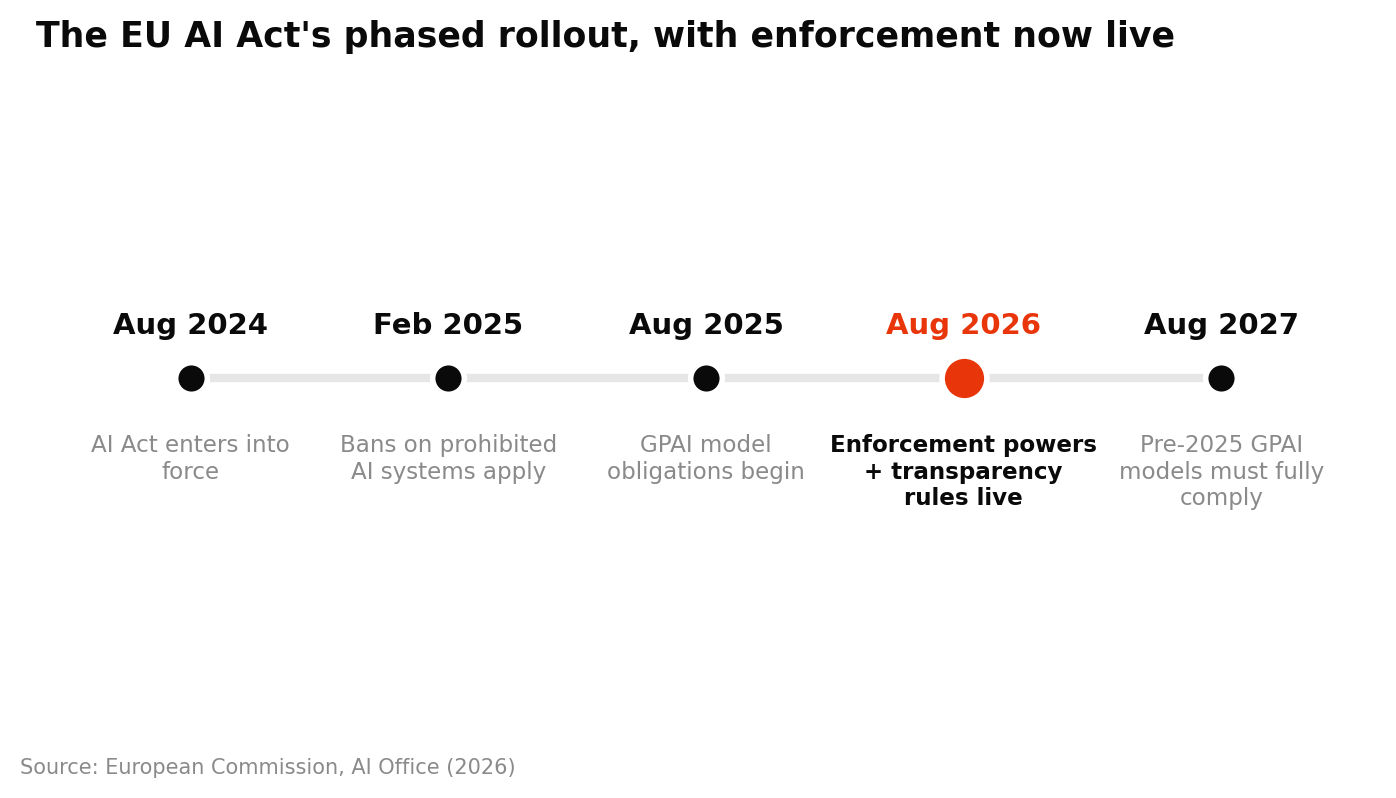
- From August 2, the European Commission's AI Office can enforce the AI Act against providers of general-purpose AI models, with power to demand documentation, run evaluations, order corrective measures, and levy fines of up to 3% of global annual turnover or 15 million euros, whichever is higher.
- The same date activates the Act's transparency obligations: chatbots must tell users they are dealing with a machine, and AI-generated or altered content, including deepfakes, must be labeled and carry machine-readable marks.
- About 190 organizations have signed a voluntary Code of Practice to demonstrate compliance, and a grace period runs to December 2, 2026 for the marking obligation on systems already on the market.
Brussels flips the enforcement switch
For a year, providers of general-purpose AI models have carried obligations under the European Union's AI Act without an authority empowered to enforce them. That changed on August 2. The Commission's AI Office, working with national regulators, now holds the power to supervise the largest model makers directly, request their technical documentation, evaluate their systems, order changes, and impose fines when it finds a provider acted intentionally or negligently.
Landing on the same date is the part of the law most people will actually see. Under Article 50, chatbots and other interactive systems must disclose that a user is talking to AI rather than a person. Deepfakes must be labeled as artificial, and AI-generated or altered images, audio, and video must carry machine-readable marks so the content can be detected downstream.
"Europeans have a right to know whether what they see, hear or read has been made or altered by AI, especially when such content can shape public debate. Transparency is how we protect trust."Henna Virkkunen, Executive Vice-President of the European Commission for Tech Sovereignty, Security and Democracy
Powers with real teeth
The enforcement powers arrive with a defined penalty ceiling. For providers of general-purpose AI models, fines can reach 15 million euros or 3% of worldwide annual turnover, whichever is higher, a level that turns compliance from a paperwork exercise into a board-level financial risk for the handful of companies that supply the world's frontier models.
To give companies a concrete path to compliance, the Commission published a first list of more than 180 organizations, roughly 190 by the end of July, that have signed a voluntary Code of Practice on transparency of AI-generated content. Signing does not replace the law, but it offers what the Commission calls a streamlined and predictable way to show that labeling and marking obligations are being met.
| Maximum GPAI fine, as share of global annual turnover, or 15 million euros | 3% |
| Maximum fine for prohibited AI practices, or 35 million euros | 7% |
| Organizations signed to the transparency Code of Practice | About 190 |
| Deadline to mark content from pre-August systems | December 2, 2026 |
The transition is not instant
Enforcement beginning does not mean every provider is immediately exposed. Models placed on the market before August 2, 2025 have until August 2, 2027 to comply fully, and the obligation to mark AI-generated content on systems already deployed before August 2, 2026 carries a grace period to December 2, 2026. The practical test now is how quickly the AI Office moves from holding these powers to using them, and which provider becomes the first to feel them.
Santage is committed to independent, transparent journalism. This article is produced in accordance with Santage's Editorial Standards and aims to provide accurate and timely information. This is regulatory reporting, not legal advice. Readers are encouraged to verify information independently.