

- A tally of Anthropic's publicly disclosed compute agreements since late 2025 reaches a reported $517 billion across about 14.8 gigawatts of new capacity, spanning AWS, Google, Microsoft, SpaceX, Fluidstack, Nscale and Lambda.
- The total is more than double the roughly $180 billion in server leasing the company was projected to sign through 2029, set against an annualized revenue run rate near $65 billion.
- Even at $517 billion, Anthropic trails OpenAI's stated target of about $750 billion and 30 gigawatts by 2030, which reframes the figure as the cost of staying in the race.
Anthropic's compute commitments now total a reported $517 billion
The company that built its reputation on caution about scaling is now contracting for compute like the most aggressive buyer in the industry. Across a run of agreements signed since late 2025, Anthropic has lined up roughly 14.8 gigawatts of new capacity, a total that public tallies of its disclosed deals put near $517 billion over the life of the contracts. The commitments reach across every tier of the supply chain: about $100 billion with Amazon Web Services under the Project Rainier expansion, a $50 billion build with Fluidstack in Texas and New York, $45 billion with Nscale, $35 billion with Lambda, a $30 billion Azure commitment with Microsoft, and a framework to take more than 300 megawatts and 220,000 GPUs at SpaceX's Colossus 1 site. Google and Broadcom add several further gigawatts on terms the companies have not priced publicly.
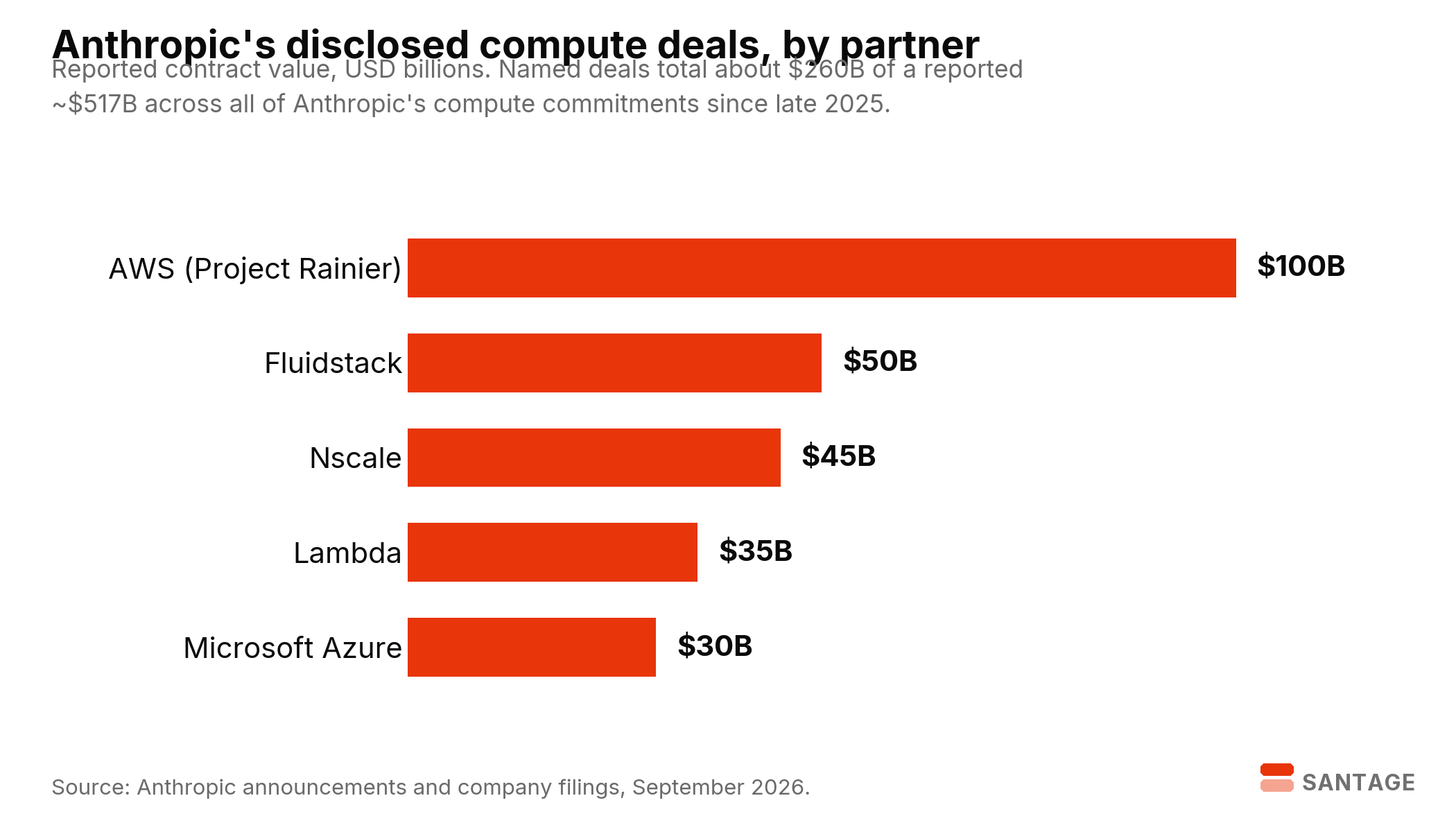
The $517 billion figure is not a budget Anthropic has published. It is the sum of its disclosed agreements, and several run ten years or longer, so the headline number reflects lifetime contract value rather than near-term cash. The direction is what carries the signal. As recently as this summer, Anthropic was modeled to sign around $180 billion in server leasing through 2029. Its disclosed AI infrastructure commitments now clear that projection more than twice over.
Why a safety-first lab is spending like an infrastructure company
Anthropic has framed every one of these deals around the same constraint: capacity governs both the research and the products that pay for it.
We're getting closer to AI that can accelerate scientific discovery and help solve complex problems in ways that weren't possible before.Dario Amodei, CEO and co-founder of Anthropic, announcing the company's $50 billion Fluidstack infrastructure build
The spending sits against a revenue run rate the company has put near $65 billion annualized, which leaves a wide gap between what Anthropic earns now and what it has agreed to pay over the next decade. That gap is why the compute build has become inseparable from the financing question Santage has tracked across the sector, from off-balance-sheet structures to debt-funded chip orders. It also lands as Anthropic moves toward a public listing, where a half-trillion-dollar compute obligation is something investors price directly.
| ~14.8 GW | New capacity contracted since late 2025 |
| ~$517B | Reported value across all disclosed deals, over contract lifespans |
| ~$180B | Earlier projected server leasing through 2029 |
| ~$65B | Annualized revenue run rate |
| ~$750B / 30 GW | OpenAI's stated compute target by 2030, still ahead of Anthropic |
The number that should hold attention is not $517 billion. It is that even this total leaves Anthropic behind OpenAI's stated ambition of roughly $750 billion and 30 gigawatts by 2030. A figure that would have defined the entire AI infrastructure story two years ago now reads as the price of staying in the race, not the proof of winning it.
The $517 billion aggregate and the 14.8 gigawatt figure are reconstructed from Anthropic's own announced agreements and public filings, not from a budget the company has disclosed; several contracts span ten years or more, so the total reflects lifetime value. Individual deals are drawn from Anthropic's official announcements, including its $50 billion Fluidstack build and its SpaceX Colossus 1 framework. Figures are as reported at publication and may be revised as terms are finalized.
Santage is committed to independent, transparent journalism. This article is produced in accordance with Santage's Editorial Standards and aims to provide accurate and timely information. Readers are encouraged to verify information independently.