
- The seven-year commitment can grow by a further $9 billion to about $20.6 billion, and Akamai issued Anthropic warrants for up to 5% of its stock at $111.33 a share.
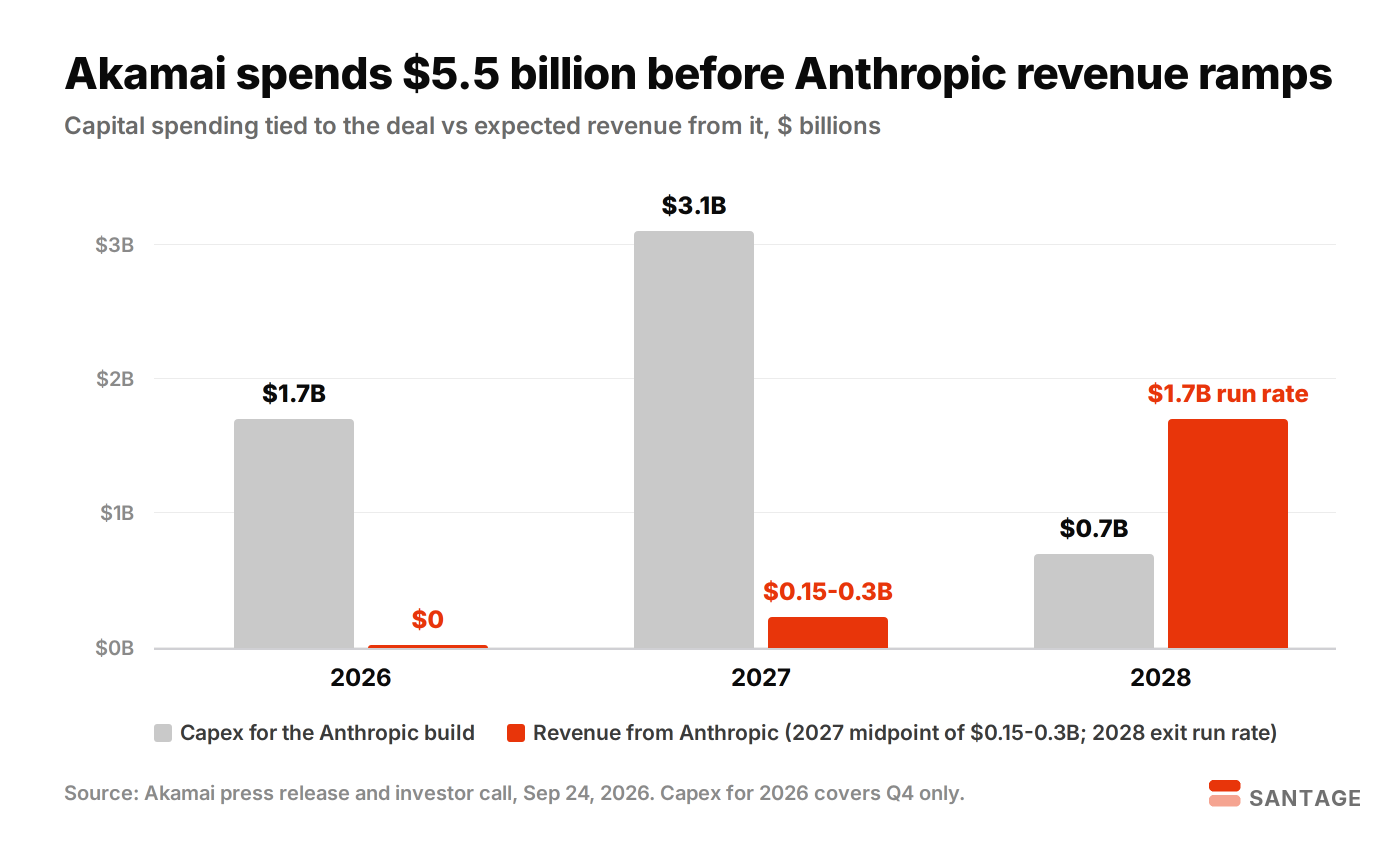
- Akamai will spend about $5.5 billion in capital through 2028 before revenue reaches an expected $1.7 billion annual run rate at the end of that year; its shares rose more than 20% after hours.
- The contract covers what Akamai calls Anthropic's “accelerating CPU workload demands,” a sign that agent workloads are pulling spending toward processors that GPU-centric deals have left behind.
Anthropic has committed $11.6 billion over seven years to Akamai for processor capacity, the largest contract in the cloud and security company's history, and the deal is built around general-purpose CPUs, the chips that AI agents lean on when they run code and call tools.
Anthropic committed $11.6 billion and can add $9 billion more
Akamai announced the agreement after the market closed on September 24. According to its press release, Anthropic will run CPU workloads on Akamai Cloud's distributed AI infrastructure for seven years, with the option to add up to $9 billion of further services inside the same term. Chief executive Tom Leighton told investors it is the largest contract Akamai has signed.
“Anthropic is advancing the AI revolution and we are thrilled they chose Akamai’s capabilities for building and operating AI infrastructure at scale.”
Dr. Tom Leighton, co-founder and CEO, Akamai, press release, September 24, 2026
The scale is easiest to see against Akamai's existing cloud business. Its Cloud Infrastructure Services line brought in $99 million in the second quarter, up 39% from a year earlier, SiliconANGLE reported, which annualizes to roughly $400 million. Akamai expects the Anthropic contract alone to reach about $1.7 billion in annualized revenue by the end of 2028. The relationship began smaller: in May, Akamai disclosed a $1.8 billion, seven-year commitment from an unnamed frontier model company that Bloomberg later identified as Anthropic.
| $11.6B | Seven-year commitment, Akamai's largest ever |
| $9B | Additional option within the same term |
| 5% | Akamai stock covered by Anthropic's warrants, at $111.33 a share |
| $5.5B | Akamai capital spending tied to the build through 2028 |
| $1.7B | Expected annualized revenue from Anthropic by end of 2028 |
Akamai spends $5.5 billion before the revenue arrives
Akamai's investor call laid out a front-loaded build. It expects about $1.7 billion of capital spending in the fourth quarter of 2026, about $3.1 billion in 2027 and about $700 million in 2028, with part of the 2026 money going to lock in memory and other components in short supply. Revenue from Anthropic starts in the second half of 2027, at $150 million to $300 million for that year, before climbing to the $1.7 billion run rate. The combined $14.4 billion of recent cloud commitments will need roughly 95 to 105 megawatts of power across several colocation sites. Akamai left its 2026 revenue guidance unchanged.
The deal buys CPUs, the chips agent workloads keep consuming
Most of the money in AI infrastructure has gone to GPUs for training and serving models. Anthropic has not said exactly which workloads it will move to Akamai, and the release describes only accelerating CPU demand. The broader market data points in one direction. Intel said in April that AI deployments had shifted from about one CPU for every eight GPUs to one for every four, and that agentic AI could push the ratio toward parity, according to Tom's Hardware. Server CPU prices rose 10% to 20% between March and April, with lead times near six months.
Agent workloads are the main reason for that shift. A model that writes and runs code, browses, or chains tool calls spends much of each task in sandboxes and orchestration software that run on ordinary processors, and products like Claude Code multiply that work per user. Akamai's network of distributed sites suits workloads that need to sit close to users and scale out cheaply, which is a different profile from the gigawatt GPU campuses in Anthropic's other deals.
| Anthropic compute partner | Reported commitment | Main resource |
|---|---|---|
| Amazon Web Services (Project Rainier expansion) | About $100 billion | Trainium accelerators |
| Fluidstack (Texas and New York) | $50 billion | GPU data centers |
| Nscale | $45 billion | GPU capacity |
| Lambda | $35 billion | Nvidia GPU capacity |
| Microsoft Azure | $30 billion | GPU cloud |
| Akamai | $11.6 billion, up to $20.6 billion | CPU cloud capacity |
Source: company announcements; Santage tally of Anthropic’s compute commitments, September 2026; Akamai, September 24, 2026.
Warrants turn the supplier into Anthropic's investment
The equity terms are the part investors should study. Akamai issued Anthropic warrants for non-voting convertible preferred stock covering about 7.7 million common shares, roughly 5% of the company, exercisable at $111.33. About 2% vests with the current commitment, and a further 1% vests with each additional $3 billion Anthropic buys. The strike sits close to where the stock traded before the announcement, so the after-hours jump of more than 20% flowed straight into the value of Anthropic's vested position.
Anthropic is now paid in equity for choosing a supplier, which means the biggest AI buyers can capture part of the market value their contracts create.Santage analysis
The structure echoes the October 2025 agreement in which AMD granted OpenAI warrants for up to 160 million shares tied to GPU deployments. It rewards the customer for concentration, and that is the main risk for Akamai shareholders: one customer's capacity plans will drive a large share of the company's growth for the rest of the decade, funded by capital spent up front. Santage has tracked how that kind of commitment is increasingly financed off the balance sheet across the sector.
For Akamai, a company long valued as a slow-growing content delivery and security business, the contract reprices it as an AI infrastructure supplier overnight. For the market, the signal is that the next leg of AI capital spending will reach well beyond GPUs, into the processors, memory and distributed sites that agents run on, and the buyers placing those orders now expect a stake in the suppliers they make.
Santage is committed to independent, transparent journalism. This article is produced in accordance with Santage's Editorial Standards and aims to provide accurate and timely information. Readers are encouraged to verify information independently.