

- Meta extended Muse to the Mac on September 17, giving the agent direct control of native Mail, Calendar, Notes, Messages, and Files, ten days after the phone and web launch.
- Muse climbed to No. 2 on the US App Store with roughly 83,000 iOS downloads in its first days, and Shopify merchants now sell inside the agent with checkout completed in the app.
- Putting the agent on the desktop turns a personal assistant into a computer operator and a checkout layer, which explains why one launch is topping app charts and unsettling commerce platforms at the same time.
Muse jumped from the phone to the desktop and started operating native Mac apps
Meta shipped Muse for the Mac on September 17, and the change is larger than a new platform checkbox. On the phone the agent worked mostly inside its own app and a sandboxed browser. On the Mac it now reaches into the software people already live in, reading and acting inside Mail, Calendar, Notes, Messages, and Files on an opt-in basis, and asking for approval before it does anything sensitive. Alexandr Wang announced the release on X and Mark Zuckerberg framed the cadence bluntly, saying the team is shipping fast. Meta added voice calling to Muse the same week.
The speed is the story as much as the feature. Muse launched to US users on September 8 as a phone and web product, and reached the desktop nine days later. A personal AI agent that lives on the Mac sits where knowledge work actually happens, close to the documents, inboxes, and calendars that fill a working day. Controlling those native applications is a far broader claim on a user's computer than answering questions in a chat window, and it moves Muse into the same territory that OpenAI and Anthropic have been circling with their own computer-use tools.
Muse climbed to No. 2 on the US App Store within two days of launch
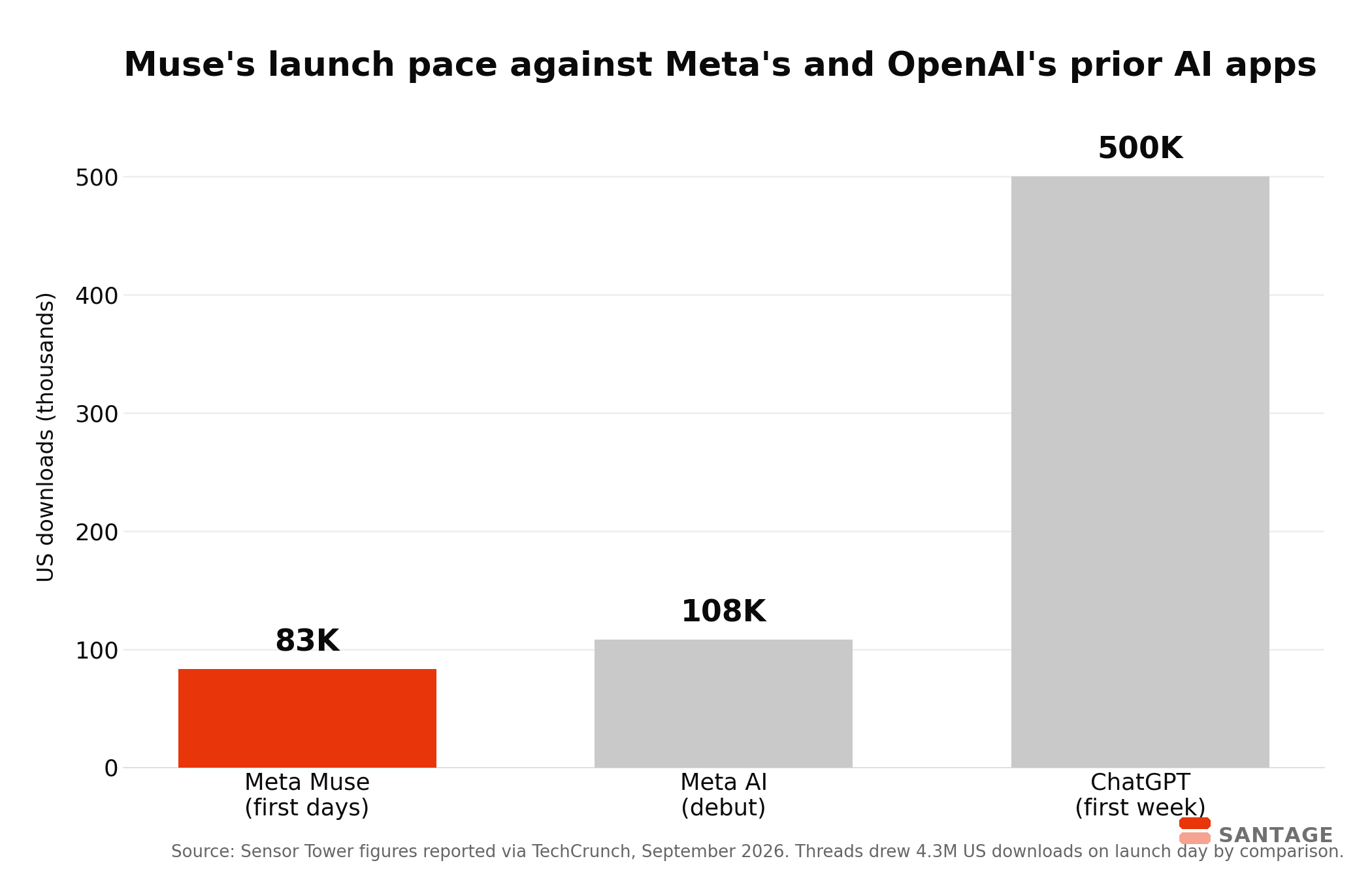
The adoption curve has been steep for a product that asks users to hand over logins and payment cards. Sensor Tower recorded roughly 83,000 iOS downloads in the United States within the first days, and Muse moved up from No. 4 on Wednesday to the No. 2 slot on the App Store Top Charts by September 10. That figure lands close to the 108,000 downloads Meta's own AI app drew across its full debut, and it sits on a trajectory toward the roughly half a million installs ChatGPT logged in its first week, a respectable start for an agent that people have to trust with their accounts.
The numbers also mark the ceiling. Threads pulled more than 4.3 million US downloads on its launch day by riding an existing social graph, and Muse has no such shortcut because trust in an agent that spends money has to be earned one cautious user at a time. On Android the gap is visible already, where Muse sat at No. 338 in the Productivity category while the iOS chart surged.
Shopify merchants now sell inside Muse, and retail platforms felt it
The commerce hook is what separates this launch from a better chatbot. Shopify connected its product catalog to Muse, so a shopping request inside the agent searches live merchant inventory and completes the purchase without leaving the app, paid through Link built by Stripe and Shop Pay. Shopify said so directly on the day of the drop.
The enthusiasm and the anxiety come from the same mechanism. When an agent finds the product and completes checkout inside Meta's app, the merchant's own storefront and the paid ad click that usually precedes a sale both risk being skipped. Investors read that as a threat to the businesses built on being the place where the transaction happens, and shares in commerce platforms wobbled on the news even as Meta's app climbed. An agent that owns the moment of purchase owns the most valuable step in online retail, and that is a direct challenge to every company that currently sells the click leading up to it.
| Sept 8, 2026 | US launch on iOS, Android, and the web |
| Sept 17, 2026 | Mac app with control of native Mail, Calendar, Notes, Messages, and Files |
| No. 2 | US App Store Top Charts rank by September 10 |
| 83,000 | US iOS downloads in the first days |
| $20 / $100 | Power and Maximum monthly subscription tiers |
Meta wants Muse to be the agent you default to, and the desktop is how it gets there
The desktop reach and the checkout button point at the same goal. Whoever runs the agent that acts, rather than the one that only talks, becomes the layer sitting between a person and every app, inbox, and store they touch. Meta is sprinting for that position while the field is still open, racing Instinct, the roughly $10 billion startup that added voice calling the same week, and OpenAI, which spent the summer pushing ChatGPT from answering to doing. The Mac release, the Shopify tie-in, and the free tier all serve one aim, which is to make Muse the habit before a rival sets it.
The obstacle sits where it always has for Meta, in whether people believe the company will hold their logins, cards, and calendars without turning that access into another advertising signal. Muse routes outward actions through a separate Sentinel approval agent and keeps credentials in a store the model cannot read, real safeguards that Meta is right to lead with. The company also watched OpenAI's public agents get manipulated into off-script actions this month, a reminder that an agent with hands is an agent that can be misdirected. Muse has won the first sprint on distribution and speed. The harder race is convincing a wary public to let a Meta agent run the machine where they work and the checkout where they spend.
Santage is committed to independent, transparent journalism. This article is produced in accordance with Santage's Editorial Standards and aims to provide accurate and timely information. Readers are encouraged to verify information independently.