

- At work, people are more than twice as likely to use ChatGPT to complete a task or produce something than they are outside work, where asking still dominates.
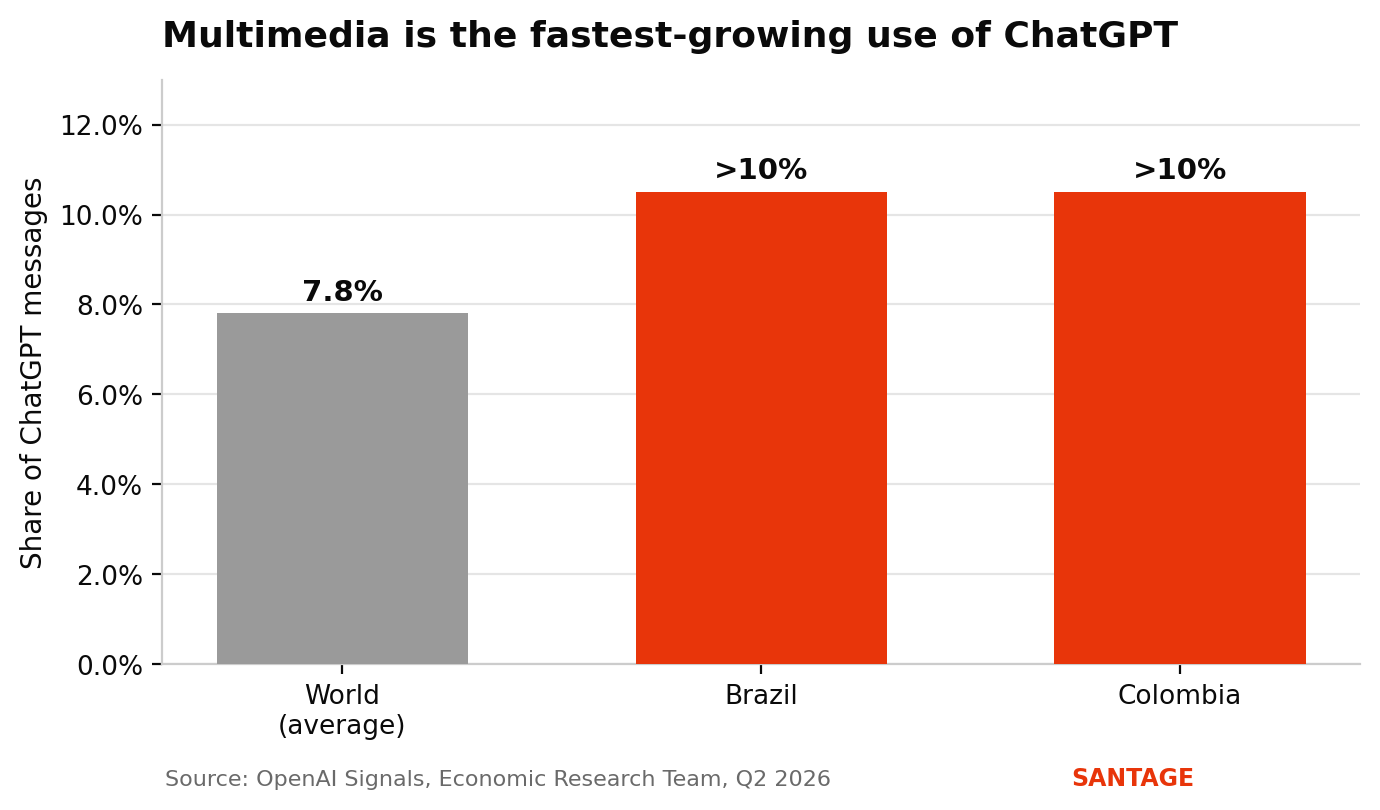
- Multimedia is now the fastest-growing use case at 7.8% of messages globally, and more than one in ten in Brazil and Colombia.
- Adoption is broadening beyond early adopters: usage among people over 35 rose in nearly every country, gaining more than 10 percentage points of message share in France and Czechia.
OpenAI's first country data shows a move from asking to doing
For the first time, OpenAI has published country-by-country data on how more than a billion people use ChatGPT, and the headline finding is a change in what the product is for. Drawn from its Economic Research team's Signals dataset, the data shows that at work people are more than twice as likely to use ChatGPT to do something, editing, coding, or running an analysis, than they are outside work, where seeking information remains the largest category.
That distinction matters more than any single usage statistic. A tool people ask is a better search engine. A tool people use to finish work is something closer to labor. OpenAI frames the shift plainly.
"AI is no longer just helping people find answers. It is helping more people, in more places, get things done."OpenAI Economic Research Team, in its August 6 report
The dataset carries an important caveat that sharpens rather than softens the point. It reflects only individual accounts on the Free, Go, Plus and Pro tiers, not the organisation-managed enterprise seats where task completion is most concentrated. The doing shift OpenAI measures is therefore a floor, not a ceiling.
Why the shift from asking to doing changes the moat
When AI answers a question, the thing that wins is model quality. When AI completes a task inside a workflow, the things that win are integration, permissions, and trust that the output can be shipped without a second pass. The competitive surface moves from the chat box toward the systems where work actually happens.
This is visible in the second finding. Multimedia generation and analysis is the fastest-growing use case, reaching 7.8% of messages globally since the release of ChatGPT Images 2.0 in April 2026, and passing one in ten messages in Brazil and Colombia. Creating an image or analysing a document is doing, not asking, and it is the category climbing fastest.
Asking is a search product that competes on relevance. Doing is a labor product that competes on trust and integration. The two require different companies to win them.
The growth is coming from the people who were supposed to adopt last
The most underappreciated signal in the release is who is driving the change. Adoption is no longer led only by young technologists in North America and Europe. Usage among people over 35 rose in nearly every country and now accounts for a 5% higher share of messages than a year ago, with France and Czechia gaining more than 10 percentage points. Roughly three-quarters of European countries saw above-average increases in this cohort.
The geography is broadening in parallel. Countries that started with lower per-capita use, across Latin America, Africa and Oceania, are closing the gap, with Peru, Uruguay and Costa Rica rising most in the second quarter. The frontier of growth has moved from the earliest adopters to the mainstream, which is exactly the population that monetisation and policy tend to track.
| More likely to "do" than "ask" at work | 2x or more |
| Share of messages that are multimedia, globally | 7.8% |
| Rise in message share from users over 35, year over year | +5% |
| Countries rising most in Q2 per-capita rankings | Peru, Uruguay, Costa Rica |
What this means for builders, competitors, and policymakers
For builders, the lesson is that distribution and workflow depth now matter as much as raw capability. The product closest to the task, an agent, an integration, an approved action, captures more value than a better answer delivered in a chat window. For competitors, differentiation on answer quality alone is eroding as the job shifts to doing, where lock-in comes from the systems an assistant can touch. For policymakers, country-level usage becomes a new measure of economic exposure, and one that will increasingly correlate with which workforces are being reshaped first.
The last two years measured AI by how well it answered. The next two will measure it by how much it finishes. OpenAI's own data shows the shift is already underway, and it is moving fastest not among the engineers who built the technology, but among the workers and countries who were expected to adopt it last.
Santage is committed to independent, transparent journalism. This article is produced in accordance with Santage's Editorial Standards and aims to provide accurate and timely information. Readers are encouraged to verify information independently.