
- Meta Superintelligence Labs released Muse Glimmer, a 30-billion-parameter dense multimodal model, under a permissive Apache 2.0 license on Hugging Face with day-one support in Ollama, LM Studio, and vLLM.
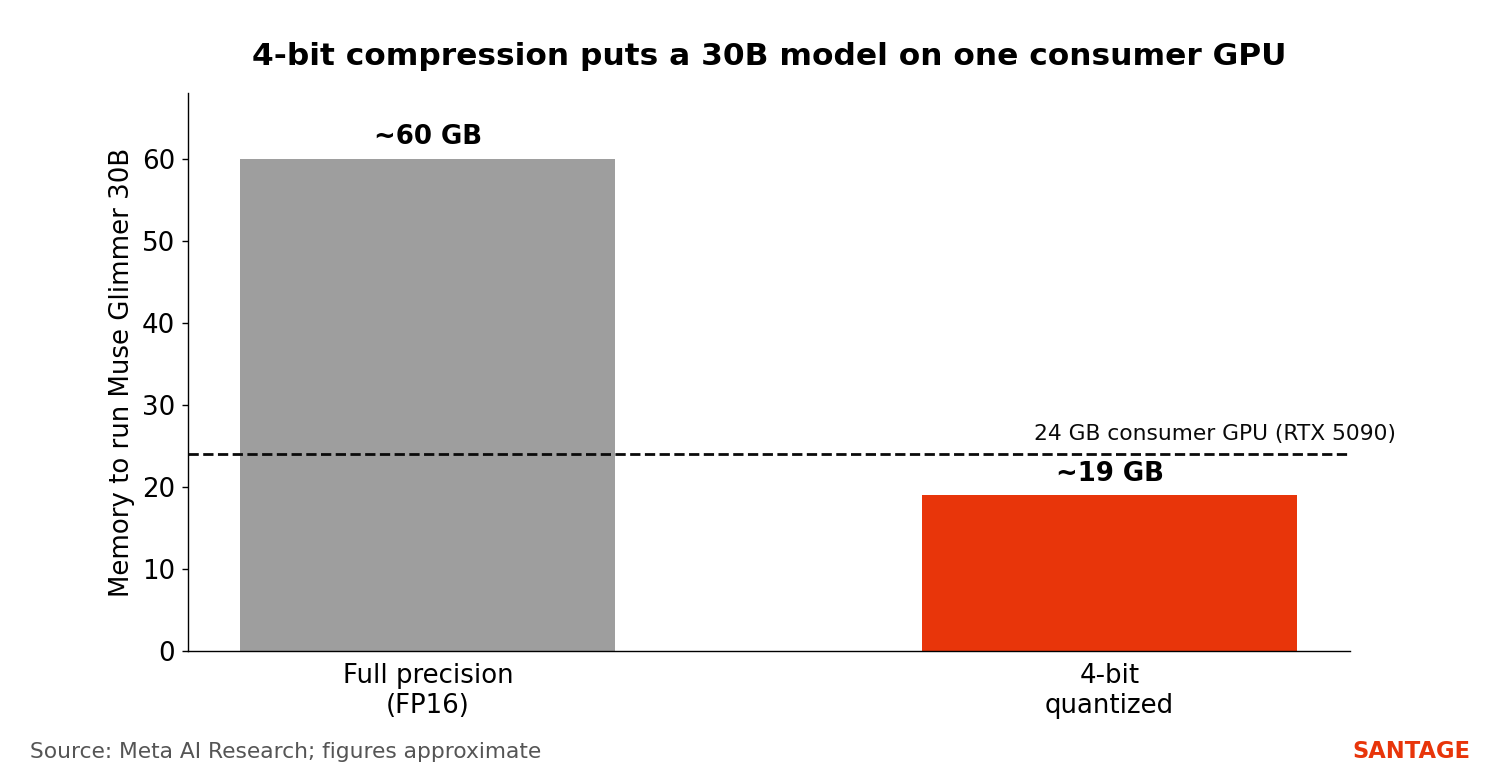
- Compressed to 4-bit, the model needs under 20GB of memory and runs on a single consumer GPU such as a 24GB card or a MacBook, and is tuned for local agents, tool use, coding, and LLM-as-judge evaluation.
- It is Meta's first notable open-weight language model since April 2025 and ships with a 131K-token context window, shorter than the 1M windows rivals now advertise.
Meta puts a 30B agentic model back in the open
Meta has returned to open weights. On August 10 the company's Superintelligence Labs published Muse Glimmer, a 30-billion-parameter dense multimodal model, and released the weights under an Apache 2.0 license, one of the most permissive terms available. It is the first major open language model Meta has shipped since April 2025, when the Llama line went quiet.
The pitch is local. A 30B model normally needs more than 55GB of memory at full precision, but Meta compressed Muse Glimmer to roughly 4-bit and added block-level speculative decoding, bringing the footprint under 20GB. That fits on a single 24GB or 32GB consumer graphics card, or a MacBook, which lets the model sit inside an always-on agent loop rather than a data center. Meta paired the launch with day-one support across Ollama, LM Studio, and vLLM, and promised open weights for its larger Muse Spark 1.2 model in the coming weeks.
| Parameters (dense multimodal, text and images) | 30B |
| Memory after 4-bit compression (from ~60GB at full precision) | Under 20GB |
| Context window | 131K tokens |
| License | Apache 2.0 |
| Day-one runtimes | Ollama, LM Studio, vLLM |
The model is built for agents rather than benchmark sweeps. Meta positions it for local function calling, coding, and long-running tasks, with 100-plus language support. In the company's own comparison table it edges Qwen 3.6 27B and Gemma 4 31B on several tests, though the wins are not universal.
| Benchmark (higher is better) | Muse Glimmer 30B | Qwen 3.6 27B | Gemma 4 31B |
|---|---|---|---|
| MCP Atlas (agentic tool use) | 75.5 | 62.5 | 54.2 |
| DeepSearch QA | 74.6 | 71.1 | 61.7 |
| WildClawBench | 47.6 | 43.2 | 37.6 |
| SWE-Bench Pro (coding) | 51.2 | 50.2 | 36.9 |
Selected results from Meta's published model card, August 2026. Qwen 3.6 27B still leads on some desktop-agent and multimodal tests, including OSWorld-Verified, where it scores 75.6 to Glimmer's 65.9. The 131K context window is also modest next to the million-token windows rivals now market.
Why Meta is going open again
The release arrived with a policy argument attached. Meta CEO Mark Zuckerberg published a long essay alongside the model defending open weights and model distillation, and framing the release as part of his personal-superintelligence vision.
"Rather than centralizing superintelligence, we should distribute it widely and give every person the ability to direct it."Mark Zuckerberg, essay accompanying the Muse Glimmer release, August 10, 2026
The weights landed with a full local-AI stack behind them. Meta published the model on Hugging Face with BF16 weights, GGUF k-quants, and ExecuTorch builds, and support rolling out across Ollama, LM Studio, vLLM, SGLang, Together AI, Fireworks AI, and OpenRouter.
For a company that spent 2025 pouring capital into closed superintelligence labs and hiring, putting a capable agentic model back in the open, on terms that let anyone run it locally, is a deliberate return to the strategy that built Llama's following.
Santage is committed to independent, transparent journalism. This article is produced in accordance with Santage's Editorial Standards and aims to provide accurate and timely information. Readers are encouraged to verify information independently.