

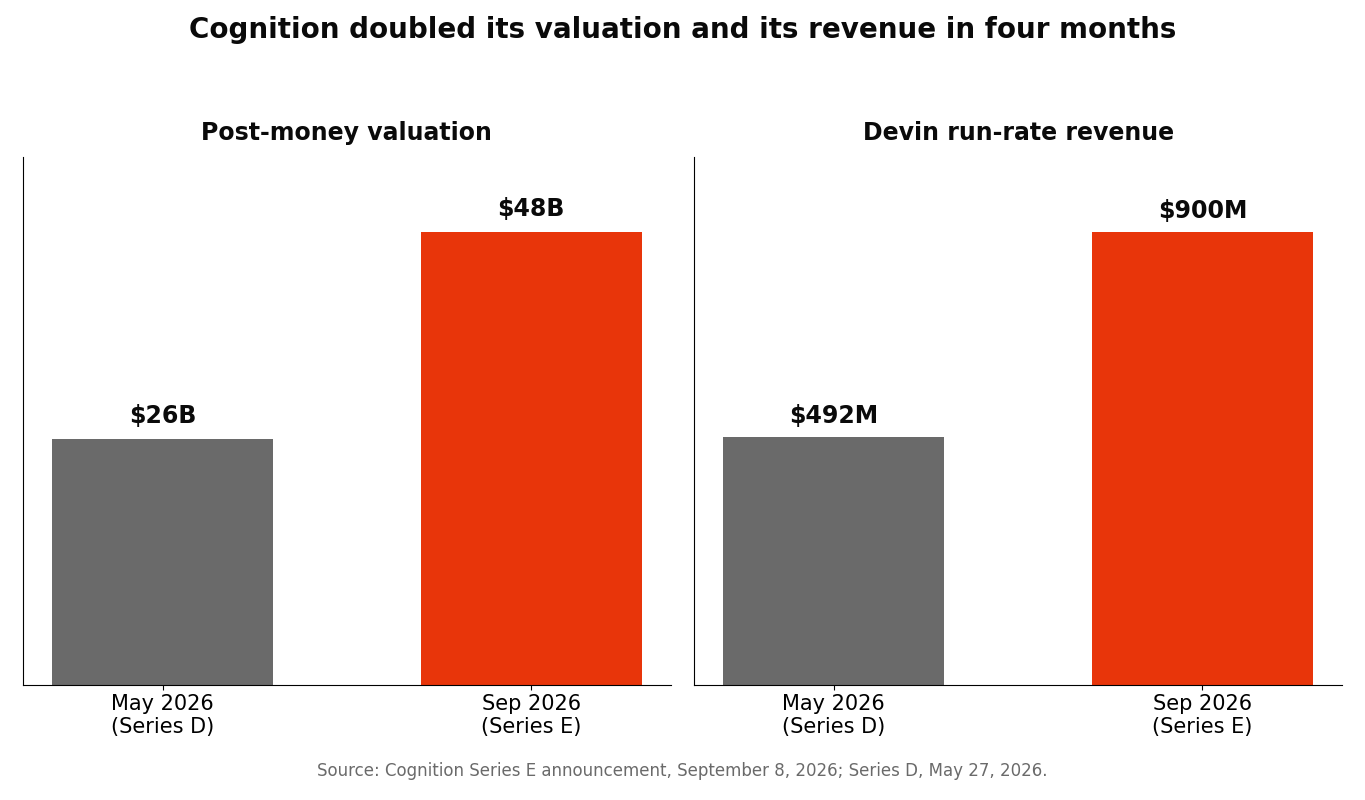
- Cognition raised over $2 billion in a Series E led by Andreessen Horowitz and Accel, at a $48 billion valuation, nearly double the $26 billion it reached in May.
- Devin's run-rate revenue climbed from $492 million in May to almost $900 million in September, roughly 83% growth in four months.
- Enterprise customers now include Nvidia, GE Aerospace, Citi, Mercedes-Benz, and Modal, and 89% of the code Cognition's own engineers commit is written by Devin.
Andreessen Horowitz and Accel lead a $2 billion round at a $48 billion valuation
Cognition, the company behind the Devin coding agent, said on September 8 that it had raised more than $2 billion in a Series E led by Andreessen Horowitz and Accel. The round values the company at $48 billion, up from the $26 billion it reached only in May, when Lux Capital, General Catalyst, and 8VC led an earlier raise of more than $1 billion. Two funding rounds, four months apart, and the valuation nearly doubled between them.
The pace is the story. Cognition has moved from a fast-growing startup to one of the most valuable private AI companies in the world in a single year, and it has done so in the most crowded corner of the market, software development, where it competes with Cursor, GitHub Copilot, and a field of open-weight coding models. The Series E is a bet that the company selling autonomous agents, rather than autocomplete, is the one that captures the enterprise budget.
| Round size | More than $2 billion (Series E) |
| Post-money valuation | $48 billion, up from $26 billion in May 2026 |
| Lead investors | Andreessen Horowitz and Accel |
| Run-rate revenue | About $900 million, up from $492 million in May |
| Product signal | 89% of code committed by Cognition's own engineers is written by Devin |
Why Devin's revenue curve matters more than the valuation
Valuations in AI have detached from most people's intuition, so the number that deserves attention is the revenue. Devin's run-rate went from $492 million in May to almost $900 million in September, an 83% jump in four months. That is not the curve of a demo that went viral. It is the curve of a product that enterprises are expanding across teams after it clears a pilot, which is the harder and more durable kind of growth.
We believed engineers should operate more like architects and delegate execution to swarms of agents. Together, engineers and their Devins could dramatically expand the world's capacity to build great software and solve hard problems.Cognition, "Announcing our Series E," September 8, 2026
The customer list backs that up. Cognition names Nvidia in chip design, GE Aerospace in aviation, Citi in financial services, Mercedes-Benz in automotive, and Modal in AI infrastructure among the companies running Devin. These are buyers with security reviews and procurement cycles that punish hype, and their presence signals that Devin has crossed from novelty into infrastructure inside real engineering orgs.
The coding-agent market is consolidating around a few expensive winners
Cognition's raise does not sit in isolation. Capital is concentrating fast in the companies that turn AI into working software, from Lovable's $13 billion vibe-coding valuation to the AI app studio HubX reaching unicorn status with Point72 backing. The competitive lines are hardening too, visible in the moment OpenAI cut Cursor off from priority access. A $48 billion valuation buys Cognition the compute and the runway to press that advantage while rivals fight over model access.
Devin now writes 89% of the code Cognition ships. The company is its own best case study, and its most honest risk.
The number most coverage will skip
The figure that flatters Cognition also frames its exposure. Devin writing 89% of the company's own committed code is a genuine proof point, and it is also a reminder that Cognition's growth is now tied to a capability that its largest suppliers, the frontier labs, keep improving and could choose to sell directly. Every coding agent runs on models it does not own. When those models get better at agentic coding on their own, the value migrates toward whoever controls the weights, unless the agent layer has built something the raw model cannot replicate, in workflow, memory, and enterprise integration.
That is the real question buried under the $48 billion. Cognition has proven demand, revenue, and reference customers that most AI startups can only script. What it has not yet proven is that an agent built on someone else's model can hold a durable margin once that model learns to do the same job. The Series E gives Cognition two years to answer it. The revenue curve says the market is not waiting for the answer before it buys.
Santage is committed to independent, transparent journalism. This article is produced in accordance with Santage's Editorial Standards and aims to provide accurate and timely information. Readers are encouraged to verify information independently.