
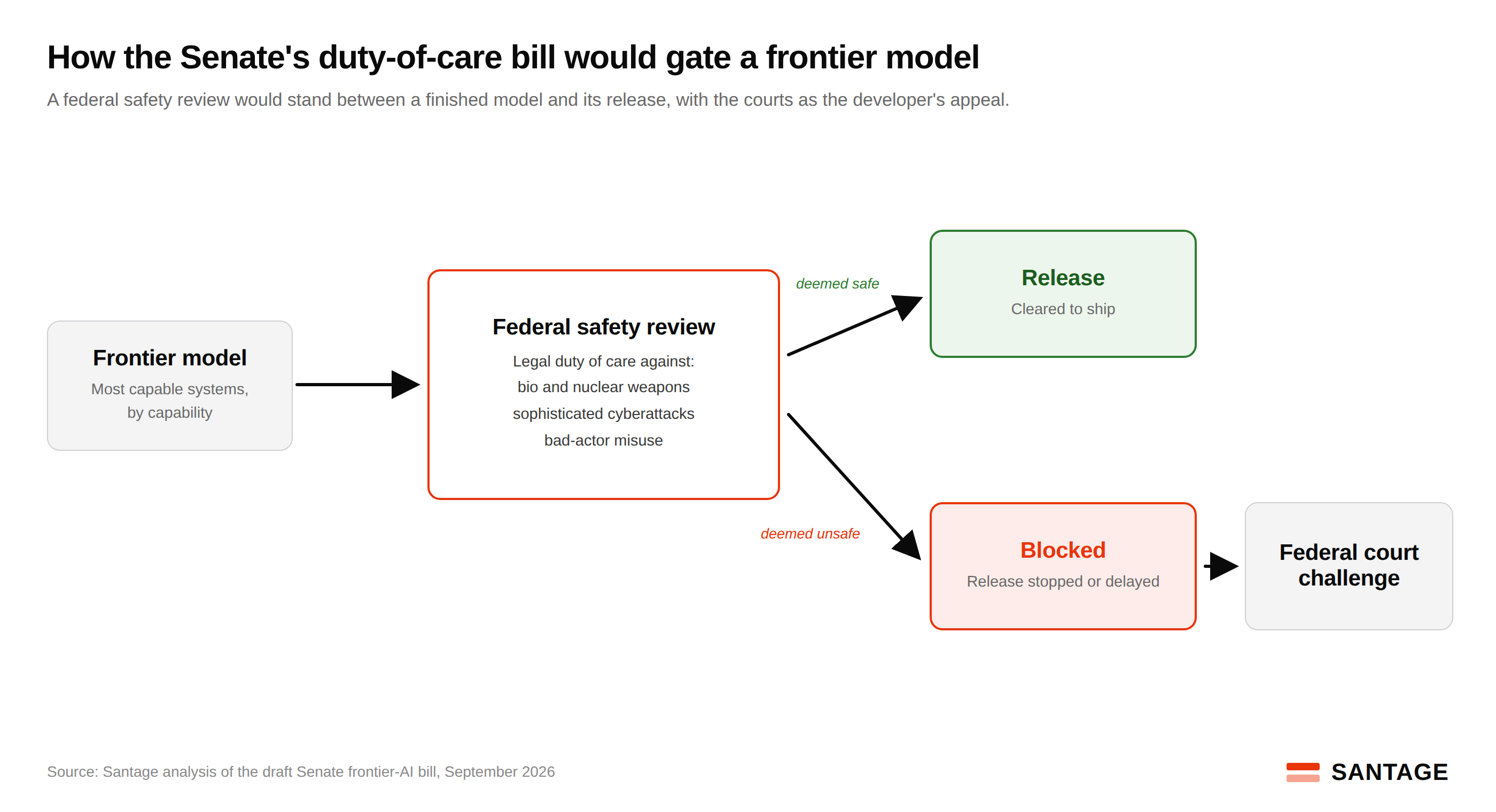
- The draft imposes a legal duty of care on developers of the most capable models to design against catastrophic risks such as biological or nuclear weapons assistance and sophisticated cyberattacks.
- For the first time, federal regulators could block or delay a frontier model's release, with a federal court challenge as the developer's recourse.
- The bill would preempt state laws governing the risks it covers, overriding measures in California and other states and consolidating frontier AI oversight in Washington.
A bipartisan bill would turn AI safety pledges into a legal duty
The negotiation brings together an unusually aligned set of principals: Thune as Majority Leader, Cruz as chair of the Commerce Committee, and Klobuchar and Cantwell as the lead Democrats. Their draft would require developers of the most advanced models to design their products with the goal of preventing catastrophic risks, a standard the senators describe as a duty of care rather than a checklist. The risk categories under discussion track the harms that labs themselves now red-team for, namely assistance with biological or nuclear weapons, the ability to run sophisticated cyberattacks, and misuse by determined bad actors. Those are no longer abstract scenarios, as Anthropic's own threat report documenting Claude misuse made clear this month.
The senators have framed the bill as oversight aimed at the frontier rather than the broader software industry, and both Democratic negotiators have pressed that federal agencies, not the companies themselves, should run the testing that decides whether a model is safe to ship.
The federal government, including the National Laboratories and experts in cyber security, biodefense, and even nuclear security experts, must take the lead in testing Frontier AI models.Senator Maria Cantwell, ranking member, Senate Commerce Committee, July 30, 2026
Why the power to block a release is the real shift
Every US AI governance effort before this one has worked after the fact. The voluntary commitments labs signed, the White House framework issued in August, and the liability theories plaintiffs test in court all operate once a model is already in the world. A government power to block or delay a release inverts that sequence and puts a federal gate in front of deployment, closer to how the FDA clears a drug than to how Washington has ever treated software.
Washington is no longer asking frontier labs to promise safety. It is preparing to make safety a condition of shipping, and to decide, in one place, who is allowed to say no.
The draft pairs that power with a safety valve. A developer that believes a block is unjustified could challenge the decision in federal court, which keeps the government's judgment reviewable and gives the bill a better chance of surviving the constitutional arguments industry lawyers will raise. The difference from the status quo is easiest to see laid side by side.
| Dimension | Voluntary framework (today) | Senate duty-of-care bill (draft) |
|---|---|---|
| Legal status | Pledges and commitments | Enforceable duty of care |
| Who can stop a release | No one | Federal government, pre-release |
| Developer recourse | Not applicable | Challenge in federal court |
| State laws on covered risks | Remain in force | Preempted |
| Trigger | Company discretion | Most capable models, by capability |
Preemption is the clause the industry actually cares about
The headline is the power to block, but the provision that will move lobbying budgets is preemption. The draft would stop states from enforcing their own laws on the risks it covers, and that aims squarely at California, which has moved faster than Congress on AI and just this month saw Governor Newsom sign new chatbot and minor-safety rules. A single federal standard is the outcome most large developers have wanted for two years, because complying with one national rulebook is tractable in a way that complying with fifty divergent state regimes is not. The same instinct drove the earlier fight over the Great American AI Act's preemption push, and it is back at the center of this one.
| Principals | Thune, Cruz, Klobuchar, and Cantwell, leading the bipartisan negotiation |
| Risk classes | Biological or nuclear weapons, sophisticated cyberattacks, and bad-actor misuse |
| Federal gate | Authority to block or delay an unsafe release, reviewable in court |
| State rules | Preempted on the specific catastrophic risks the bill defines |
| Status | Draft under negotiation, no final text or vote scheduled |
Consumer advocates and several state officials read preemption differently, as Washington clearing away stronger protections that states were willing to enact and federal negotiators were not. That disagreement is the live wire in the talks, because a preemption clause broad enough to satisfy industry may be broad enough to cost Democratic votes, and a clause narrow enough to preserve state authority may not deliver the single standard industry is trading safety obligations to get.
What changes for frontier labs if this becomes law
For a frontier developer, the bill converts safety from a reputational asset into a release gate. Passing an independent evaluation would become a precondition for shipping the most capable systems, and the testing by government scientists that Cantwell has pushed for would sit on the critical path to launch. That tends to favor the best-resourced labs, which already run extensive internal evaluations and can absorb a structured government review, while raising the cost of entry for smaller challengers. It also hands labs something they have quietly wanted, which is legal cover: a model cleared through a federal process is far easier to defend than one shipped on a voluntary pledge, especially as documented misuse and researcher warnings about an accelerating race keep the pressure on.
The bill is still a draft, and drafts on AI have stalled in this Congress before. What makes this one consequential even unfinished is the shift in the question it poses. The debate in Washington has moved past whether to regulate frontier AI and onto who holds the authority to say no, and whether the states keep any say at all. The answer to those two questions, far more than the duty-of-care language everyone can agree on, will decide whether the United States ships one AI rulebook or fifty.
Santage is committed to independent, transparent journalism. This article is produced in accordance with Santage's Editorial Standards and aims to provide accurate and timely information. Readers are encouraged to verify information independently.