

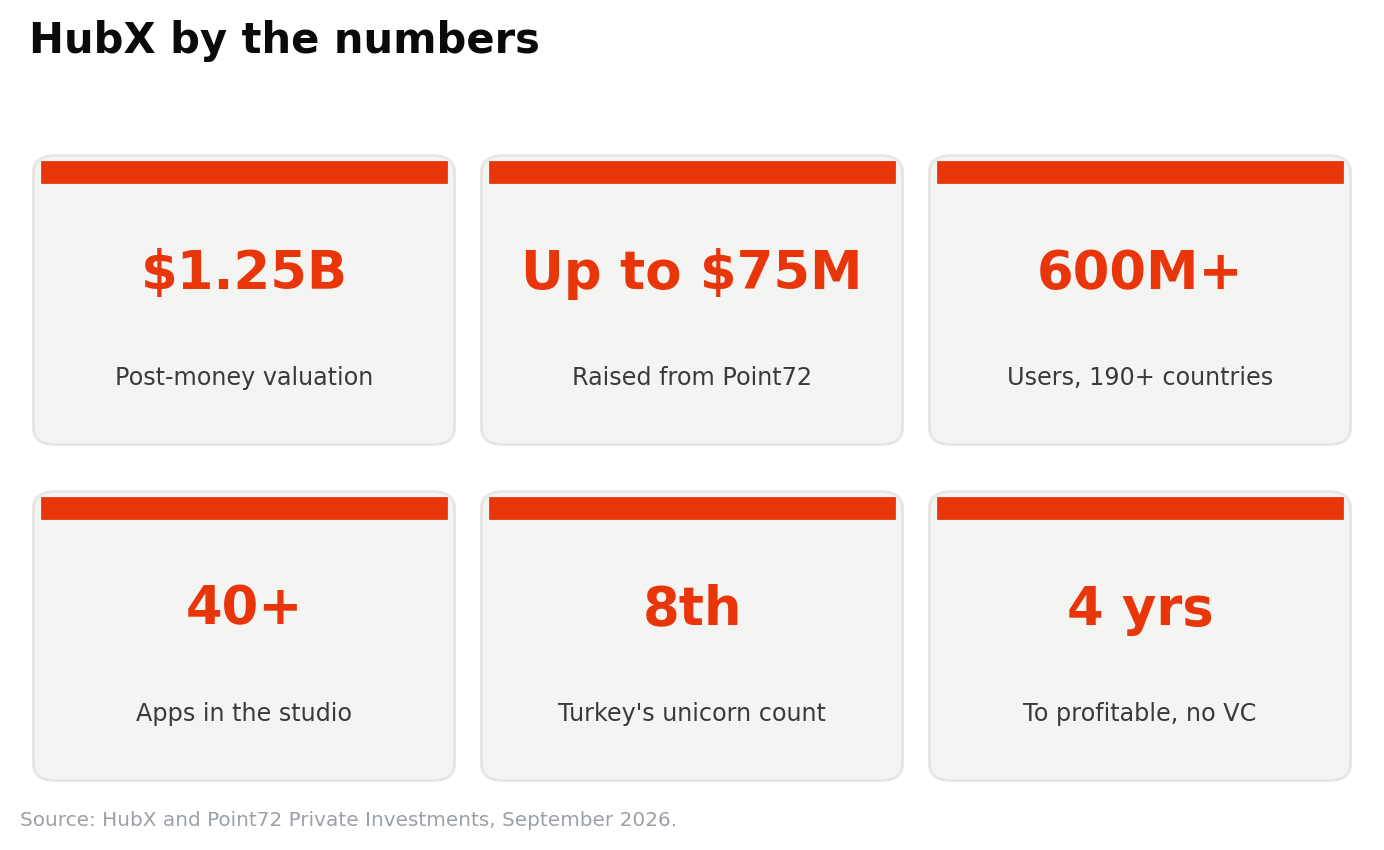
- HubX, a profitable consumer-app studio based in Izmir, Turkey, raised up to $75 million from Point72 Private Investments at a $1.25 billion post-money valuation, its first external funding and Turkey's eighth unicorn.
- The company reached 600 million users across 40-plus apps in four years without prior venture money, and will spend the round acquiring consumer apps and scaling them with its AI, data and monetization stack.
- The check is a bet on the AI application layer rather than the model layer, from a hedge-fund investor buying distribution and profit instead of frontier research.
A profitable app studio, bootstrapped to a unicorn
Point72 Private Investments, the venture arm tied to Steve Cohen's firm, agreed to put up to $75 million into HubX, a consumer-technology studio founded in 2022 in Izmir, Turkey. The structure is a $50 million initial tranche with a $25 million option, at a $1.2 billion pre-money and roughly $1.25 billion post-money valuation. It is the first outside capital HubX has taken, and it makes the company Turkey's eighth unicorn.
The detail that matters for investors is the one most funding stories cannot claim. HubX is profitable, and it got to this scale without venture money. The company says it runs more than 40 mobile and web apps, spanning generative AI, photo and video, education and wellness, with products including Nova, Wiser, DaVinci and Lotus Flow, reaching more than 600 million users across 190 countries with a team of about 370 people. Reaching a billion-dollar valuation on a first check is rare anywhere. Doing it from Izmir, profitably, is rarer still.
Reaching this scale within just four years while remaining profitable validates the model we've built and the opportunity ahead.Kaan Ortabas, HubX co-founder
Why Point72 is buying distribution
The interesting question is not why HubX raised, but what a hedge-fund investor thinks it is buying. HubX describes itself as an operating engine for consumer technology. The plan for the money is a rollup, acquiring and partnering with consumer apps around the world, keeping their teams, and plugging them into HubX's shared capabilities in AI, data, monetization, engineering and growth. Point72 partner Ishan Sinha framed the appeal as HubX's ability to spot consumer demand and quickly build, distribute and scale products.
Read against the rest of this week, the check is a statement. The headlines went to a new frontier model and a $12.93 billion chip acquisition, both bets on the model and infrastructure layers. Point72 wrote a growth check at the opposite end of the stack, on the layer where AI meets a paying user. It is closer in spirit to the $13 billion valuation the market put on vibe-coding app Lovable than to any lab round, and it fits the wider split between AI infrastructure spending and the businesses that have to monetize it.
| Investor | Point72 Private Investments, up to $75 million ($50 million plus a $25 million option) |
| Valuation | $1.2 billion pre-money, roughly $1.25 billion post-money |
| Milestone | first external round, Turkey's eighth unicorn, its first app-studio unicorn |
| Scale | 40-plus apps, 600 million-plus users across 190 countries, about 370 employees |
| Status | profitable, founded 2022, based in Izmir with an Istanbul office |
| Use of funds | acquiring consumer apps and scaling them on HubX's AI and monetization stack |
The logic is that durable margin in consumer AI may accrue less to whoever trains the best model and more to whoever owns the distribution and the paying relationship. Foundation models are converging and getting cheaper, a trend visible in the two-tier split now forming in inference pricing. If the model is becoming a commodity input, the studio that can drop a capable model into 40 apps, monetize it, and buy more apps to repeat the move is holding the scarcer asset. That is the thesis Point72 is underwriting.
The week's biggest checks went to models and chips. The quieter signal is a profitable app studio reaching a billion dollars on its first raise, at the layer where AI meets a paying customer.
What the rollup has to prove
The risks are the ones every app-studio rollup faces, now with an AI twist. Consumer apps live and die on retention and acquisition cost, and a portfolio stitched together by acquisition can hide churn behind a big top-line user number. HubX's 600 million figure is reach, not revenue, and the company has not disclosed how concentrated its profit is across the 40 apps. The rollup only compounds if acquired apps keep their users and if HubX's shared AI and monetization layer lifts them enough to justify the purchase prices it is about to start paying.
There is also platform risk. A studio of consumer apps sits downstream of Apple and Google, whose store fees, privacy rules and their own AI features can compress margins without warning. And the AI edge itself is not proprietary. The same models HubX drops into its apps are available to every competitor, so the moat has to be execution, data and distribution rather than the model.
For founders and investors the takeaway is concrete. A profitable, bootstrapped, non-Silicon-Valley studio just cleared a billion dollars on its first check by treating AI as a feature to be distributed rather than a science to be funded. If HubX's acquisitions compound, it validates a playbook that many app companies can copy. If they do not, it becomes the cleanest test yet of whether the AI application layer can carry venture-scale returns, or whether the value keeps flowing upstream to the labs and the chipmakers after all.
Santage is committed to independent, transparent journalism. This article is produced in accordance with Santage's Editorial Standards and aims to provide accurate and timely information. Readers are encouraged to verify information independently.