

- The Institute of Foundation Models, the research lab of Abu Dhabi's MBZUAI, released K2 Horizon, a fleet of six models from 0.9B to 375B parameters, all under an Apache 2.0 license.
- The lab shipped not only weights but the training code, data recipes and evaluation details, positioning the release as fully open science rather than open weights alone.
- The flagship 375B model uses a sparse design that activates 23B parameters at a time and scores 47 on the Artificial Analysis Intelligence Index, well above the median for open models of its class.
A full fleet, released open end to end
The Institute of Foundation Models, known as IFM, is the research arm of the Mohamed bin Zayed University of Artificial Intelligence in Abu Dhabi. On September 3 it released K2 Horizon, six models sized for very different jobs: a 0.9B model for wearables, 3.7B and 7B models for phones, a 32B dense model for local hosting, and two sparse mixture-of-experts models, a 36B that activates 4B parameters and a 375B flagship that activates 23B.
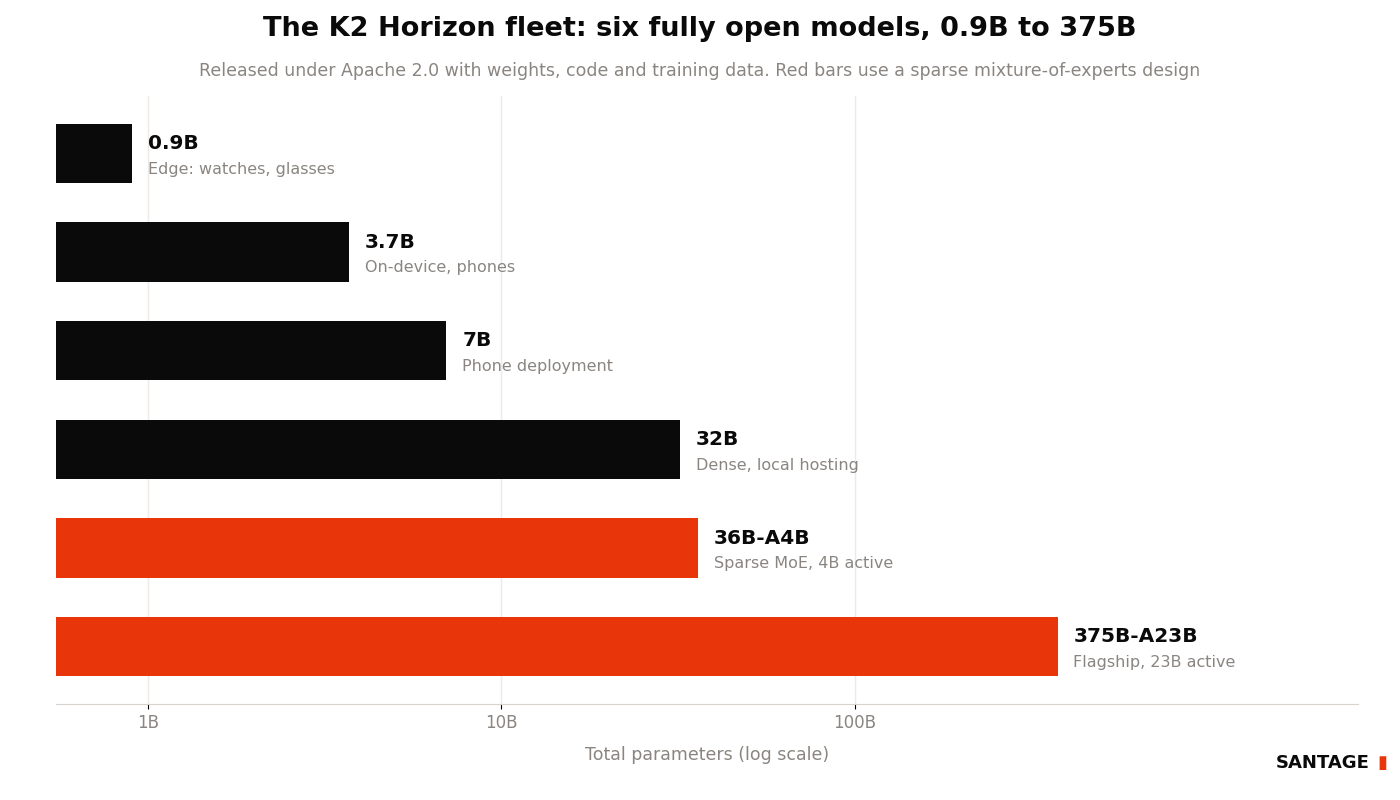
What separates the release from most open launches is how much came with it. IFM published the weights, the training code, the data-construction recipes or training data, checkpoints and evaluation information alongside the final models. That is the difference between shipping a car and shipping the factory that built it, and it is the claim on which IFM is staking the release.
Open source is much more than open weights. Science works when others can see the data, follow the method, reproduce the result, and improve on it.Eric Xing, founder of IFM and president of MBZUAI
Where it sits in the open field
The flagship 375B-A23B model is a reasoning model with a 524,000-token context window, and by activating only 23B of its 375B parameters at inference it aims to run far cheaper than its total size suggests. On the Artificial Analysis Intelligence Index it scores 47, against a median of 29 for open-weight models of similar size. IFM also points to two efficiency techniques, a diffusion-distillation method it says roughly triples generation speed, and a mixture-of-value-attention design meant to sharpen reasoning.
| Models | six, from 0.9B to 375B parameters |
| License | Apache 2.0, with weights, code and training data released |
| Flagship | 375B total, 23B active, 524,000-token context, Intelligence Index 47 |
| Availability | Hugging Face, vLLM and SGLang, with API access through Compass, Cerebras and Nebius |
| Backer | IFM, the research lab of Abu Dhabi's MBZUAI, led by Eric Xing |
The release lands in an open ecosystem that has grown crowded and competitive, from Google's Gemma models passing a billion downloads to a wave of open-weight coding models reaching the frontier and Chinese labs like DeepSeek pushing agentic coding toward commodity pricing. K2 Horizon is the Gulf's bid to compete on openness itself, and by handing over the training data as well as the weights, it sets a higher bar for what other labs will have to call open.
Santage is committed to independent, transparent journalism. This article is produced in accordance with Santage's Editorial Standards and aims to provide accurate and timely information. Readers are encouraged to verify information independently.