
- DeepSeek opened a public beta of its V4 Flash API on July 31, describing significantly enhanced agent capabilities and benchmark results it says far exceed its earlier V4-Pro preview, with coding performance the company puts on par with GPT-5.4.
- The pricing is the weapon. At $0.14 per million input tokens and $0.28 per million output tokens, V4 Flash costs a fraction of the Western budget tier while claiming near-frontier results on coding benchmarks.
- The pressure lands on the one area where US labs have kept pricing power, namely agentic and coding workloads, which burn tokens by the millions and where a tenfold cost gap compounds into real money.
The gap moved up the stack
When DeepSeek open-sourced the V4 family in April, the story was long context and low cost, a capable model that fell just short of the frontier and undercut it on price. The July 31 public beta of V4 Flash reframes that story. DeepSeek is no longer positioning a cheap alternative for simple tasks. It is positioning a coding and agent model it says is comparable to GPT-5.4, the exact workload category where American labs have justified premium pricing.
That distinction matters because agents are where the token economics get brutal. A chatbot answers a question and stops. An agent reads a codebase, plans, calls tools, checks its work, and loops, consuming input and output tokens in volumes an order of magnitude larger. In that setting, the price per million tokens is not a line item. It is the difference between an automation that pencils out and one that does not.
"The V4 Flash model has significantly enhanced agent capabilities, with benchmark results far exceeding V4-Pro-Preview."DeepSeek, on the July 31 public beta release of its V4 Flash API
Why the price is the product
The competitive claim is easiest to see in what a million tokens costs across the budget tier. DeepSeek's V4 Flash sits well below the fast models from Google and Anthropic that enterprises reach for when they want speed and low cost, and it does so while asserting coding parity with a flagship rather than a mini model.
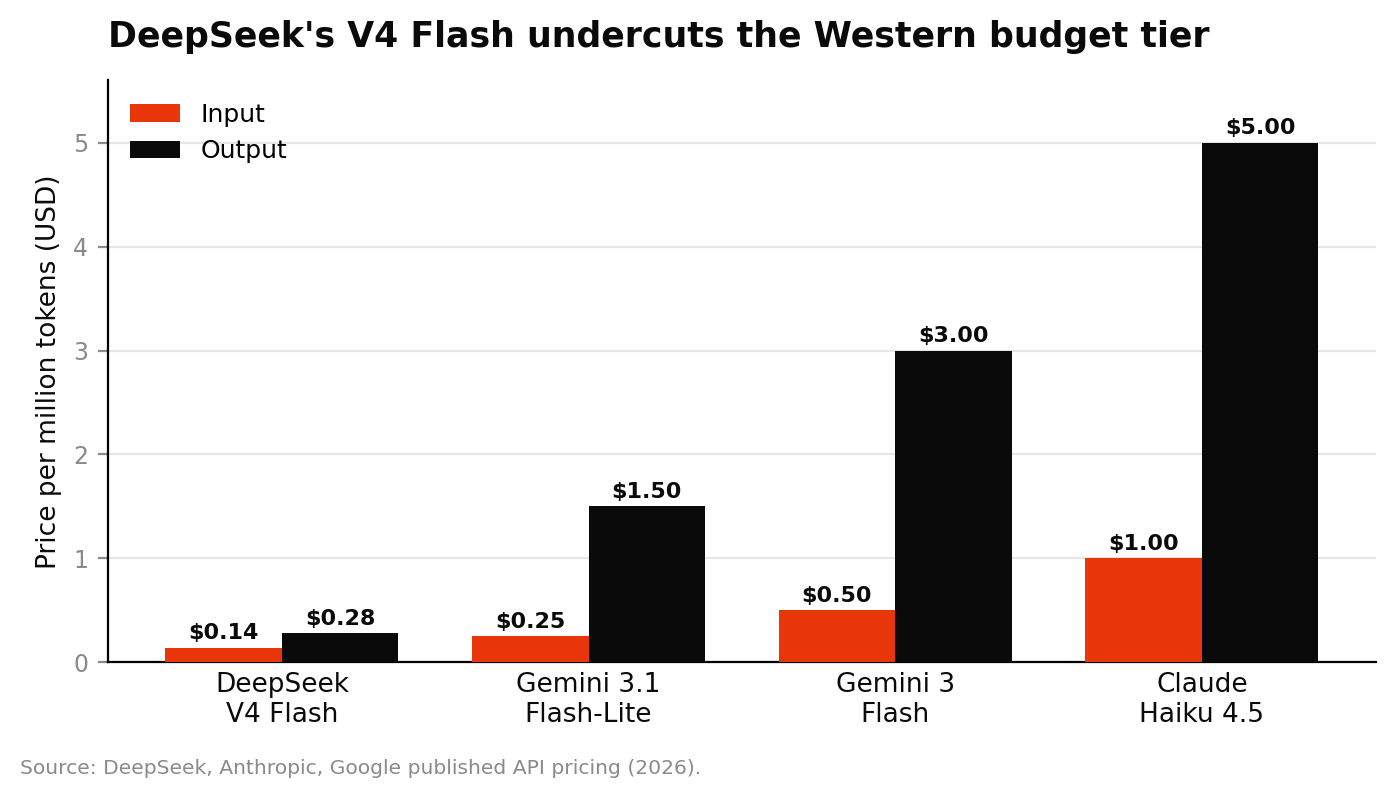
Independent trackers reinforce the point. On LiveCodeBench, DeepSeek's V4 Flash variant is the cheapest model scoring within 10% of the leader, at roughly $0.10 per million input tokens for a score near 0.92. When the cheapest option is also nearly the best on a coding benchmark, the usual tradeoff that lets a premium model justify its price starts to disappear.
| V4 Flash price per million input tokens | $0.14 |
| V4 Flash price per million output tokens | $0.28 |
| Parameters in V4 Pro, largest open-weight model | 1.6 trillion, 49 billion active |
| License on the V4 weights | MIT, commercially permissive |
The moat was never the model, it was the switching cost
US labs have a real defense, and it is not raw capability. It is integration. OpenAI, Anthropic, and Google sell coding into deep ecosystems, developer tools, enterprise agreements, security reviews, and data-residency guarantees that a Chinese lab cannot easily match for a Western buyer. Many enterprises will not route source code or customer data through a DeepSeek endpoint regardless of the price, and that reluctance is the strongest moat the incumbents have.
When the cheapest model is also close to the best on coding, the premium a US lab charges stops being a quality gap and becomes a trust-and-integration tax. That tax can hold for a while. It cannot hold forever.
But open weights route around the endpoint problem. Because V4 is downloadable under an MIT license, a bank or a defense contractor that will not touch a Chinese API can still run the model on its own infrastructure, inside its own security perimeter, at inference costs it controls. The compliance objection that protects the incumbents on the hosted side is exactly the objection open weights are designed to dissolve. The model does not have to travel to China for its economics to reach the West.
What it pressures, and what it does not
None of this dethrones the frontier. The most demanding reasoning, the largest context, and the newest capabilities still surface first in the closed flagships from the American labs, and the buyers who need the absolute best will keep paying for it. DeepSeek is not claiming that ground.
What it is claiming is the vast middle, the agentic and coding workloads that are becoming the highest-volume use of AI in the enterprise and that consume tokens faster than any other. If a Chinese open-weight model can hold coding parity with a US flagship at a tenth of the cost, the incumbents keep the premium tier and lose the argument that their pricing reflects quality everywhere else. The signal from July 31 is not that DeepSeek won. It is that the price floor for good enough coding just dropped again, and this time it reached the workload the US labs most wanted to protect.
Santage is committed to independent, transparent journalism. This article is produced in accordance with Santage's Editorial Standards and aims to provide accurate and timely information. This is market analysis, not investment advice. Readers are encouraged to verify information independently.