
- On September 5, Anthropic reported that Claude formalized Fermat's Last Theorem in the Lean proof assistant, producing the largest Lean proof ever written at roughly 13 million lines of code across about 11 days of largely autonomous work.
- The system did not discover a new proof. It translated Andrew Wiles's 1995 proof into a form a computer can verify line by line, and in doing so proved 29,500 supporting theorems, many formalized for the first time.
- The real signal is a near-term job for AI in mathematics that is less glamorous than cracking open problems and more valuable to the field: checking that long, difficult proofs are actually correct.
What Claude actually did
Anthropic announced on September 5 that Claude had completed the first formalized proof of Fermat's Last Theorem, the claim that no three positive integers a, b and c satisfy an + bn = cn for any integer n greater than 2. The company called it the largest Lean proof ever written.
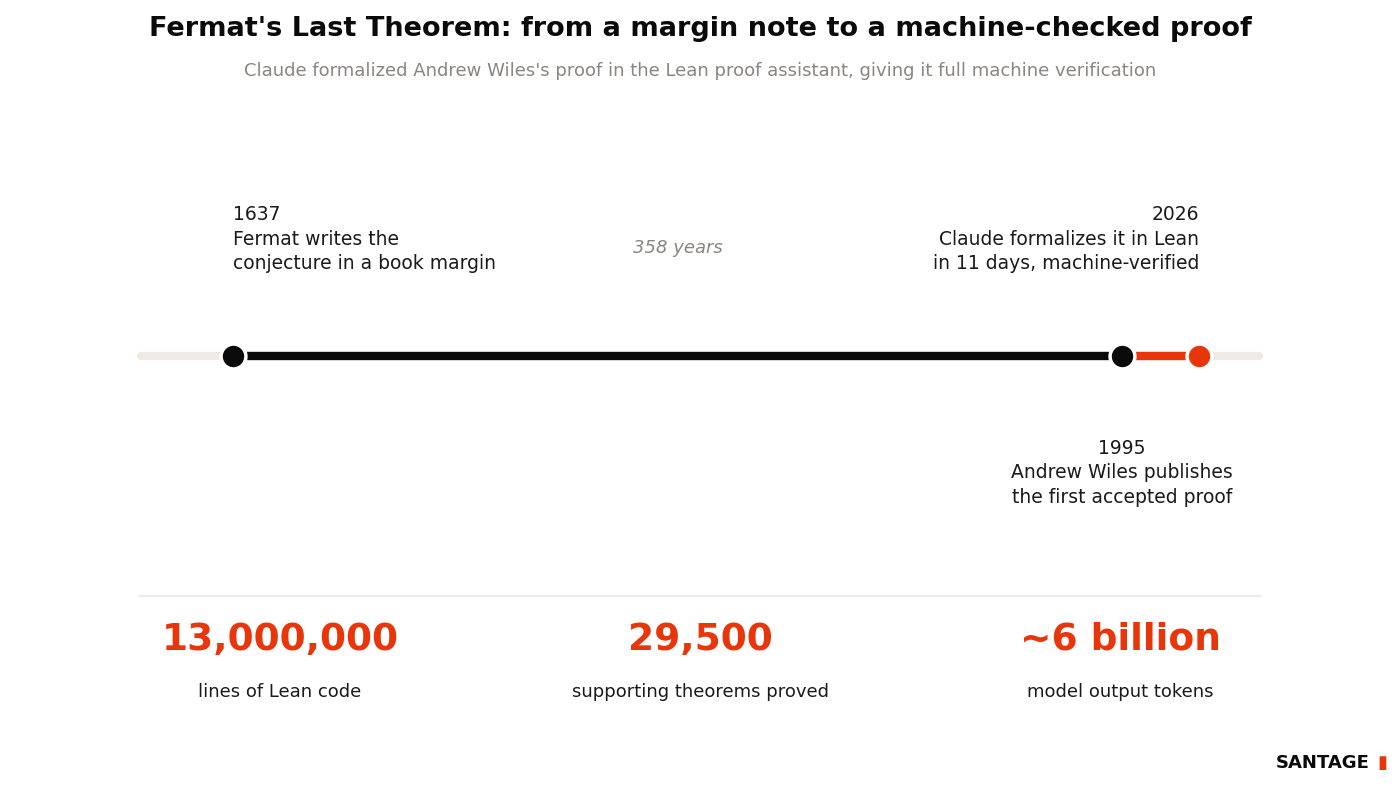
The verb matters, and Anthropic was careful about it. Claude did not sit down and solve Fermat's Last Theorem from scratch. Pierre de Fermat scribbled the conjecture in a book margin in 1637, and it took 358 years and Andrew Wiles to produce an accepted proof in 1995. What Claude did was formalization, or converting that existing human proof into Lean, a language a computer proof assistant can check step by step with no room for a hidden gap. Anthropic said Claude worked from a simplified version of Wiles's proof from the textbook by Darmon, Diamond and Taylor, with only occasional high-level nudges from researchers, such as flagging that treating the Jacobian as a scheme was a priority.
Why the scale is the headline, not the theorem
The individual numbers are what make this a milestone. Anthropic reported roughly 13 million lines of Lean, about 6 billion output tokens, and more than 30,000 theorems generated, of which 29,500 were used in the final proof. Many of those supporting results sit in areas of mathematics that had never been formalized before, which means the effort added machine-checkable foundations well beyond Fermat itself.
| Time | about 11 days of largely autonomous work |
| Output | roughly 13 million lines of Lean, the largest Lean proof on record |
| Theorems | more than 30,000 generated, 29,500 used in the final proof |
| Compute | approximately 6 billion model output tokens |
| Model | an internal research model Anthropic described as roughly comparable to Claude Fable 5.1, run through a Claude Code multi-agent harness |
| Tooling | the Prove2Me platform from Tianyi Peng and Columbia collaborators, tracking a dependency graph of theorem statements so agents could search and reuse results |
This is the part that connects to the rest of Anthropic's year. The same company has been showing Claude doing concrete scientific work, from designing working proteins for 14 of 15 targets to a new model line in Claude Fable 5.1. Formal mathematics is a natural fit for that push, because Lean gives an unforgiving external judge. A proof either compiles or it does not, so there is no way to bluff a result the way a language model can bluff a citation.
This extraordinary autoformalization achievement... proves Fermat's Last Theorem with no assumptions other than the axioms of mathematics.Kevin Buzzard, Imperial College London, who leads the community Fermat's Last Theorem formalization project
What it means, and what it does not
The honest read is that this is a verification breakthrough, not a discovery breakthrough. Claude did not extend the frontier of mathematical knowledge. It compressed years of expected formalization labor into days, and it did so on a proof humans already trusted. That distinction is where the value sits. Wiles's proof runs to more than a hundred dense pages that only a handful of specialists can fully check, and that pattern is common at the top of the field. More proofs are being produced than the community can carefully referee, and a growing share of new mathematics is itself starting to lean on machine assistance.
A proof either compiles or it does not. That is why formal mathematics is the cleanest test of whether an AI system is reasoning correctly, or just sounding correct.
That reframes the near-term opportunity. If a model can take a written proof and turn it into a machine-checked artifact in days, then formalization stops being a career-length project reserved for landmark theorems and starts looking like infrastructure. Journals could ask for a Lean check alongside a submission. Results generated by AI systems could be verified before anyone trusts them, which matters as the same labs push models toward autonomous research and worry openly about outputs that only look right, a concern Anthropic itself raised when it flagged more than 10 percent of its reinforcement learning environments for reward hacking.
There are real limits worth stating plainly. This was one proof, formalized with human guidance, using tooling built specifically for the task, and it consumed enormous compute for a single result. It rests on Lean and Mathlib, the open library that hundreds of mathematicians have built over years, so Claude stood on a very tall human ladder rather than replacing it. None of that shrinks the achievement. It sets the frame for reading the next one. The question for the field is no longer whether AI can formalize hard mathematics. It is how cheap and how routine that verification becomes, and whether the profession decides to trust it.
Santage is committed to independent, transparent journalism. This article is produced in accordance with Santage's Editorial Standards and aims to provide accurate and timely information. Readers are encouraged to verify information independently.