
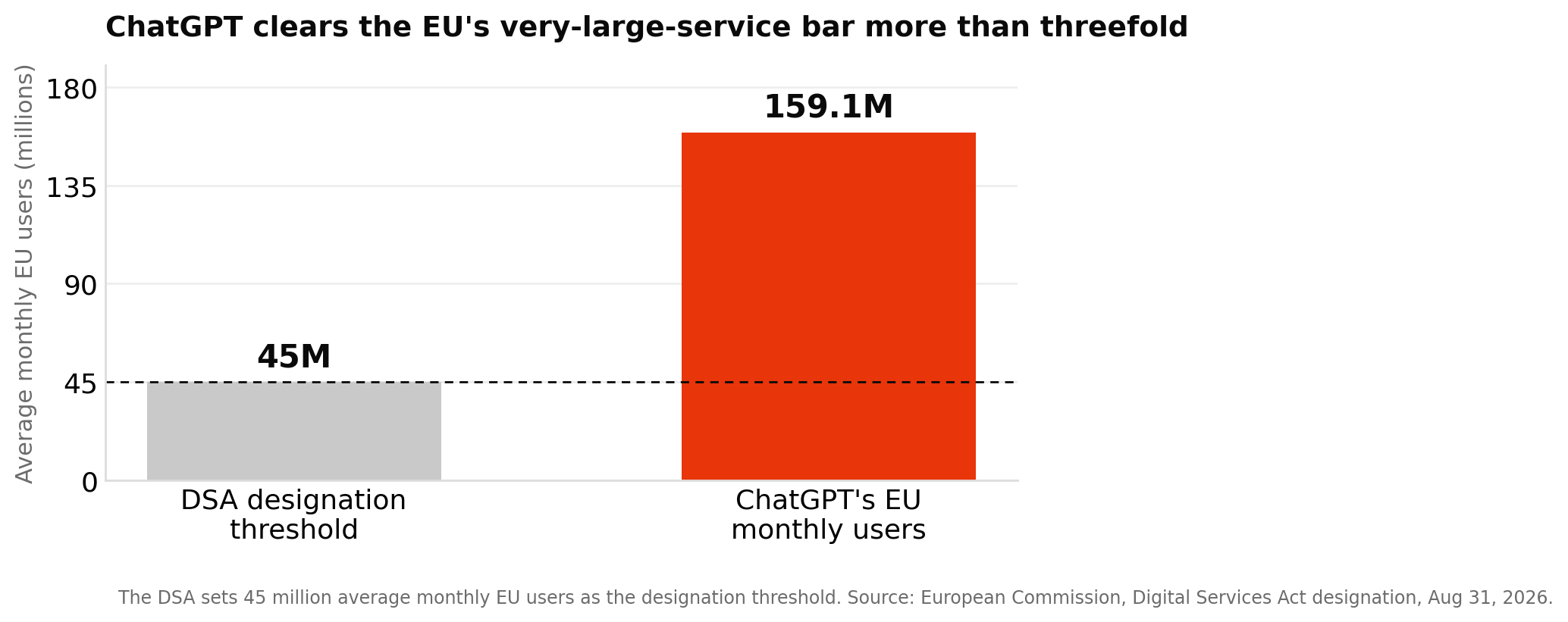
- On August 31 the European Commission designated ChatGPT a Very Large Search Engine under the Digital Services Act, the first AI chatbot to fall under the regime, citing 159.1 million average monthly EU users against a 45 million threshold.
- OpenAI now faces the DSA's strictest tier: annual systemic-risk assessments, independent external audits, a dedicated compliance function, and data access for the Commission and vetted researchers, with duties biting roughly four months after notification, around January 2027.
- The Commission classified ChatGPT by function rather than label, because it retrieves and returns web information, a precedent that reaches every assistant with a browse button.
Europe has decided that ChatGPT is, for regulatory purposes, a Very Large Search Engine. On August 31 the European Commission gave OpenAI's chatbot that label under the Digital Services Act, the first time the bloc has pulled a conversational AI product into a framework built for platforms and search, and the phrase carries the heaviest compliance load in European tech law.
Why Brussels treated a chatbot as a Very Large Search Engine
The designation names ChatGPT a Very Large Online Search Engine, or VLOSE, and the wording is deliberate. Reddit and Roblox received the platform designation, VLOP, on the same day, and the different labels matter. ChatGPT landed in the search category specifically because it can retrieve information from the open web and return online-sourced answers, which is the behavior the DSA defines as a search engine.
That functional test is the heart of the decision. The Commission looked past the "chatbot" description to what the product actually does, and a tool that browses and summarizes the web meets the definition regardless of how it presents its results. Scale did the rest. OpenAI reported 159.1 million average monthly active EU recipients for ChatGPT, more than three times the 45 million users that trigger the very-large designation.
OpenAI did not contest the categorization, a notably cooperative posture for a designation this heavy.
Our search function operates as a search service under the DSA, and we are preparing for the additional requirements.OpenAI, public statement, August 2026
What the strictest tier of the DSA actually requires
The obligations that follow are concrete and recurring, not one-time paperwork. OpenAI must run annual systemic-risk assessments across a wide list of harms, submit to independent external audits every year, and maintain a compliance function with real authority inside the company.
| Risk assessments | annual reviews covering illegal content, fundamental rights, civic discourse, elections, public security, and harms to minors, health, and well-being |
| Independent audits | mandatory yearly external audits, with recommendations implemented or a reasoned explanation for declining |
| Compliance officer | an independent function with adequate authority and resources |
| Data access | information for the Commission and Ireland's Digital Services Coordinator on request, plus vetted-researcher access under confidentiality safeguards |
| Transparency reports | the first due within two months of the compliance start, then every six months |
| Timeline | obligations take effect roughly four months after notification, which official pages place around January 2027 |
The researcher-access provision is the one that should worry OpenAI most, because it opens the model's design choices to outside scrutiny in a way the company has resisted everywhere else. A large language model that must hand vetted academics documentation of how it ranks, retrieves, and filters information is operating under a transparency regime that no US law currently imposes.
The precedent most coverage is underplaying
The label that matters is not "chatbot" or "Very Large Search Engine." It is whether a system shapes what tens of millions of people believe they have found on the web, and Brussels has decided that question belongs to it.
The reason this designation reaches well beyond one company sits in that functional test. Any assistant that can browse the web and return sourced answers now has a template for how Brussels will treat it once it crosses 45 million EU users. Google's Gemini, Microsoft's Copilot, and Perplexity all fit the same functional description, and the Commission has just shown it will apply the search-engine label to a product the industry calls something else.
The move also stacks a second European regime on top of the AI Act. The AI Act's transparency rules went live earlier this month, and now the DSA's platform machinery applies to the same product, with its own audits, risk assessments, and regulator relationships. The systemic-risk categories around minors and well-being connect directly to the debate OpenAI opened with its own teen age-gating in August, except that compliance is no longer voluntary.
What this means for every AI company serving EU users
For the majors, the practical question is no longer whether conversational AI will be regulated as core internet infrastructure in Europe, but how quickly they can build the audit trails, transparency reports, and compliance teams the DSA demands. Those are expensive functions that favor the largest incumbents, the same dynamic that has shaped Europe's push for sovereign alternatives to US models.
The designation is a regulatory classification, not a finding that ChatGPT has done anything wrong. Its significance is structural. Europe has decided that a chatbot which answers questions from the web carries the same societal weight as a search engine, and it has reached for the toughest tool in its regulatory kit to say so. Every company building an assistant that browses the internet should read the January 2027 deadline as its own.
Santage is committed to independent, transparent journalism. This article is produced in accordance with Santage's Editorial Standards and aims to provide accurate and timely information. A DSA designation is a regulatory classification and not a finding of wrongdoing. Readers are encouraged to verify information independently.