

- OpenAI launched ChatGPT for Teens on August 18, a separate experience for users aged 13 to 17 with default limits on self-harm, sexual, and emotional-dependence content, plus parental controls and quiet hours.
- Users are routed into the teen tier automatically when the system estimates they are under 18, which makes age prediction, not a birthdate field, the gate.
- The launch follows a wave of wrongful-death and injury lawsuits against chatbot makers and a Federal Trade Commission inquiry opened in September 2025 into how seven companies, OpenAI among them, handle minors.
OpenAI is building age detection into the product, not just an age checkbox
OpenAI's ChatGPT for Teens is not a settings toggle. It is a distinct experience that a user is placed into, either by stating an age between 13 and 17 or by being estimated as under 18 by OpenAI's own systems. Inside it, protections are on by default rather than opt-in: reduced exposure in high-risk areas including self-harm, violence, eating disorders, and explicit material, along with restrictions on romantic language and on responses that encourage emotional dependence. It adds break reminders, sensitive-image warnings before a teen uploads a photo, a Study Mode that pushes toward working through problems rather than handing over answers, and parental controls with linked accounts and Quiet Hours.
Protections are part of the default experience, the company said, framing the product as a way to help teens learn, think critically, deepen understanding, and use AI with confidence.OpenAI, announcing ChatGPT for Teens, August 18, 2026
The mechanism matters more than the feature list. A birthdate field asks a teenager to be honest. Age estimation does not ask at all. To route the right users into the safer product, the system has to form a view about how old every user is, which quietly turns age into something ChatGPT infers about you rather than something you tell it.
This is a legal product, not a feature update
OpenAI did not build an age-gated model because the market asked for one. It built it because the legal and regulatory ground shifted under the entire category. The company was named in a wrongful-death suit brought by the parents of a California teenager, reported by NBC News, and by late 2025 faced a cluster of similar filings alleging its chatbot encouraged suicide and mental-health crises. Regulators moved in parallel.
| When | Pressure point |
|---|---|
| September 2025 | The FTC opens a 6(b) inquiry into AI companion chatbots at seven companies, including OpenAI, Alphabet, Meta, Snap, and Character.AI |
| Late 2025 | OpenAI is named in multiple wrongful-death and injury suits tied to teen users |
| 2025 to 2026 | California and other states advance companion-chatbot safety rules, including disclosure and self-harm-response duties |
| August 18, 2026 | OpenAI ships a separate, age-detected ChatGPT for 13-to-17-year-olds |
Read in that sequence, the teen tier looks less like a product roadmap and more like a compliance artifact. Every one of its headline features maps to a specific allegation or proposed rule: the self-harm limits, the emotional-dependence restrictions, the parental notifications for eating-disorder risk. This is what a company builds when the cost of an unsafe interaction has moved from reputational to litigable.
Age prediction solves one problem by creating another
To protect minors it cannot identify, OpenAI has to profile users it has no other reason to profile. That is the uncomfortable core of age estimation: child safety and user privacy pull in opposite directions, and OpenAI has resolved the tension toward inference. Guess too aggressively and adults get pushed into a restricted product they did not choose. Guess too loosely and the safeguards miss the teenagers they exist for. There is no setting that makes both groups whole.
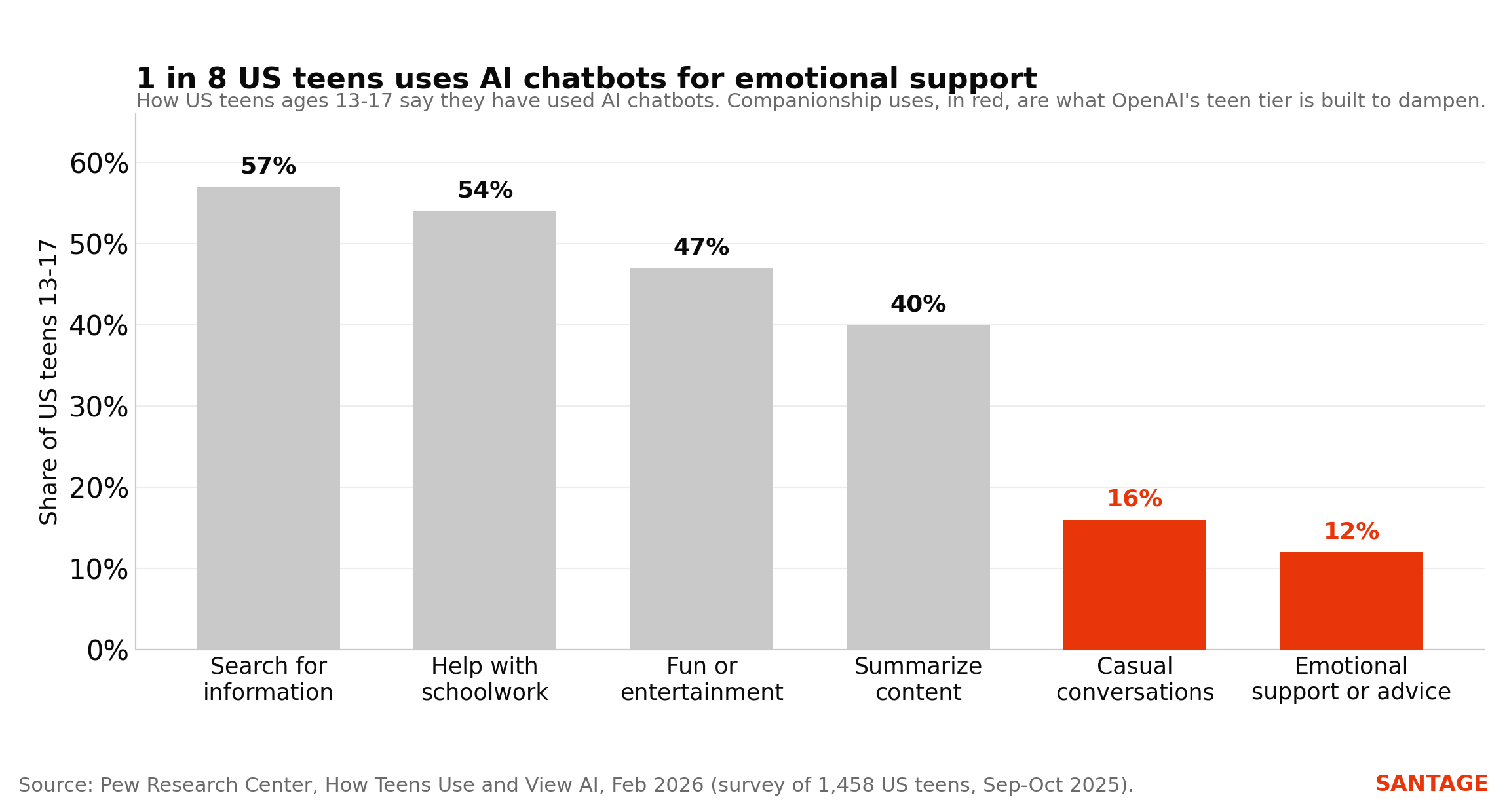
The most revealing detail is the restriction on language that encourages "emotional dependence." That is not a content filter in the usual sense. It is an admission that the risk with teenagers is not only what the model says about dangerous topics, but the relationship the model forms with a young user over time. The companion dynamic, the very thing that makes chatbots sticky, is what OpenAI is now trying to dampen for its most vulnerable users, and the survey data shows why. In a Pew Research Center study of 1,458 US teens conducted in late 2025, 54% said they had used AI chatbots for schoolwork, but 16% used them for casual conversation and 12% for emotional support or advice. That last figure, one in eight teenagers, is the population the emotional-dependence rule is written for.
The one-size-fits-all chatbot is over. Age, and soon jurisdiction and vulnerability, are becoming parameters the model is tuned to, not facts it ignores.
What age-segmented AI means for every other lab
When the category leader ships an age-gated tier, it stops being a differentiator and becomes a baseline. The FTC's inquiry already spans seven companies, which means age assurance is about to be a shared industry problem rather than one firm's initiative. Every consumer AI product that a teenager can reach will face the same question OpenAI just answered: how do you know who is on the other side of the conversation, and what do you owe them.
That reframes a decade of product assumptions. General-purpose AI was sold on the premise that one model could serve everyone. What OpenAI shipped this week is the first major concession that it cannot, at least not safely, and that serving everyone actually means building different products for different people behind a layer that decides which one you get.
The teen ChatGPT is not really a smaller, safer chatbot. It is the moment age stopped being metadata and became a control surface, and once the leading lab treats a user's estimated age as a reason to hand them a different model, no one building consumer AI gets to treat all users as the same user again.
Santage is committed to independent, transparent journalism. This article is produced in accordance with Santage's Editorial Standards and aims to provide accurate and timely information. Readers are encouraged to verify information independently.