

- Taiwan indicted nine people, including a Nvidia Taiwan sales manager and two Super Micro managers, over the diversion of 74 Nvidia B300 AI servers to China out of a single 130 unit order.
- Prosecutors say the group cleared the export by presenting a fake local lease, then routed shipments through Indonesia, Japan, and Hong Kong to hide the destination, booking about 21.2 million dollars in profit.
- The defendants face up to five years in prison for export violations and up to six years on related looting charges, in the first case to reach insiders at both a chipmaker and a server builder.
Nine face charges after 74 of 130 B300 servers reached China
Taiwan's Keelung District Prosecutors' Office has charged nine people over a scheme that moved Nvidia's most advanced B300 AI servers into China despite export restrictions, according to Bloomberg, which reviewed the indictment. Those named include a Nvidia Taiwan sales manager accused of pushing the order through the company's approval quota, two Super Micro managers, the general manager of listed distributor Albatron Technology, and representatives of a buyer called Flying Tiger Tech.
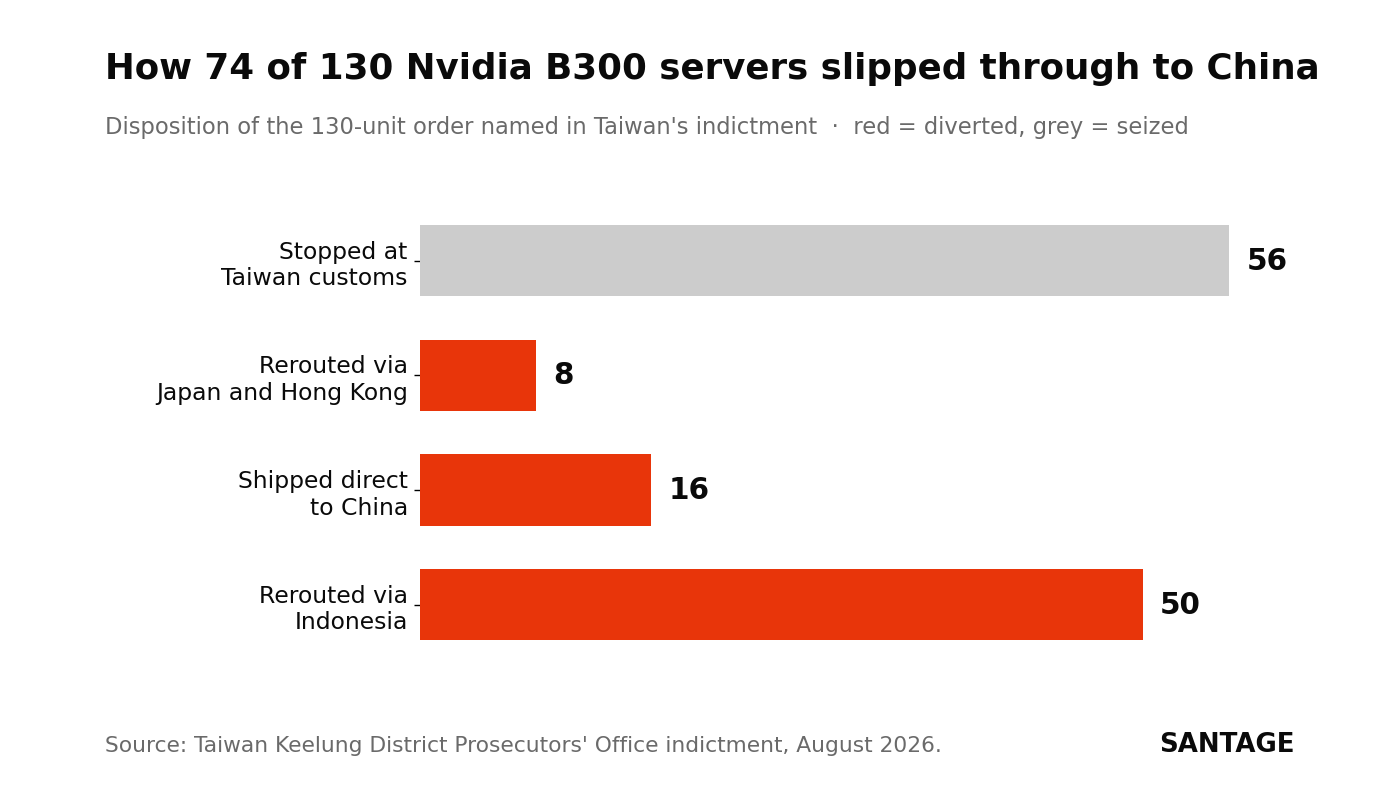
The order covered 130 B300 servers. Prosecutors say 74 of them were diverted before the remaining 56 were stopped after being declared to Japanese customs and flagged. The buyer obtained whitelist status to place the order, then presented a fake lease quotation in place of a genuine colocation agreement, and passed an inspection at a site that could not physically hold 130 servers.
| 9 indicted | including insiders at Nvidia and Super Micro's Taiwan units |
| 74 of 130 | B300 servers diverted before the rest were seized at customs |
| $21.2M | profit prosecutors attribute to the diversion scheme |
Once cleared, the machines took deliberately indirect paths. Sixteen units went straight to China in January 2026, fifty were sent to Indonesia and transshipped onward, and eight moved through a Japan controlled entity before reaching Hong Kong and the mainland.
Why the case moves the export fight inside the supply chain
For two years, export enforcement has focused on the buyers at the end of the chain, the shell companies and gray market brokers that resurface under new names. This indictment points somewhere else. It names the people with legitimate access, the sales manager who controls the quota and the account staff who sign off on a destination, and it treats their approvals as the point where the control actually failed.
Super Micro said its senior management had no knowledge of the diversion and that it has seen no evidence restricted products reached banned entities. Whatever the outcome for individual defendants, the mechanism prosecutors describe is the uncomfortable part for the industry. Whitelist status, the tool meant to speed shipments to trusted customers, became the cover that made the diversion possible.
Export rules assume that the hard problem is spotting a bad buyer. Taiwan's prosecutors are arguing the opposite, that the system can be turned by the people inside it who are trusted to run it. If that argument holds in court, every chipmaker and server builder selling into the region will have to treat its own sales approvals as a compliance surface, not just a sales one.
Santage is committed to independent, transparent journalism. This article is produced in accordance with Santage's Editorial Standards and aims to provide accurate and timely information. Readers are encouraged to verify information independently.