

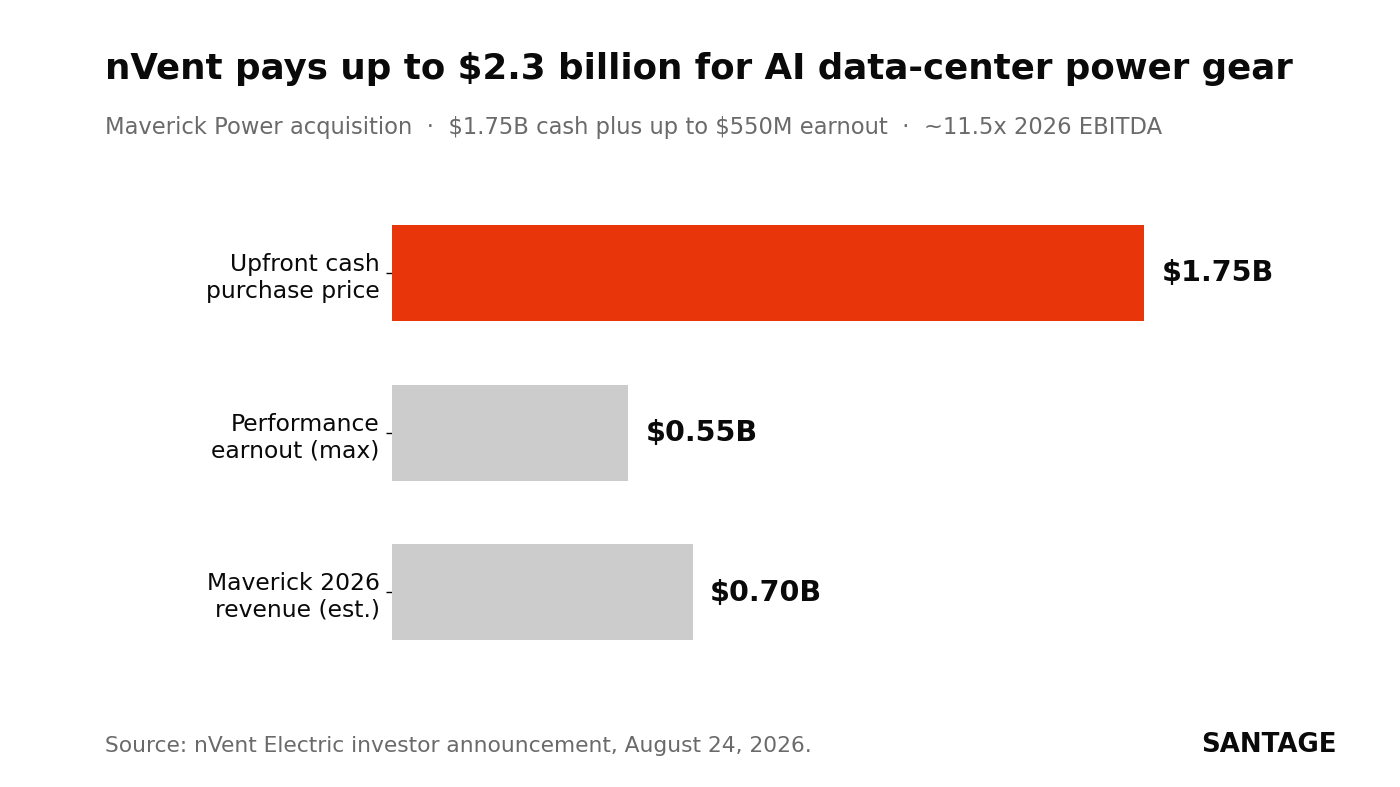
- nVent agreed to buy Maverick Power for 1.75 billion dollars in cash, plus performance earnouts of up to 550 million dollars tied to 2027 and 2028 results, a total that can reach 2.3 billion.
- The price works out to about 11.5 times Maverick's expected 2026 adjusted earnings, and roughly 2.5 times its estimated 700 million dollars of 2026 revenue, a rich multiple for an electrical equipment maker.
- Maverick's roughly 900 employees across Texas and Arizona build the low and medium voltage switchgear that stands between the power grid and the server, the layer AI data centers now compete hardest to secure.
nVent buys the box between the grid and the rack
The AI capital story is usually told through chips, models, and the multi gigawatt data centers that house them. nVent has just paid a frontier price for something far less visible. The industrial supplier agreed to acquire Maverick Power, a McKinney, Texas maker of switchgear and switchboards, for 1.75 billion dollars in cash, with up to 550 million dollars more contingent on performance through 2028, according to the company's announcement. The deal is expected to close in the fourth quarter of 2026, subject to regulatory approval, and nVent expects it to add to adjusted earnings per share in the first year.
Switchgear is the equipment that takes high voltage power from the grid and distributes it safely to everything downstream. In a data center it is the unglamorous middle layer, and for the past two years it has also been one of the hardest components to buy on any reasonable timeline.
Maverick Power is a great fit for nVent and aligns with our strategy to focus on the high-growth infrastructure vertical.Beth Wozniak, Chief Executive, nVent. Source: nVent Electric investor announcement
Why switchgear became an AI bottleneck
For most of the buildout, the scarce inputs were accelerators and, more recently, the high bandwidth memory stacked beside them. Power was treated as a site selection problem, something you solved by picking the right region and signing a utility contract. That assumption broke as data centers scaled past the capacity of a single substation and operators discovered that the electrical gear inside the building had lead times measured in quarters, not weeks.
A hyperscale AI campus needs a dense chain of transformers, switchboards, and protection equipment to move power from the property line to tens of thousands of racks without a fault taking the site down. Every gigawatt of new AI capacity pulls a proportional amount of this gear, and unlike a chip order it cannot be air freighted or reallocated quickly. The binding constraint on AI is quietly migrating down the stack, from the accelerator, to the memory beside it, and now to the switchgear that feeds the whole rack.
The reason the shortage does not clear quickly is that switchgear cannot be rushed the way a consumer product can. Each unit is engineered to a specific site, built around long lead castings and copper, tested to safety standards, and certified before it can be energized. Adding a factory line means hiring and training skilled electrical assemblers, a workforce that is itself scarce. None of that responds to a spike in demand within a quarter, which is why the capacity that already exists commands a premium and why owning it outright is worth more to a buyer than waiting to build it.
nVent is not guessing at this demand. It is paying a multiple that only makes sense if switchgear orders stay elevated for years, and it is funding the purchase with a mix of cash and new debt rather than stock, a sign of conviction that the earnings will be there to service it. By tying up to 550 million dollars of the price to results through 2028, it is also betting that Maverick's order book keeps growing well past the close, and it has arranged the deal so that the sellers share that bet rather than cashing out at the top.
| $2.3B | total potential price including the maximum performance earnout |
| ~11.5x | multiple of Maverick's expected 2026 adjusted EBITDA |
| ~$700M | Maverick's estimated 2026 revenue, up sharply on AI demand |
What an 11.5 times multiple on power gear signals
Electrical equipment makers have historically traded and transacted at modest multiples, because the business is cyclical and tied to construction. Paying more than 11 times earnings for one marks a change in how the market values this category. It says buyers now expect switchgear demand to behave less like a construction cycle and more like a secular buildout, closer to the way investors treat the semiconductor supply chain than the way they treat industrial distribution. What nVent gains is less a product line than a position, certified capacity, an installed base of data center customers, and a Texas and Arizona footprint next to the fastest growing cluster of AI construction in the country.
That is the part of this deal worth watching for anyone allocating capital. The most reliable way to earn from an infrastructure boom is rarely the headline layer, where competition and price pressure concentrate, but the boring, capacity constrained component that every project needs and few can supply. nVent has decided that in the AI buildout, that component is the switchgear, and it has paid a price that dares the rest of the industrial sector to disagree.
Santage is committed to independent, transparent journalism. This article is produced in accordance with Santage's Editorial Standards and aims to provide accurate and timely information. Readers are encouraged to verify information independently.