

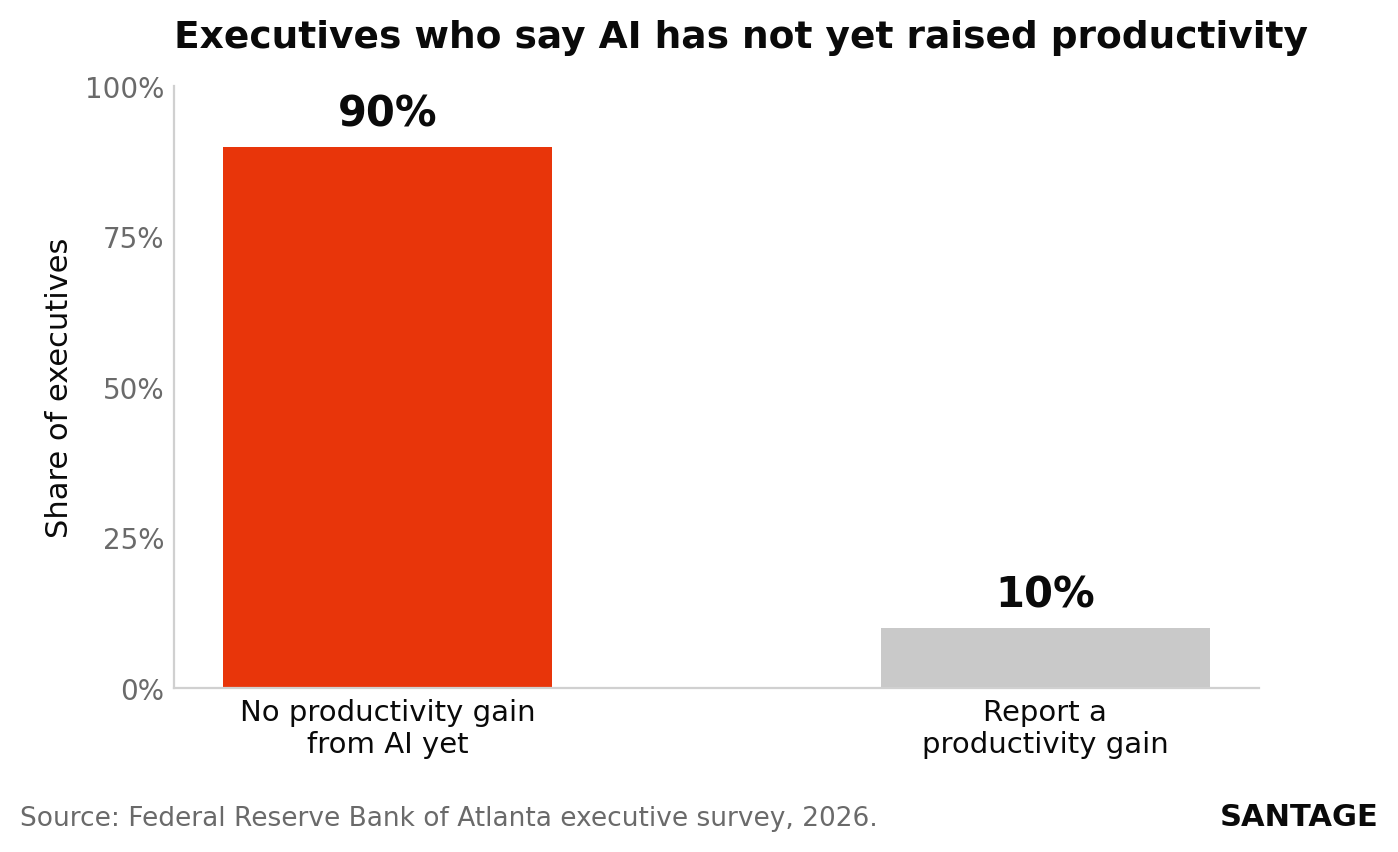
- About 90 percent of corporate executives told the Federal Reserve Bank of Atlanta that AI has not yet raised productivity at their companies, even after more than half of firms have already invested in it.
- A study of hundreds of US public companies found that firms announcing more AI investment also announce more layoffs, and that the average stock market reaction to those AI-linked job cuts was close to zero, negative or flat in more than half of cases.
- Management optimism about AI on earnings calls showed no statistically significant link to actual productivity, which means the confidence priced into the buildout is not yet backed by measured output.
The gap between what AI costs and what it has returned
The defining number in enterprise AI right now is not a benchmark score or a funding round. It is 90 percent, the share of executives who told the Federal Reserve Bank of Atlanta that artificial intelligence has not yet improved productivity at their own companies. That figure lands at a strange moment, because the same executives are presiding over the largest sustained capital investment in the technology's history, with the biggest platforms committing hundreds of billions of dollars a year to AI infrastructure. The spending is real and rising. The measured return, so far, is not showing up.
This is not a story about AI failing. Adoption is broad, more than half of firms have already put money into it, and pockets of genuine gain exist in high-skill services and finance. It is a story about timing and evidence. The capital is being deployed now, at scale, against a productivity payoff that remains, in the aggregate, a forecast rather than a fact. For an investor or a board, the distance between those two things is the entire question.
Why the layoffs are the tell, not the productivity numbers
The productivity data alone could be dismissed as early. Transformative technologies take years to show up in output statistics, a lag economists have watched since the electric motor and the personal computer. What makes the current moment different is the behavior sitting on top of the missing gains. A separate analysis of corporate AI announcements across hundreds of US public companies found that the firms announcing the most AI investment are also announcing the most layoffs, treating headcount reduction as part of the AI plan rather than a result of proven efficiency.
The market has noticed. The average share-price reaction to those AI-linked layoff announcements was close to zero, and in more than half of cases it was negative or flat. Investors, in other words, are no longer rewarding a company simply for pairing the words AI and efficiency in a press release. The reflexive bump that such announcements once produced has largely disappeared, which is the clearest sign yet that the market is starting to ask for evidence rather than intent.
| ~90% | of executives say AI has not yet raised productivity at their company |
| ~0% | average stock reaction to AI-linked layoff announcements |
| 50%+ | of those announcements met with a negative or flat market reaction |
| Measure across US public companies, 2026 | What the data shows |
|---|---|
| Executives reporting an AI productivity gain | About 1 in 10 |
| Average stock reaction to AI-linked layoff announcements | Close to zero |
| Those announcements met with a negative or flat reaction | More than half |
| Link between earnings-call AI optimism and measured productivity | Not statistically significant |
Sources: Federal Reserve Bank of Atlanta; analysis of corporate AI announcements, 2026.
The second-order cost most coverage is missing
There is a quieter finding underneath the headline number, and it is the one with the longest tail. Employee sentiment about AI, measured across public workplace reviews, runs markedly more negative than the overall tone of those reviews, and it falls sharply after a company announces AI-related cuts. Job security is the dominant worry. That matters for productivity in a direct, mechanical way: a workforce that reads every AI investment as a threat to its own jobs has little reason to help the technology succeed, and every reason to withhold the informal knowledge that makes any tool useful.
A company that announces AI to cut its workforce is teaching that workforce to resist the very tool it just bought. The productivity it expected can be canceled out by the fear it created.
This is the mechanism that can turn a productivity lag into a productivity trap. The gains from AI depend heavily on the people expected to work alongside it, and cutting jobs to fund the technology can poison exactly the cooperation the technology needs. The firms treating AI purely as a cost-reduction lever may be undermining the returns they are counting on, while the ones that see the smallest sentiment damage tend to be those framing AI as augmentation rather than replacement.
What separates the winners in the next phase
For anyone allocating capital, the signal in this data is not that AI is overhyped. It is that the returns are going to be distributed far more unevenly than the uniform capital spending suggests. The companies that convert AI investment into measured productivity, rather than into layoff announcements the market has stopped applauding, will be a minority, and they will be identifiable by evidence rather than by the confidence of their earnings calls. The next phase of the AI trade will reward the firms that can show the gain, not the ones that can only promise it.
The productivity paradox is not proof that the machines do not work. It is proof that buying them is the easy part. The value was never in the model or the capital behind it. It is in the far harder work of rebuilding how a company operates around the technology, and that is the work most of the spending has not yet touched.
Santage is committed to independent, transparent journalism. This article is produced in accordance with Santage's Editorial Standards and aims to provide accurate and timely information. Readers are encouraged to verify information independently.