

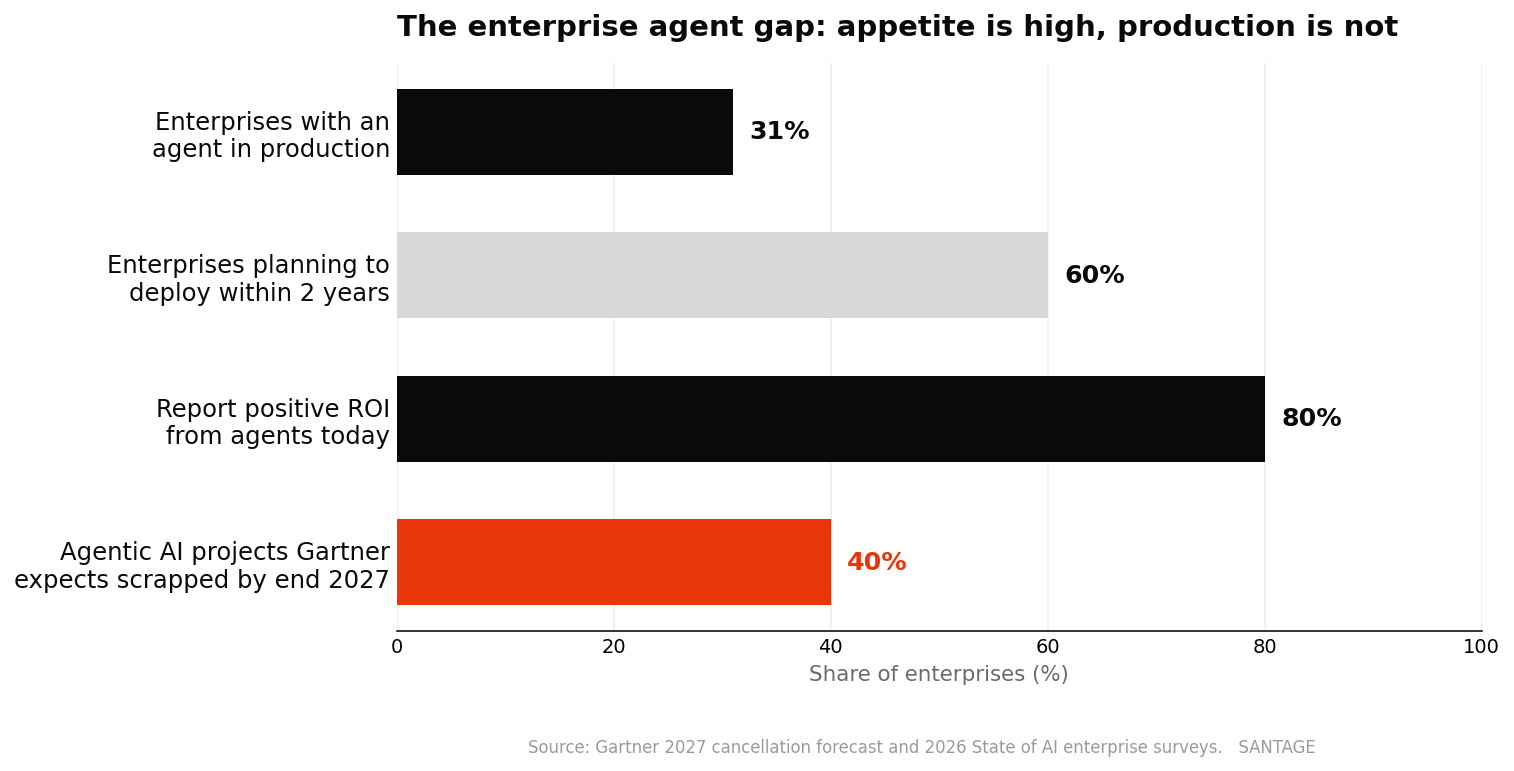
- Gartner expects more than 40% of agentic AI projects to be canceled by the end of 2027, citing escalating cost, unclear business value, and inadequate risk controls.
- Roughly 31% of enterprises have an agent in production while about 60% plan to deploy within two years, a gap that measures organizational readiness, not model quality.
- Of thousands of vendors marketing agentic products, Gartner estimates only around 130 are real, meaning much of the reported failure rate sits on top of tools that were never agents.
Gartner expects more than 40% of agent projects scrapped by 2027
The most repeated number in enterprise AI this year is a failure forecast. Gartner projects that over 40% of agentic AI projects will be canceled by the end of 2027. It is tempting to read that as a verdict on the technology. It is the opposite. Every cause Gartner names sits on the buyer's side of the table, not the model's.
The models can do the work. Frontier systems from multiple labs now write production code, run multi-step research, and operate software through tool calls. What stalls is everything around the model: the cost of running an agent at scale, the difficulty of proving business value, and the absence of controls that let a risk officer sign off. The constraint has moved from the model to the organization that has to hold it.
The three failure modes are all governance, not capability
Look closely at the picture the data draws. A large majority of enterprises intend to deploy agents, and among those that have, roughly four in five report positive return. Yet only about a third are actually running one in production, and a large share of projects will be abandoned before they get there. A technology that both delivers ROI where it lands and gets canceled at high rates is not failing on merit. It is failing on management.
Gartner's own framing makes the point directly.
"Most agentic AI projects right now are early stage experiments or proof of concepts that are mostly driven by hype and are often misapplied."Gartner, "Over 40% of Agentic AI Projects Will Be Canceled by End of 2027"
Misapplication, hype, and unclear value are scoping problems. Escalating cost is a governance problem, the kind that appears when a team ships an agent without spend caps or usage visibility and discovers the bill three weeks later. Inadequate risk control is a governance problem too. None of the three is a statement about whether the underlying model is capable. They are statements about whether the buyer built the guardrails before switching the agent on.
Agent-washing inflated the denominator
There is a second distortion in the failure number that most coverage skips. A large fraction of the projects counted were never running agents in the first place. Gartner estimates that of the thousands of vendors marketing agentic AI, only about 130 offer products with genuine agentic capability. The rest is what analysts have started calling agent-washing: assistants and chatbots relabeled as agents to catch budget.
| Agentic AI projects expected to be canceled by end of 2027 | More than 40% (Gartner) |
| Self-described agentic vendors judged to be real | About 130 of thousands (Gartner) |
| Enterprises with an agent in production | Roughly 31% |
| Enterprises planning to deploy within two years | About 60% |
| Deployed agents reporting positive ROI | Around 80%, median time-to-value near five months |
When the denominator is padded with tools that cannot plan, act, or recover from error, a high cancellation rate is arithmetically guaranteed. Strip the rebadged chatbots out and the story changes from "agents do not work" to "most things sold as agents were not agents." The genuine deployments, the ones built on real planning and tool use, are the same cohort posting the positive-ROI numbers.
What separates the projects that ship
The projects that reach production share a pattern, and it is not a better model. They start with a narrow, measurable task rather than a general-purpose assistant. They instrument cost from day one so finance can see spend per team before it compounds. They put a human approval step where the agent touches money, customers, or production systems. And they run the agent close to the data it needs rather than shipping sensitive material to an external runtime.
That pattern explains why the frontier labs are now competing on control surfaces as hard as they compete on benchmarks. Spend caps, model-level entitlements, usage analytics, and on-premise execution are not compliance chores bolted onto the product. They are the features that decide whether a project survives the risk review and the budget review that kill it. The labs treating governance as a first-class product are selling the exact thing the 40% cancellation rate says buyers are missing.
The lesson of the coming cancellation wave is not that agentic AI was oversold. It is that capability arrived before the discipline to hold it. The enterprises that win the next two years will not be the ones with the best model, because everyone will have that. They will be the ones that learned to scope, meter, and govern an agent before turning it loose.
Santage is committed to independent, transparent journalism. This article is produced in accordance with Santage's Editorial Standards and aims to provide accurate and timely information. Readers are encouraged to verify information independently.