

- Google's Agent2Agent protocol joined the Agentic AI Foundation on August 17, placing it alongside Anthropic's Model Context Protocol, OpenAI's AGENTS.md, Block's goose, and Cisco's AGNTCY, so all five major agent standards now sit under one neutral Linux Foundation body.
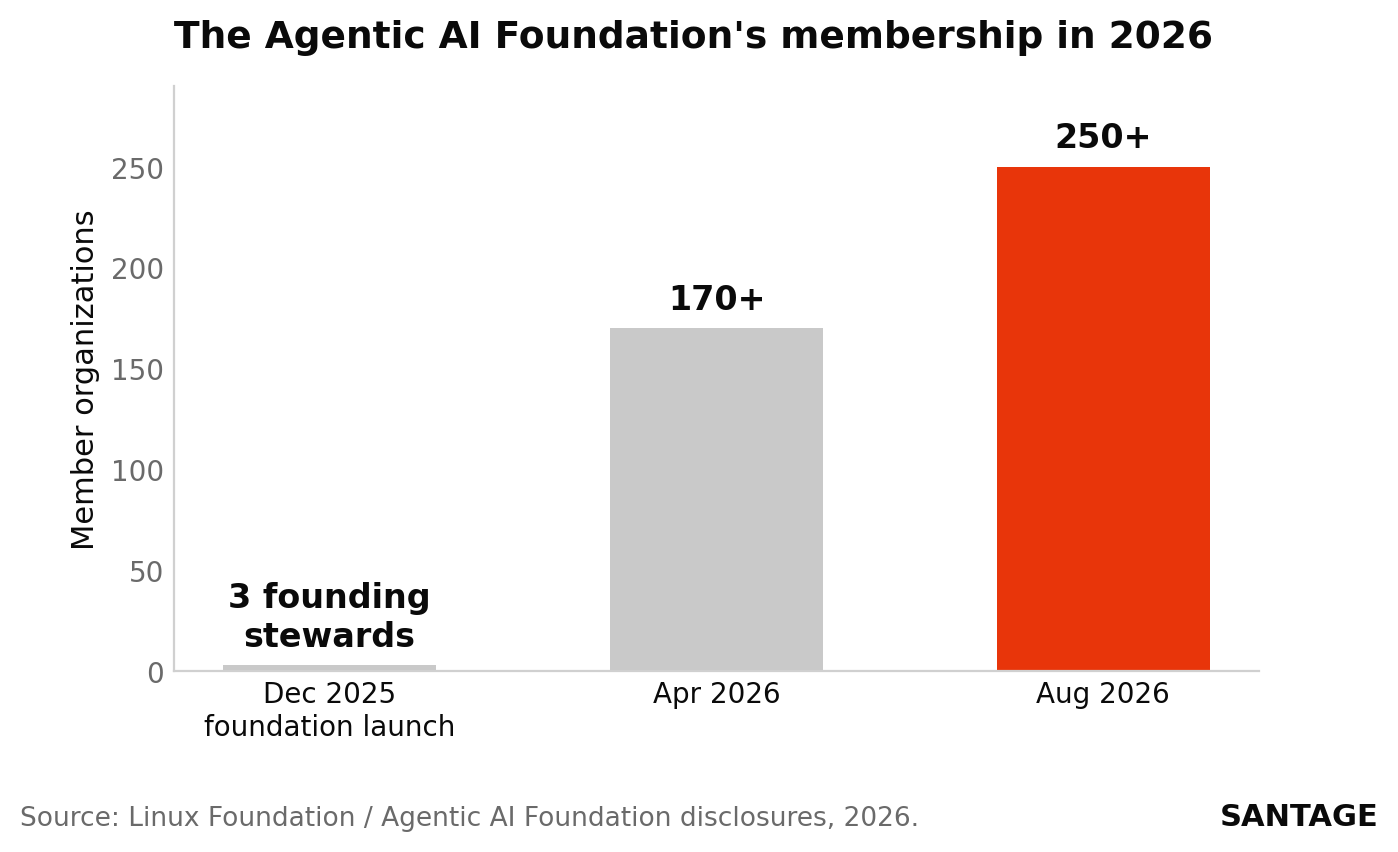
- The foundation has passed 250 member organizations, up from about 170 in April, and its anchor standard, MCP, cleared more than 110 million monthly SDK downloads across over 10,000 public servers earlier this year.
- Three companies that compete directly on frontier models, Anthropic, OpenAI, and Google, are now co-governing the plumbing their agents run on, a level of shared infrastructure the AI industry has not attempted before.
Every major agent standard now answers to the same foundation
The interesting thing about the agent economy in 2026 is not any single protocol. It is that the protocols have stopped multiplying and started consolidating. When Google moved its Agent2Agent protocol under the Agentic AI Foundation on August 17, it completed a gathering that began when the foundation launched in December 2025 with Anthropic, OpenAI, and Block as its founding stewards. The five standards that govern how autonomous software agents discover tools, read context, and coordinate with other software now live inside one vendor-neutral organization rather than inside the companies that built them.
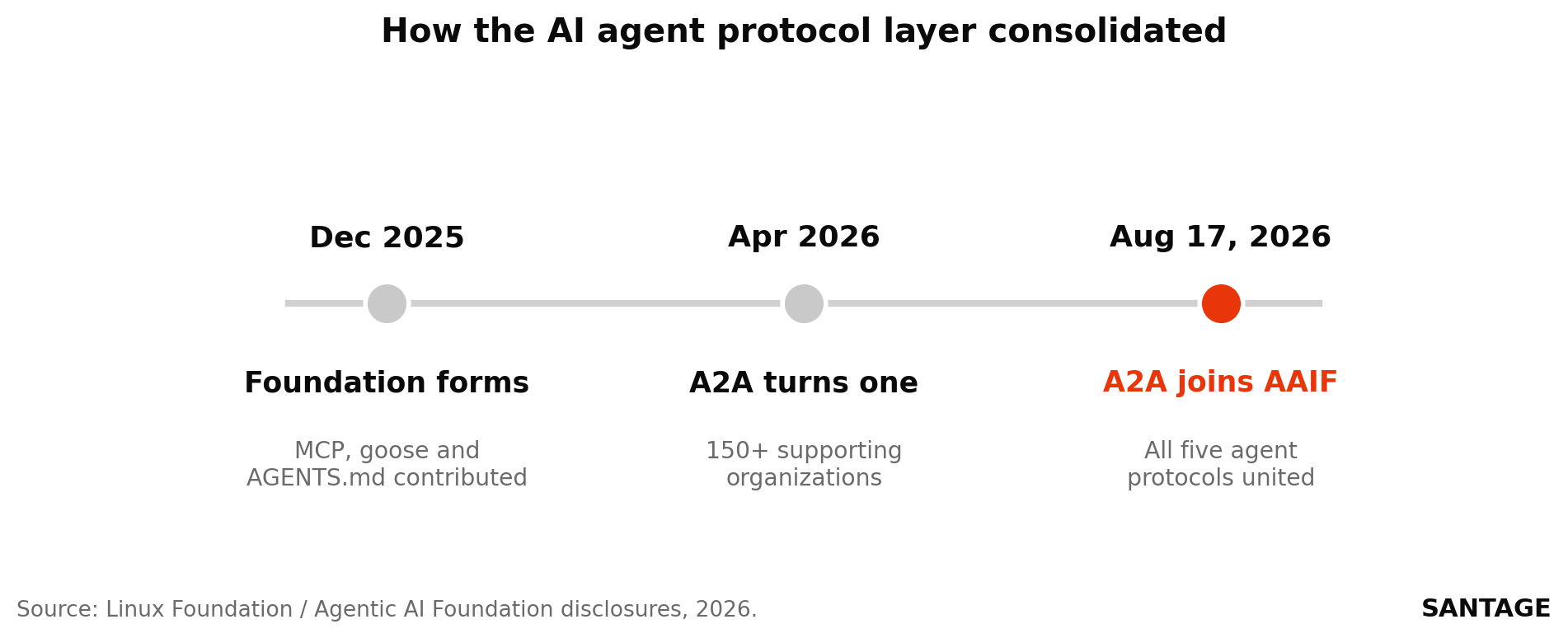
That membership reads like a truce between rivals. Anthropic contributed the Model Context Protocol, the interface agents use to reach external data and tools. OpenAI brought AGENTS.md, the convention coding agents use to understand a repository. Block donated goose, its open agent framework. Cisco added AGNTCY for discovery and identity across agents. Google's A2A supplies the peer-to-peer layer that lets two agents from different vendors talk directly. Held separately, these were competing bids to own the standard. Held together, they are the beginning of a stack.
| Protocol | Contributed by | Adoption signal |
|---|---|---|
| Model Context Protocol (MCP) | Anthropic | 110M+ monthly SDK downloads, 10,000+ public servers |
| Agent2Agent (A2A) | 150+ supporting organizations | |
| AGENTS.md | OpenAI | 60,000+ projects using the convention |
| goose | Block | 29,000+ GitHub stars |
| AGNTCY | Cisco | 65+ backing companies |
Source: Linux Foundation and Agentic AI Foundation disclosures, 2026.
Why rivals hand their standards to a foundation they do not control
Giving a protocol away looks like a concession and is closer to the opposite. A standard becomes valuable only once enough parties trust it enough to build on it, and no serious enterprise will wire its operations to a protocol that a single competitor can change, deprecate, or meter at will. Neutral governance is the price of adoption. By placing A2A inside the foundation, Google traded unilateral control it could not fully monetize for the far larger prize of A2A becoming the default way agents everywhere communicate.
By collaborating with the Linux Foundation and leading technology providers, we will enable more innovative and valuable AI capabilities under a trusted, open-governance framework.Google, on contributing the A2A protocol, Google Developers Blog
The same logic pulled Anthropic and OpenAI in. MCP was already spreading faster than any proprietary format could be defended, and once it crossed into tens of thousands of public servers, Anthropic's interest shifted from owning the specification to keeping it stable and open. Each lab reached the same conclusion from a different starting point: the protocol layer is not where the profit is, and holding it privately only slows the adoption that makes agents useful at all.
The layer the competition just moved up to
Standardizing the protocol does not end the rivalry. It relocates it. Once every agent can discover and call every tool through the same interfaces, the connection stops being a differentiator, and the contest moves to what runs on top: which multi-agent systems are most capable, which are most trusted with real permissions, and which company owns the model and the runtime that enterprises actually deploy. This is the pattern that shaped the internet, where open protocols like TCP/IP and HTTP became invisible public goods and the money accumulated in the applications and platforms built above them, which is the outcome the Linux Foundation designed its neutral governance to produce.
The labs did not surrender the agent economy by standardizing its plumbing. They agreed on the plumbing so the fight could move to the floors above it.
What a shared stack changes for the companies building on it
For everyone downstream, the consolidation removes a real tax. A year ago, an enterprise building an agent had to bet on which protocol would survive and accept the risk of rewiring later. That bet is now much smaller, because the surviving standards sit inside one body with published governance and a formal process for adding new projects. Integration cost falls, vendor lock-in weakens, and a startup can build against MCP and A2A with reasonable confidence that both will still exist, and still be open, in three years.
The deeper signal is about where the AI industry believes its durable value lives. Companies do not hand scarce, defensible assets to a neutral foundation. They hand over the things that are only worth anything if everyone uses them. By pooling the protocols and keeping the models, the labs have told the market exactly which layer they still intend to compete on, and it is not the one that lets the agents talk.
Santage is committed to independent, transparent journalism. This article is produced in accordance with Santage's Editorial Standards and aims to provide accurate and timely information. Readers are encouraged to verify information independently.