
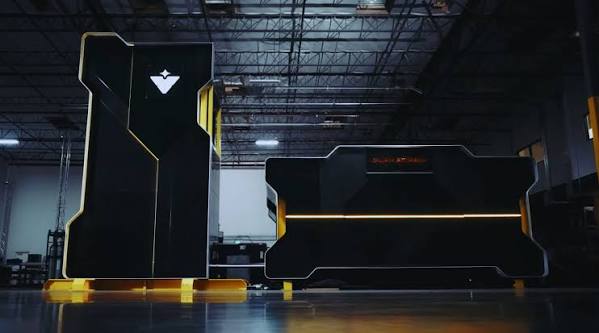
- Valar Atomics closed a $1 billion Series B led by Sequoia Capital on August 3 at a $6 billion valuation, alongside a separate $200 million credit facility from Erebor and J.P. Morgan, roughly $1.2 billion in new financing.
- The three-year-old startup wants to build small reactors like manufactured products rather than one-off construction projects, and it names AI data centers as a primary market. In July it powered an NVIDIA Blackwell cluster from a 30 megawatt waterless reactor that reached self-sustaining criticality.
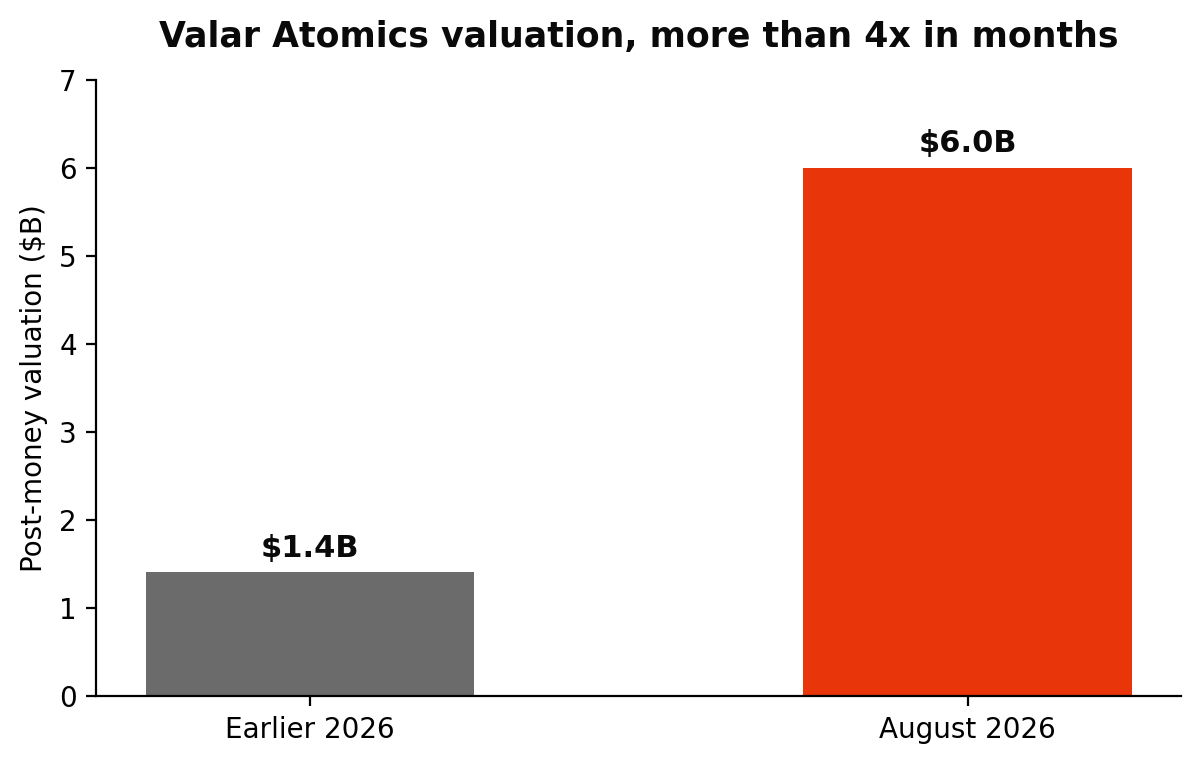
- The round more than tripled Valar's valuation in months. It is a capital-markets signal that investors now treat power, not chips, as the binding constraint on the AI buildout.
A nuclear startup priced like an AI company
Sequoia Capital led a $1 billion equity round into Valar Atomics on August 3, with partner Shaun Maguire joining the board. The syndicate reads like an AI cap table rather than an energy one: Valor Equity Partners, Atreides Management, Point72, Conviction, Riot Ventures, Snowpoint, Dream Ventures, Apandion, and HOF Capital all took part. A separate $200 million credit facility from Erebor and J.P. Morgan brought total new financing to about $1.2 billion.
The valuation is the headline. At $6 billion post-money, a company founded three years ago and led by a founder who dropped out of high school is now worth more than four times what it was earlier this year. Nuclear startups do not usually reprice like software. Valar just did, and the reason is what it plans to power.
The bottleneck moved from chips to electrons
For two years the AI buildout was a story about compute. The scarce resource was NVIDIA silicon, and the companies that could secure chips set the pace. That constraint has not gone away, but a second one has moved in front of it. A data center full of Blackwell clusters is useless without power to run it, and the grid cannot add gigawatts on the timeline hyperscalers want to add racks. Electrons, not accelerators, are now the thing in short supply.
Valar's answer is to treat a reactor as a product. Its model chains multiple small units into what it calls Gigasites, standardized plants built on a manufacturing line rather than assembled once on a custom site. The distinction is the whole thesis, and the founder put it plainly.
"One reactor can be built as a project. A fleet has to be manufactured."Isaiah Taylor, founder and CEO of Valar Atomics, via TechCrunch
The company backed the claim with hardware before raising the round. In July its Ward 250 reactor, a 30 megawatt waterless design, became the first startup-built advanced reactor to reach self-sustaining criticality, and it used that output to directly power an NVIDIA Blackwell cluster. That sequence, a working reactor feeding AI silicon, is what let Valar raise on a manufacturing story rather than a research one.
| Series B led by Sequoia, at a $6 billion valuation | $1 billion |
| Ward 250 waterless reactor that reached criticality | 30 MW |
| Valuation increase over earlier in 2026 | More than 4x |
Why investors are funding electrons
The round fits a pattern that ran through the same week's deals. Capital is concentrating on the hard, physical bottlenecks under AI rather than on more models. Valar's raise landed next to a $1 billion round for modular nuclear from a rival approach, a $312 million round for photonic inference chips, and continued financing for the power and cooling that data centers consume. The common thread is that investors have decided the scarce input is no longer intelligence in software but the energy and hardware to run it.
The AI trade has quietly rotated. The bet is no longer only on the model that thinks fastest, but on the reactor, the chip, and the megawatt that let it run at all.
For Sequoia, the logic is that whoever can deliver firm, carbon-free power on a manufacturing timeline captures a market the hyperscalers are desperate to buy into. Microsoft, Google, Amazon, and OpenAI have all signed power deals or funded nuclear projects to feed their data centers. A company that can turn out standardized reactors rather than negotiate bespoke plants would sell into demand that is already contracted and still growing.
The risk on the other side
The caution is that nuclear has humbled confident capital before. Reaching criticality on a demonstration unit is a real milestone, but manufacturing a fleet means clearing regulatory approval, supply chains, fuel, and siting at a scale no advanced-reactor startup has yet proven. The Nuclear Regulatory Commission moves on timelines that do not resemble a venture roadmap, and a $6 billion valuation prices in execution that is years from being demonstrated. If deployment slips, the gap between the raise and the revenue is long enough to test any backer's patience.
The bull case is that the demand is unusually certain even if the delivery is not. Data centers need power that is firm, dense, and clean, and there are few ways to supply all three at once. Valar has now shown a reactor that works and raised the capital to try to build many of them. Whether it can manufacture nuclear the way it promises is unproven. That investors were willing to underwrite the attempt at $6 billion is itself the signal: in the AI buildout of 2026, the constraint that commands the highest premium is no longer the chip. It is the electricity to run it.
Santage is committed to independent, transparent journalism. This article is produced in accordance with Santage's Editorial Standards and aims to provide accurate and timely information. Readers are encouraged to verify information independently.