
- Foxconn's Q2 2026 net profit rose 35% to NT$60 billion as revenue climbed 41% to NT$2.53 trillion, both ahead of analyst forecasts.
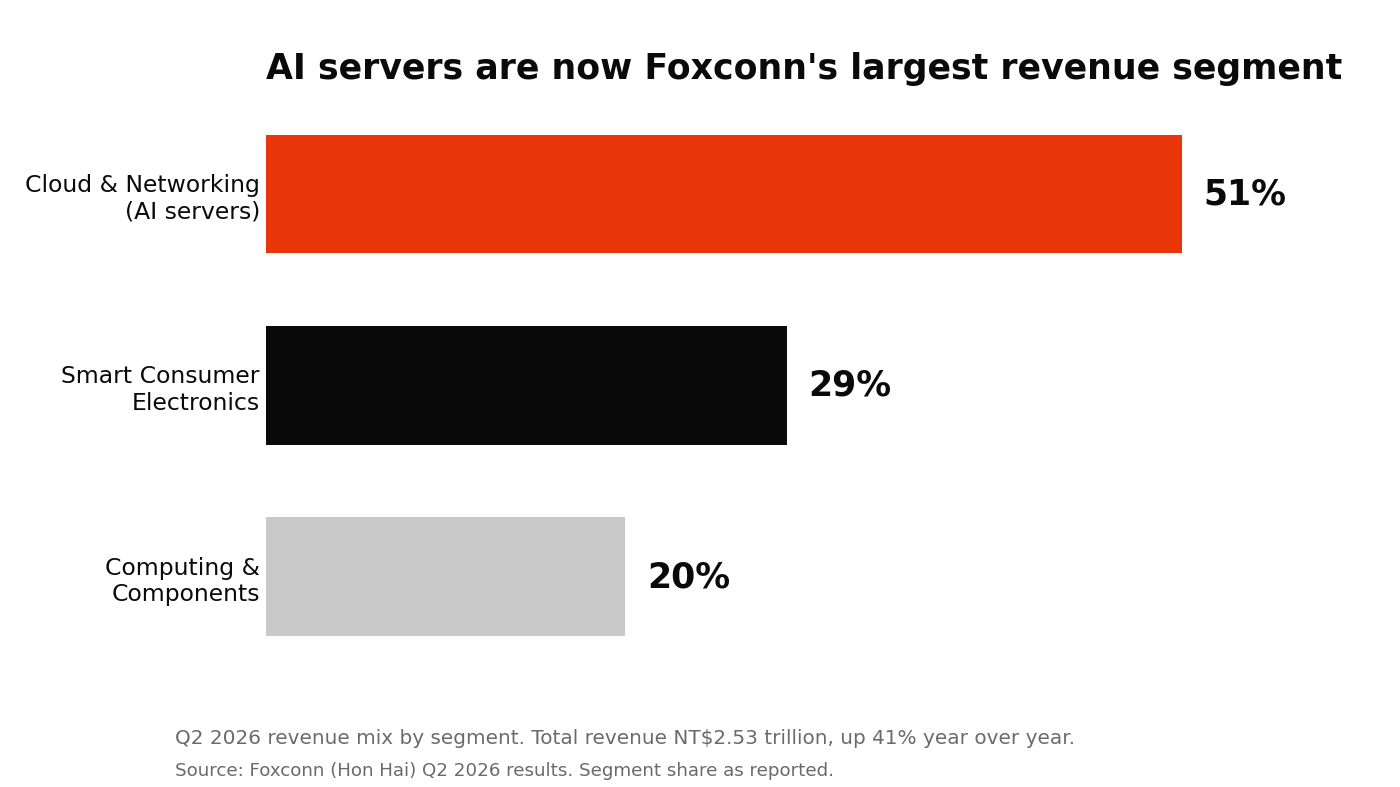
- AI servers now make up roughly 51% of Foxconn revenue, overtaking the consumer electronics unit at about 29% that built the company around the iPhone.
- Management guided to stronger AI capacity demand into 2027 and rising capex, with co-packaged optical switches set for mass production in Q3 2026.
AI servers overtake the iPhone as Foxconn's revenue center
Foxconn, formally Hon Hai Technology Group, is the largest contract electronics manufacturer in the world, and for two decades it has been effectively synonymous with the iPhone. That identity flipped in the second quarter of 2026. In results released this week, the company reported net profit of NT$60 billion, up 35% year over year, on revenue of NT$2.53 trillion, up 41%. Both figures beat forecasts.
The composition underneath those numbers is the real story. The cloud and networking segment, which houses Foxconn's AI server business, has become the single largest source of revenue, passing the smart consumer electronics unit that assembles Apple's hardware.
| Net profit, year over year | NT$60 billion, up 35% |
| Revenue, year over year | NT$2.53 trillion, up 41% |
| AI servers as a share of total revenue | ~51% |
| Consumer electronics as a share of total revenue | ~29% |
| Co-packaged optical switches mass production | Q3 2026 |
Why a contract manufacturer is now an AI infrastructure proxy
The crossover reads as a hard, primary signal about where AI capital is actually landing. Most of the market watches the chip layer, Nvidia's order book and the price of high-bandwidth memory. Foxconn sits one layer up, in system integration: turning trays of accelerators into finished, racked, cooled, and networked machines that a data center can switch on. When that business alone outweighs the largest consumer-electronics supercycle in modern manufacturing, it confirms that the AI build-out is not a chip story with a hardware footnote. It is a full physical construction boom, and the assembly of the systems is now a bigger line than the phones.
Foxconn's leadership is leaning into exactly that framing.
Foxconn's advantage in AI lies in providing complete, end-to-end system solutions, rather than just single products.Michael Chiang, Rotating CEO, Hon Hai Technology Group
Chiang added that customer demand for AI production capacity will stay very strong heading into 2027, and that the company plans capex increases across multiple locations. For an investor, that reclassifies Foxconn. It is no longer a consumer-hardware cyclical tied to the iPhone refresh calendar. It is a proxy for the pace of global AI infrastructure spending.
Where the constraint is moving next
The forward signal in the results is not the profit line. It is the mention of co-packaged optics reaching mass production in Q3 2026. Co-packaged optics move the network connection directly next to the chip, cutting the power and latency cost of shuffling data between accelerators. Foxconn putting that into volume production is a tell that the binding constraint on AI servers is shifting away from raw compute and toward the parts that feed and connect it: advanced packaging, power delivery, and optical interconnect. Reporting around the results has already flagged advanced packaging capacity as a likely ceiling on AI server output in 2027. For a manufacturer, being early to the next bottleneck is not a footnote. It is how Foxconn intends to keep the AI server lead it just reported, because the company that solves interconnect and packaging at volume captures the next wave of orders before the constraint becomes visible to everyone else.
The number most coverage is missing
Read the two headline figures together and a quieter warning appears. Revenue grew 41% while profit grew 35%. Profit rose fast, but it rose slower than the top line, which means the revenue mix is diluting blended margin. That is the expected cost of the crossover. System assembly and integration carry thinner margins than high-value components, so as lower-margin AI server revenue becomes the majority of the business, each additional dollar of sales earns a little less. Foxconn is winning enormous scale in AI, and it is doing so on a structurally leaner margin than the components-and-devices mix it is replacing.
That trade is the whole thesis of the AI hardware supply chain in one quarter. The volume is real, the growth is real, and the demand runs into 2027. The margin, for the companies doing the physical assembly rather than selling the scarce silicon, is where the pressure quietly sits. Foxconn just became the clearest public gauge of how large the AI infrastructure build has grown, and of who captures the economics of it.
Santage is committed to independent, transparent journalism. This article is produced in accordance with Santage's Editorial Standards and aims to provide accurate and timely information. Readers are encouraged to verify information independently.