
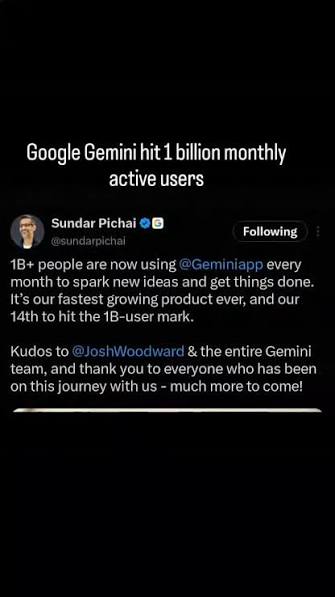
- Google's Gemini app crossed 1 billion monthly active users, the fastest any Google product has reached the mark, with more than 100 million of them on iOS.
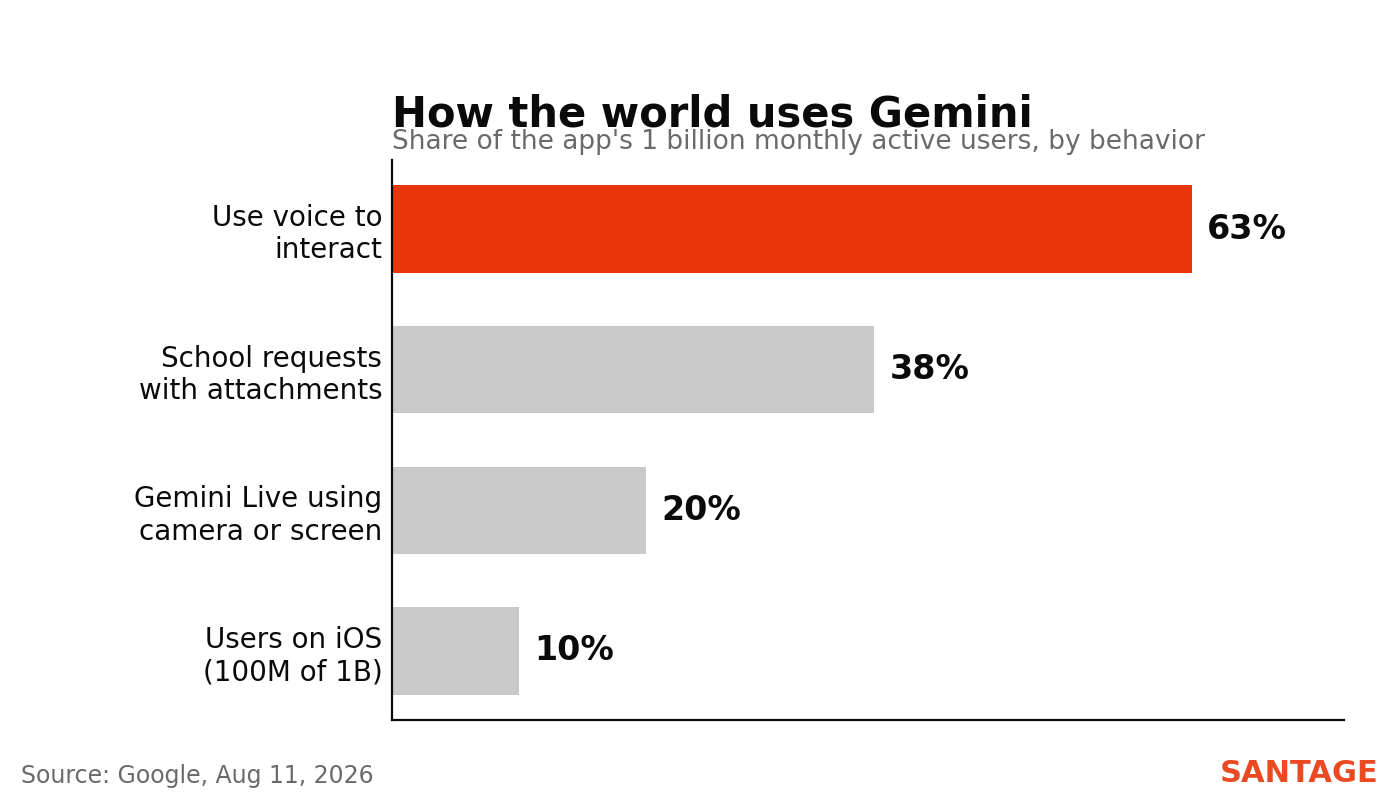
- 63% of users now interact by voice and one in five Gemini Live sessions use a live camera or screen share, evidence the assistant is being used daily rather than just installed.
- Google reported engagement in detail but disclosed no paying-subscriber figure, leaving the question that decides whether reach becomes revenue unanswered.
Gemini reaches a billion users faster than any Google product
Google said the Gemini app now has more than 1 billion monthly active users, making it the fastest-growing product in the company's history. The milestone puts Google's consumer assistant on the same population scale as its largest properties, and it lands while the company is still spending far more to serve those users than it collects from them.
The usage detail matters more than the headline number. Voice has become the default way people reach Gemini, with 63% of users interacting by speaking rather than typing. The app generates over 150 million images a day, more than 100 million of its users are on iOS rather than Android, and roughly 40 popular apps can now be driven through Gemini to take actions on a user's behalf. This is a product being lived in, not a download that sits idle on a home screen.
| Monthly active users, Google's fastest product to the mark | 1 billion |
| Images generated per day | 150 million |
| Users who interact by voice | 63% |
| Active users on iOS, not Android | 100 million+ |
The number Google left out is the one investors want
For all the metrics in the announcement, one was missing: how many of those billion people pay. Google detailed voice adoption, image volume, and Gemini Live behavior, but not subscribers to its paid tiers. That omission is the story. Distribution at this scale is a moat only if it converts, and a free assistant bundled across Android, Chrome, Search, and Workspace can reach a billion people without proving that any of them would miss it enough to pay.
The competitive framing sharpens the point. OpenAI reports ChatGPT in weekly active users, a tougher measure of habit, while Google is choosing the monthly frame that produces the larger figure. Both companies are now optimizing for the same thing, a daily assistant habit deep enough to eventually carry a subscription or an ad load, and both are still serving these users at a loss.
A billion monthly users is a genuine distribution achievement that few companies on earth could engineer. It is also the easy half of the problem. The number that will define whether Gemini is a business rather than a habit is the one Google decided not to print, and until it does, the milestone measures reach, not revenue.
Santage is committed to independent, transparent journalism. This article is produced in accordance with Santage's Editorial Standards and aims to provide accurate and timely information. Readers are encouraged to verify information independently.