
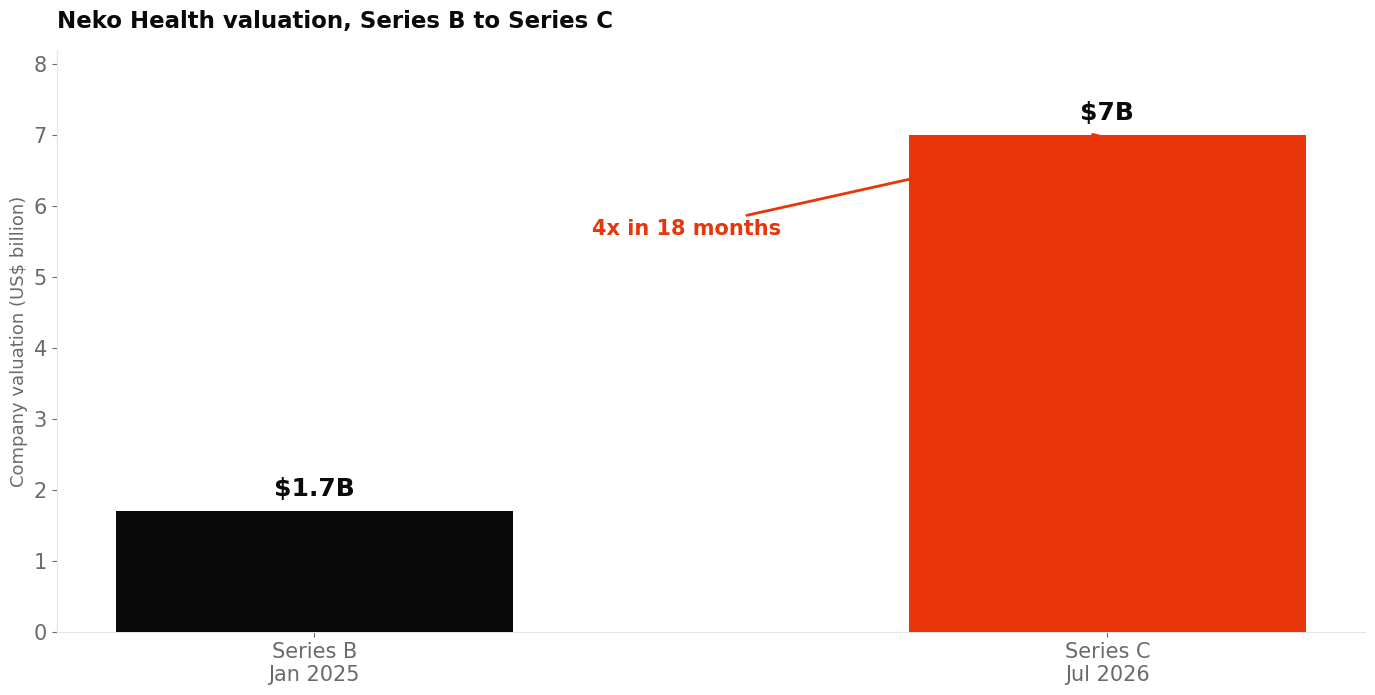
- Neko Health closed a $700 million Series C at a valuation of nearly $7 billion, a fourfold jump from its $1.7 billion Series B 18 months earlier.
- Each Neko visit is a 60-minute, radiation-free scan that captures millions of data points plus blood analysis, all read by AI to flag cardiovascular, metabolic, and skin risk.
- The US waitlist has passed 300,000 signups ahead of a New York launch, and the cap table now includes Lightspeed, General Catalyst, Mark Zuckerberg, and OpenAI.
The number that reframes preventive health as a venture category
Neko Health, the Stockholm-based screening company co-founded by Spotify's Daniel Ek, raised $700 million in a Series C that values the company at close to $7 billion. The round was led by Lightspeed Venture Partners and co-led by O.G. Venture Partners, with existing investors Atomico, General Catalyst, and Lakestar returning alongside new backers including BDT & MSD and Positive Sum. The valuation is roughly four times the $1.7 billion Neko commanded at its Series B in January 2025.
What makes this an AI Alpha story rather than a healthcare headline is what the capital is buying. Neko is not selling a drug or a device. It is selling a data-capture loop: a physical scan dense enough that machine learning can find patterns no single clinician reviews in a 15-minute appointment, and a growing library of those scans that makes each future read sharper.
How the scan actually works
A Neko visit takes about an hour and is noninvasive and radiation-free. Proprietary sensors capture millions of data points across the body while a blood draw is analyzed on site. The system assesses skin health, biomarkers for prediabetes, blood abnormalities, and risk factors tied to metabolic syndrome, stroke, and heart attack. The company describes the goal directly:
Our mission is to make it possible to detect and prevent disease before it becomes serious, and to give everyone access to a proactive picture of their own health.Neko Health, Series C announcement
The AI layer is the point. A body scan that produces millions of measurements is useless to a human reviewer without a model that can triage which signals matter. Every completed scan also becomes training data, so the diagnostic edge compounds with volume. That is the same flywheel logic that made Ek's first company valuable, applied to the body instead of the music catalog.
Why the investor list is the real signal
- $700M raised
- Nearly $7B valuation, up 4x from $1.7B at Series B (January 2025)
- 300,000+ US waitlist signups before the first clinic opens
- 60-minute radiation-free scan capturing millions of data points
- Backers include Lightspeed, General Catalyst, Atomico, Mark Zuckerberg and Priscilla Chan, and OpenAI
The cap table reads like a bet placed across two industries. Lightspeed and General Catalyst are classic growth investors. But the participation of Mark Zuckerberg and Priscilla Chan, whose philanthropy centers on curing disease, and of OpenAI itself, signals that the frontier AI world sees consumer health screening as a proving ground for applied AI. When the company building GPT models writes a check into a body-scanning clinic, the thesis is not charity. It is that high-volume, high-dimensional physiological data is one of the most valuable untapped training substrates left.
That is also why the $700 million matters beyond Neko. It sets a price for the category. Preventive, AI-read screening has spent years as a wellness curiosity. A near $7 billion valuation tells every other founder and fund that the market now treats it as infrastructure for a shift from reactive medicine to continuous monitoring.
The number most coverage is missing
The headline figure is $700 million. The more revealing figure is 300,000, the size of the US waitlist before a single American clinic has opened. Demand at that scale, unprompted by a product anyone has used yet, is the asset the valuation is really pricing. It suggests the constraint on preventive screening was never patient appetite. It was the cost and throughput of capturing enough data to make AI diagnosis reliable, and Neko is spending the round to solve exactly that.
The risk sits in the same place as the promise. Screening healthy people produces false positives, and a model tuned to catch everything can send anxious patients into cascades of unnecessary follow-up tests. Neko's valuation assumes its AI can hold specificity high enough to avoid that trap at scale. No regulator has yet defined what accuracy a consumer AI screening service must clear, which means Neko is building the standard and the business at the same time.
If it works, the model is genuinely new: not a clinic that sees you when you are sick, but a data company that watches the whole population get healthier and prices the insight accordingly. A $700 million round says the smartest money in both tech and medicine now believes the body, scanned densely and read by machine, is the next great dataset. Whether that is a medical breakthrough or an expensive way to worry the worried well is the question the next 300,000 scans will answer.
Santage is committed to independent, transparent journalism. This article is produced in accordance with Santage's Editorial Standards and aims to provide accurate and timely information. Readers are encouraged to verify information independently.