
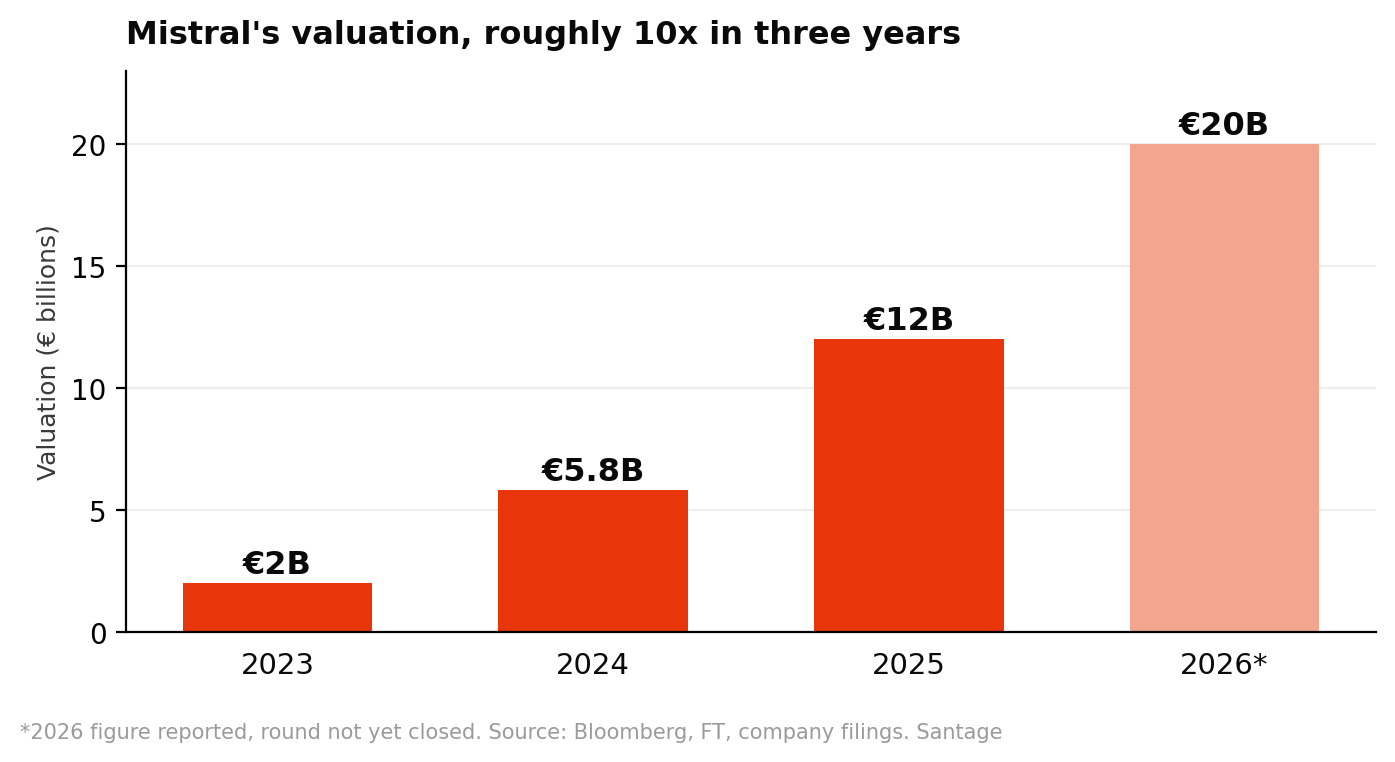
- Mistral is reportedly raising up to €3 billion at a valuation of roughly €20 billion, nearly double the €12 billion it reached in September 2025.
- Samsung is in advanced talks to invest up to €1 billion, joining reported discussions with EQT's Scaleup Europe Fund, Novo Holdings, and Santander.
- The valuation reflects a strategic thesis more than a revenue one: Mistral has become the vehicle for Europe's bid to control its own AI infrastructure.
A €20 billion valuation that is really a sovereignty premium
Mistral, the Paris company founded in 2023, is reportedly in talks to raise as much as €3 billion at a valuation near €20 billion, according to reporting on July 22. That would nearly double the €12 billion valuation it reached only ten months earlier and value a company still a fraction of OpenAI's size at a level that its revenue alone cannot explain. Samsung is in advanced discussions to invest up to €1 billion, alongside reported talks with EQT's Scaleup Europe Fund, Novo Holdings, and Santander. Neither company has confirmed the deal, which remains in negotiation.
To read this as a normal venture round is to miss what is being priced. Mistral is not being valued purely as the maker of competitive open-weight models. It is being valued as the closest thing Europe has to a domestic champion in a technology that European governments have decided they cannot afford to import wholesale. That is a different asset, and it carries a different premium.
Why Europe decided it needs its own AI stack
The sovereignty logic hardened over the past year. As the United States tightened access to its most advanced models, tying frontier releases to government review and, in some cases, restricting foreign access, European institutions confronted a dependency they had underestimated. A continent that relied on American models running on American clouds could find its most strategic technology governed by another country's export policy.
Scaling our infrastructure in Europe is critical to empower our customers and to ensure AI innovation and autonomy remain at the heart of Europe.Arthur Mensch, co-founder and chief executive of Mistral, as reported by the Financial Times
Mistral's response has been to build the full stack rather than rent it. It raised roughly $830 million earlier this year to construct Nvidia-powered data centers on European soil, signed a compute arrangement with Microsoft, and set a target of one gigawatt of its own capacity by 2030. The strategy is to keep the models, the weights, and increasingly the compute inside European jurisdiction, so that a French bank, a German carmaker, or an EU agency can adopt AI without routing its most sensitive data through infrastructure it does not control.
What Samsung's money signals about the new alignment
The most telling detail is who is writing the check. Samsung is not a European institution or a sovereign fund. It is a South Korean conglomerate that makes memory chips, and its interest reveals how the sovereignty story is reshaping global capital. For Samsung, a stake in Mistral is a dual play: exposure to Europe's leading model company and a foothold with a customer whose data center ambitions will consume enormous quantities of the memory Samsung sells.
Europe's push for AI independence is being financed, in part, by an Asian chipmaker. Autonomy in models does not yet mean autonomy in silicon.
That contradiction is the honest center of the story. Europe can fund its own models and build its own data centers, but the chips inside those centers still come from Nvidia, and the memory still comes from Korea and the United States. Sovereignty at the model layer sits on top of a supply chain Europe does not control, which is precisely why a Samsung investment is strategically logical for both sides and quietly awkward for the sovereignty narrative.
None of this makes the bet irrational. A €20 billion valuation is a wager that political will, regulatory pressure, and a genuine market for trusted, locally governed AI will carry Mistral to a scale its current revenue does not justify. Governments and large enterprises are already choosing European AI for reasons that have nothing to do with benchmarks and everything to do with jurisdiction.
The number to watch is not the valuation but the gigawatt target. Mistral's promise is European AI independence, and independence is measured in compute the continent actually owns, not in funding rounds. If Mistral reaches one gigawatt of European capacity by 2030, the €20 billion will look like a bargain. If it does not, Europe will have paid a champion's price for a company that still runs on everyone else's infrastructure.
Santage is committed to independent, transparent journalism. This article is produced in accordance with Santage's Editorial Standards and aims to provide accurate and timely information. Readers are encouraged to verify information independently.