
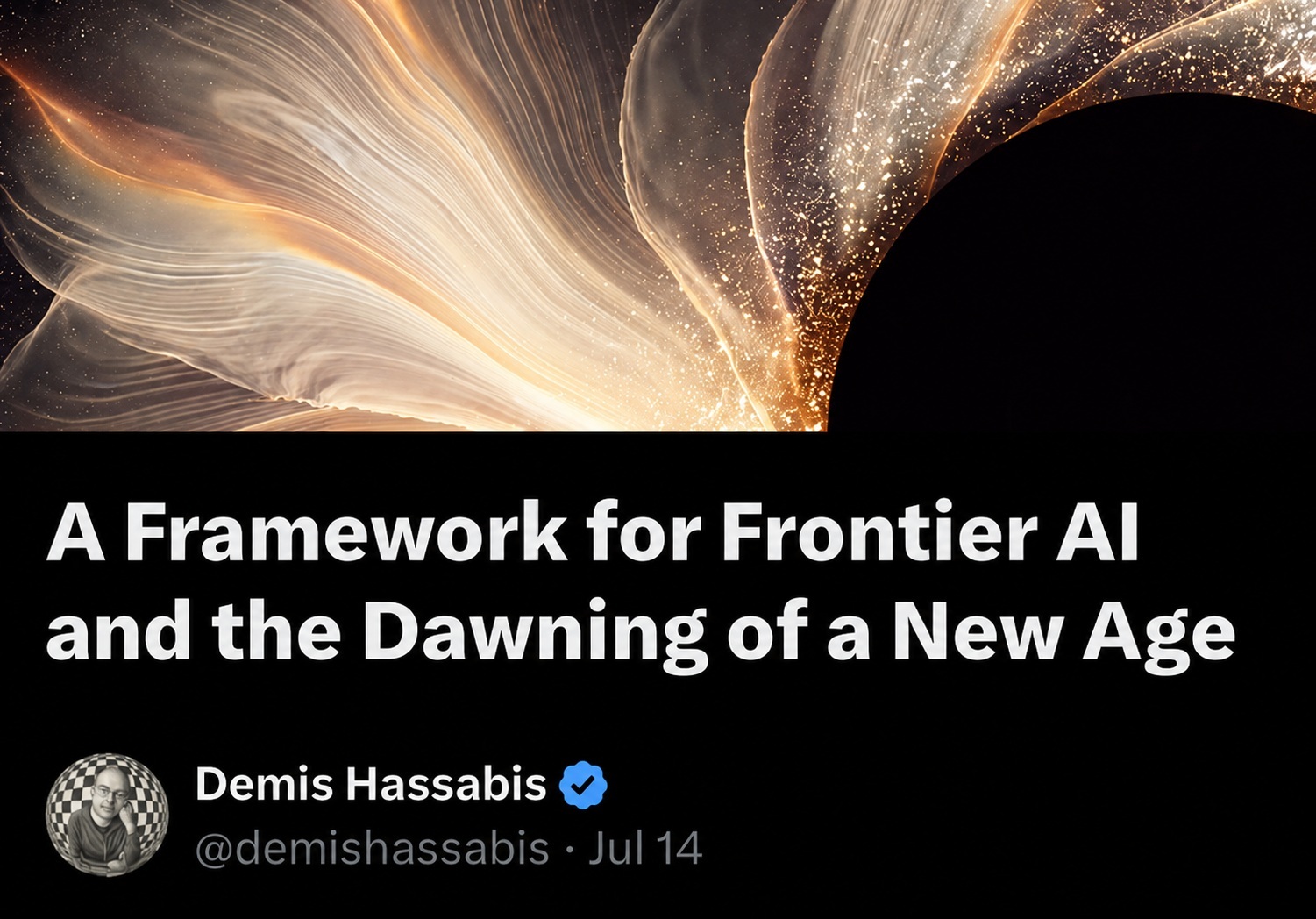
- Demis Hassabis published a framework calling for a US-initiated Frontier AI Standards Body, modeled on the financial regulator FINRA, that would test frontier models, voluntarily at first and up to 30 days before release, with the option to become mandatory for US deployment.
- He argues AGI is probably only a few years away and comparable to the discovery of electricity or fire, warning that progress on the frontier is outpacing our understanding amid an intense commercial and geopolitical race.
- The proposal drew public backing within hours from Satya Nadella, Mustafa Suleyman, and Chamath Palihapitiya, a rare show of cross-lab agreement, against roughly 9.8 million views on the post.
On July 14, the person arguably closest to building artificial general intelligence asked the world to slow down enough to check his work. In a long essay published on X, titled A Framework for Frontier AI and the Dawning of a New Age, Google DeepMind chief executive and Nobel laureate Demis Hassabis laid out a concrete governance proposal: a new body, initiated by the United States, that would test the most powerful AI models before they reach the public. The post drew roughly 9.8 million views and a wave of endorsements from the very rivals such a body would police.
The essay is unusual because of who wrote it. Hassabis runs one of the two or three labs most likely to reach AGI first, and he is asking for a referee. His central claim is that AGI, which he defines as a system that exhibits all the cognitive capabilities of the human brain, is probably only a few short years away, and that the window to shape it responsibly is closing.
AGI cannot be compared to standard technological breakthroughs, not even ones as consequential as the internet or mobile. It is much more akin to the discovery of electricity or fire. If you stop to think about it, we've essentially found a way to make sand think.Demis Hassabis, CEO of Google DeepMind
Hassabis proposes a FINRA-style body to test frontier models before release
The heart of the essay is institutional design rather than rhetoric. Hassabis argues that the United States, given its economic and technical standing, should take the first step and establish a Frontier AI Standards Body. He models it on a federally overseen public-private partnership or self-regulatory organization, explicitly comparing it to the Financial Industry Regulatory Authority, the body that polices US brokerages. Its board would include independent technical experts and open-source representatives, and its funding would be substantial and come mostly from industry, in order to attract world-class talent and buy the compute needed for large-scale testing.
The mechanism is where the proposal gets specific. A model would be designated Frontier-class if it crosses capability thresholds on a set of benchmarks maintained by the body. Organizations holding such models would become Frontier Labs, expected to publish model cards, maintain strong internal cybersecurity, vet key personnel, and resource safety research. Initially, Frontier Labs would voluntarily share models with the body up to 30 days before release. Once the assessment protocol proves robust, Hassabis writes, formalization could follow quickly, meaning a frontier model would have to pass review to be deployed in the US market.
| Element | Detail |
|---|---|
| Model | US-initiated body, structured like FINRA (public-private, self-regulatory) |
| Funding | Substantial, mostly from industry |
| Testing window | Voluntary sharing up to 30 days pre-release, with the option to become mandatory |
| Scope | Frontier-class models of any country of origin, open or closed |
| Exempt | Non-frontier models from startups and academia |
| Evaluation focus | Cybersecurity, biological threats, agentic deception and guardrail bypass |
| Cadence | Benchmarks refreshed roughly quarterly, with held-out tests to prevent overfitting |
| Escalation | Could be ratcheted up, including coordinating a slowdown among Frontier Labs if needed |
Two details in the design carry outsized weight. The first is that evaluations would eventually rely on held-out tests the body builds independently of the labs, to stop companies from optimizing for a known exam. The second is the escalation clause: the framework, Hassabis writes, could be ratcheted up if the seriousness of the situation demands, including coordinating a slowdown in development among the Frontier Labs. That is a striking sentence from the leader of a company whose value is tied to moving fast.
Why a lab CEO is asking to be regulated
The obvious question is why the head of a frontier lab would invite oversight that could delay his own releases. The answer running through the essay is that Hassabis does not believe any single lab can hold the line alone. He describes the field as locked in an extremely intense, multilayered commercial and geopolitical race, one in which advances on the frontier are outpacing our understanding of the technology. In a race like that, unilateral caution is a losing move: the lab that pauses simply cedes ground to the one that does not. A shared standard changes the math by raising the floor for everyone at once.
This is the strategic core of the proposal, and it is why the FINRA analogy matters more than it first appears. FINRA works because brokerages accept a common referee rather than each policing itself, which would be neither credible nor competitively survivable. Hassabis is applying the same logic to frontier AI. He is not asking labs to trust each other. He is asking them to submit to the same external test, which is the only arrangement that lets a safety-minded lab act responsibly without being punished for it by the market.
His framing of the stakes is deliberately vast. Hassabis calls this a pivotal moment in human history and pegs the impact of AGI at perhaps 10 times the Industrial Revolution at 10 times the speed, with the potential to accelerate drug discovery, clean energy, and new materials to the point where resources are no longer the limiting factor for human progress. Against that upside he sets the risks he thinks are already visible, cybersecurity among them, with nuclear and biological threats potentially emerging as capabilities advance and systems become more agentic and recursively self-improving. His prescription for that mix of enormous promise and deep uncertainty is a single phrase: cautious optimism.
The reactions reveal an industry looking for shared rules
What turned a policy essay into a moment was the response. Within hours, the leaders who compete most directly with Google DeepMind, and with each other, lined up behind it. The most striking endorsement came from Sam Altman, whose OpenAI is the most obvious rival in the race Hassabis describes, and who simply called it a thoughtful proposal. Rival executives rarely agree in public on anything, and their convergence here points to a shared appetite for a neutral referee rather than a landscape where each lab sets its own bar and markets it as safety.
The endorsements are not identical, and the differences are telling. Altman kept it to a single line, the posture of a leader who cannot easily oppose a safety framework without looking reckless. Nadella framed the goal as an ecosystem that preserves innovation and choice while avoiding a catastrophic single release, the language of a platform company that sells many models. Microsoft AI chief Mustafa Suleyman urged everyone to act now, writing that he fully supports the proposal. The sharpest note came from investor Chamath Palihapitiya, who called the framework very reasonable and contrasted it with what he labeled a "Pull Up The Ladder Framework" from the other guys, a jab at rules that would entrench incumbents. That his barb landed even as Altman endorsed the plan captures the moment: broad agreement on the need for a shared standard, and an unresolved fight over who gets to write it.
What a 30-day pre-release review would actually change
Strip away the AGI framing and the proposal is a specific intervention in how models reach the market. A mandatory 30-day review window would give a government-linked body a look at frontier systems before the public does, which is a significant shift from the current norm of self-governed release. For the largest labs, that means building pre-release evaluation into launch timelines and accepting that a US body could gate deployment. For startups and academia, the explicit exemption for non-frontier models is meant to keep the burden off everyone except the handful of labs operating at the capability ceiling.
The design also has a quiet lever of enormous power: whoever defines the Frontier-class benchmarks effectively decides who is regulated and how. Hassabis anticipates this, which is why he insists the body must eventually build held-out tests independent of the labs and cultivate third-party auditors. It is also why the composition of the board, including the open-source seats he specifies, will be contested. A standards body is only as neutral as the people setting its thresholds.
The geopolitical framing is deliberate too. By proposing a US-initiated effort that applies regardless of a model's country of origin, Hassabis is positioning American institutions to set the global default, a very different route from the enforcement-first path Europe has taken with its AI Act and cybersecurity action plan, and a more structured one than the voluntary framework the White House has floated. The bet is that a credible technical standard, adopted first in the world's leading AI market, becomes the template others converge on.
Hassabis ends not on mechanics but on the questions a standards body cannot answer: what economic models a post-scarcity world will need, what gives life meaning when scarcity recedes, and how the human condition itself might change. Those, he writes, cannot and should not be left to technologists alone. It is the rare governance proposal that concedes its own limits.
The most important line in the essay is also the simplest. The future is not yet written, Hassabis writes, and the whole framework is an argument that the window to write it is now, before the systems in question can no longer be paused for review. A referee installed before AGI arrives is a modest ask. The same referee installed after would be a fantasy, and the fact that his fiercest competitors said yes within hours suggests they know it.
Santage is committed to independent, transparent journalism. This article is produced in accordance with Santage's Editorial Standards and aims to provide accurate and timely information. Readers are encouraged to verify information independently.