

- From December 9, Tidal will reject any wholly AI-generated track submitted to it and remove the ones already live, a purge the company puts at about 29 million songs, with the catalog expected to be clear by early 2027.
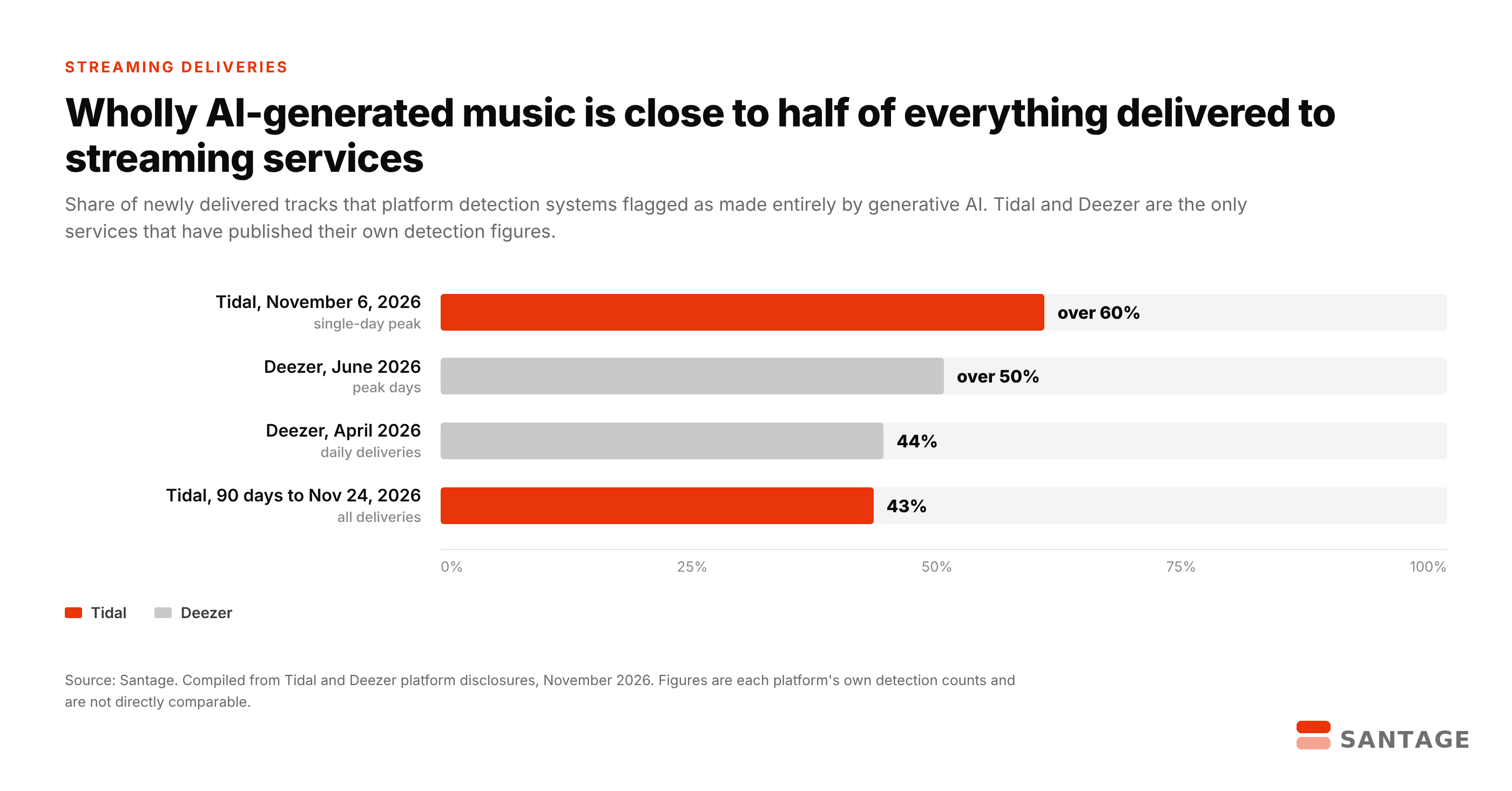
- Tidal detected AI in 43% of all tracks delivered to it in the 90 days to November 24, and in more than 60% of deliveries on November 6 alone, its heaviest day on record.
- About 27 million tracks in the catalog carry Tidal's AI tag, roughly 6.3% of its available music, and 96% of them drew zero streams over the past three months.
Tidal will stop accepting music made entirely by generative AI on December 9 and delete roughly 29 million tracks already sitting in its catalog, after its detection systems flagged 43% of everything distributors sent it over the past 90 days as wholly machine-made.
Tidal moves from labelling AI tracks to deleting them
Tidal's existing policy, which took effect on June 29, tagged wholly AI-generated recordings with an on-screen badge and cut them off from royalties and direct-to-fan sales while still letting them onto the service. The update published on Tuesday replaces that with removal, and the company's own support documentation now carries the change at the top of the page.
"Please note that starting December 9, 2026, any wholly AI-generated track that's submitted to Tidal will be rejected and removed from our platform."
Tidal, AI Policy, updated November 24, 2026
The ban reaches the supply chain as well as the catalog. Distributors are barred from delivering wholly AI-generated tracks, and Tidal says it will reject any delivery whose metadata declares the recording as fully machine-made. Music made with AI assistance stays, since the rule applies only to recordings that are the sole output of a generative tool, which leaves producers using AI for stem separation, mastering or vocal processing untouched.
| 29M | Tracks Tidal expects to delete |
| 43% | Of 90-day deliveries detected as wholly AI-generated |
| 96% | Of AI-tagged tracks with zero streams in three months |
| December 9 | Removal and rejection begin |
The upload numbers behind the decision
The scale of the inflow is what pushed Tidal past labelling. The company says 94% of its AI-tagged catalog traces to a single generator, Suno, and that it has already pulled more than 65,000 AI tracks for suspected artist impersonation. Its lead at Block, Robert Andersen, set out the reasoning publicly on Tuesday.
Tidal is not alone in the flood. Deezer, which built its own detector, reported that fully AI-generated music accounted for 44% of daily deliveries in April and about 90,000 tracks a day in June, and it has chosen filtering rather than deletion.
Removal turns detection into a liability question
Tagging a track costs a platform very little if the detector is wrong, because the song keeps playing. Deleting it does not, and Tidal has put its catalog decisions behind a classifier supplied by Ircam Amplify, which reports a false positive rate below 0.02%. Across 29 million removals that rate still implies thousands of human recordings swept up by mistake, which is why the appeals route Tidal already offers for wrongly tagged tracks becomes the real pressure point in December.
The deeper signal is economic. Those 29 million tracks were earning nothing already, since 96% of them went unplayed and none could collect royalties under the June rules, so removal frees no meaningful money for artists. What it buys is catalog quality and the ability to say the shelves are human, a claim no competitor at scale has made while licensed AI products move the other way, as Universal Music's remix platform with ElevenLabs showed in September.
Streaming services spent two years arguing that labelling AI music was enough because listeners could decide for themselves. Tidal just conceded that when 43% of the inflow is synthetic, the label is not a choice, it is a filing system for a problem nobody wants filed.
For the generative music tools themselves, the loss of a mid-sized platform matters less than the precedent of a distribution chain that now checks metadata at the door. Rejecting 80,000 to 85,000 submissions a day, as Tidal expects to, converts generative AI output from catalog into traffic to be screened, and screening is a cost the tools' users, not the platforms, will eventually be asked to carry.
Tidal is a small service making a loud choice, and the number it published is the part that travels: a 43% AI share of new deliveries is a statement about the whole distribution pipeline, not about one catalog. Every platform that has only tagged AI music so far now has a figure of its own that it has not released.
Santage is committed to independent, transparent journalism. This article is produced in accordance with Santage's Editorial Standards and aims to provide accurate and timely information. Readers are encouraged to verify information independently.