

- xAI marks Grok API text on every endpoint by default; Anthropic marks all Claude text worldwide with no opt-out; OpenAI marks ChatGPT and Codex text only in the EU and leaves its API off unless customers opt in.
- xAI's opt-out requires a team admin to confirm that a legal exception applies, logs the change in an audit trail, and makes the developer solely responsible for any marking duty.
- Detection stays gated at every lab, so the mark can be applied at scale long before schools, platforms or regulators can routinely read it.
Since November 7, text generated by seven of xAI's Grok models through its API has carried an invisible watermark by default, worldwide, and any developer who switches it off must certify that a legal exception applies and accept responsibility for compliance. That design choice completes a three-way split among the leading labs on how to meet Europe's AI-content marking rule, and with the European Union's December 2 deadline 23 days away, the default each company picked is quietly deciding who carries the legal risk.
xAI made the watermark the starting point for every Grok API customer
xAI, which now publishes its developer documentation under the SpaceXSI name, says the watermark covers grok-4.7, grok-4.6, grok-4.5, grok-4.3 and three grok-4.20 variants across the Responses and Chat Completions APIs. It applies to ordinary text, structured outputs and tool-call arguments, which means the arguments an agent passes to other software are marked too. Developers need no code change, and a response header reports whether a given output was marked.
"Opting out asks you to confirm that an exception under applicable law applies to your use, and that you are solely responsible for any marking, disclosure, or other legal requirement."
SpaceXSI, Output Watermarking documentation, updated October 31, 2026
The mark works the way most current text watermarks do. During generation, the model's token choices are nudged slightly so that a detector can later score a passage as watermarked, not watermarked or uncertain, with longer passages giving a stronger signal. xAI says the process changes neither quality nor speed and adds no hidden characters.
Three labs read the same EU rule and chose three defaults
Article 50 of the EU AI Act has required providers of generative systems to mark synthetic content in a machine-readable, detectable format since August 2, with a transition period to December 2 for systems already on the market before that date. The law sets the outcome and leaves the method open, and the leading labs have taken that freedom in different directions.
| Provider | Consumer apps | API default | Opt-out | Detector access |
|---|---|---|---|---|
| Anthropic (Claude) | Marked worldwide since August | Marked worldwide | None | Third-party detection still in development as of August |
| OpenAI (ChatGPT, Codex) | Marked in the EU only, rolling out since October 5 | Off; customers can opt in for select models | Not applicable in the API | Approved researchers only |
| xAI (Grok) | Not covered by the API change | Marked on 7 models, all endpoints, since November 7 | Team admin, per model, with legal attestation | By application |
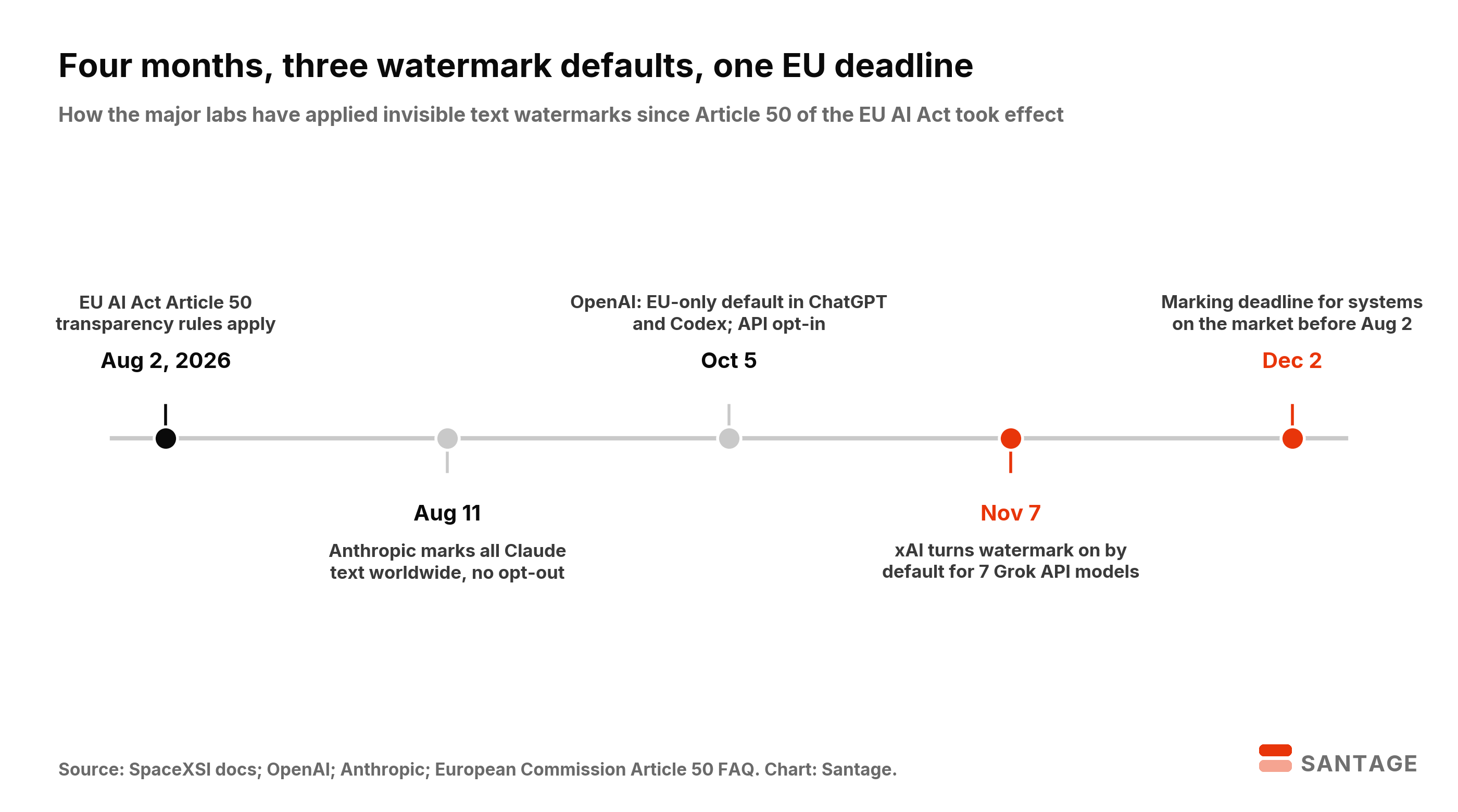
Anthropic chose the broadest coverage, with every surface marked and no exit. OpenAI chose the narrowest consumer footprint and treated its API as a tool developers enable themselves. xAI sits between them, marking all API output everywhere while letting businesses leave on the record. For a company building on several models at once, the same product can now emit marked text on one provider and unmarked text on another, depending on settings that sit in different consoles.
The opt-out moves compliance risk onto developers
The most consequential line in xAI's documentation is about liability. A team that disables the watermark has affirmed that an exception applies, and the audit log records who made that call and when. Under Article 50, a provider that misses the marking duty faces fines in the band of up to 15 million euros or 3% of worldwide annual turnover, whichever is higher, so the attestation turns a product toggle into a compliance decision with a named owner.
OpenAI's design pushes the same question the other way. Because its API is unmarked by default, a developer building a customer-facing generative product for European users has to decide whether to enable textGrain or meet the obligation through other means. Anthropic removes that choice entirely. Readers following how AI agents chain model calls together should note that tool-call arguments are now in scope at xAI, which pushes watermarking into machine-to-machine traffic for the first time at a major lab.
A mark nobody outside the labs can routinely read
Every approach shares a gap. xAI grants detection access by application, OpenAI limits its detector to approved researchers, and Anthropic described third-party detection as still in development when it launched, a point Santage examined when Claude's watermark proved presence rather than authorship. OpenAI has been unusually direct about what the technique cannot do.
That limitation shapes what the December deadline will actually deliver. Europe will soon have most major large language models marking their output in some form, while the ability to verify those marks stays concentrated inside the companies that applied them. Schools, publishers and platforms hoping for a reliable AI-text check will find a signal designed for regulatory compliance first and public verification later.
The watermark itself is a commodity. The default setting, and the attestation attached to switching it off, is where each lab has written its own policy.
What builders should settle before December 2
Teams shipping generative features to EU users have three practical questions to answer in the next three weeks: which of their providers mark by default, whether their own product counts as a provider of a generative system under Article 50, and who in the organization signs off if a mark is disabled. The answers now differ by vendor, and the logs xAI keeps will show regulators exactly when each choice was made.
The industry spent two years arguing about whether text watermarks work. Article 50 settled a narrower question first: marks will be applied whether or not they can be widely read, and the companies that set the defaults have also decided how much of the legal burden stays with them.
Santage is committed to independent, transparent journalism. This article is produced in accordance with Santage's Editorial Standards and aims to provide accurate and timely information. Readers are encouraged to verify information independently.