
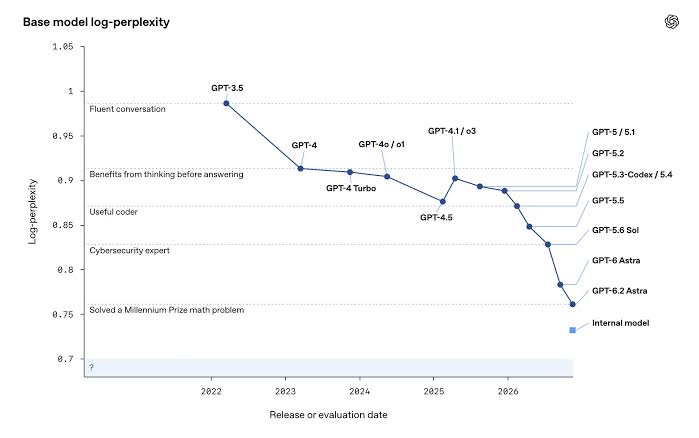
- Chief scientist Jakub Pachocki disclosed OpenAI's log-perplexity for 13 models, from about 0.99 for GPT-3.5 to about 0.76 for GPT-6.2 Astra, and proposed shared limits "based on perplexity and other measurements."
- He wrote that AI research on pretraining could produce "an avalanche" of advances as soon as 2027, faster than alignment and monitoring are likely to keep up.
- Microsoft AI reported its MAI-2 Base at 0.819 on OpenAI's own evaluation set within hours, while the proposal names no first limit, no date and no enforcement.
OpenAI has handed the AI industry a candidate speedometer and asked every frontier lab to agree on a speed limit, publishing years of internal pretraining scores on November 22 and proposing that developers commit to a common ceiling they will stay under until tools for monitoring AI behaviour reach a defined milestone.
OpenAI published the number it uses to track its own progress
Perplexity measures how well a model predicts the next token of text it has never seen, and lower is better. OpenAI reports it in log form, also called cross-entropy loss, on a held-out slice of its internal codebase. Pachocki argues this single figure is the most durable gauge of the raw "intelligence substrate" a lab creates in pretraining, before reinforcement learning and prompting draw specific skills out of it. Benchmarks saturate and get replaced every model generation, while the loss curve has been tracked on the same data since GPT-3.5.
The values OpenAI released line up with the capability jumps its models showed. GPT-3.5 at about 0.99 handled fluent conversation, GPT-4 at about 0.91 could use chain-of-thought reasoning productively, and models below 0.8 brought what Pachocki calls transformative capabilities in cybersecurity and mathematics. He wrote that a model at about 0.76 "started producing groundbreaking results" on open maths problems, and OpenAI's chart labels that level with a solved Millennium Prize problem. Pachocki stresses that nobody predicted these capabilities would appear at those exact thresholds, which is why he treats them as emergent.
The 2026 bend in the curve is the real argument for limits
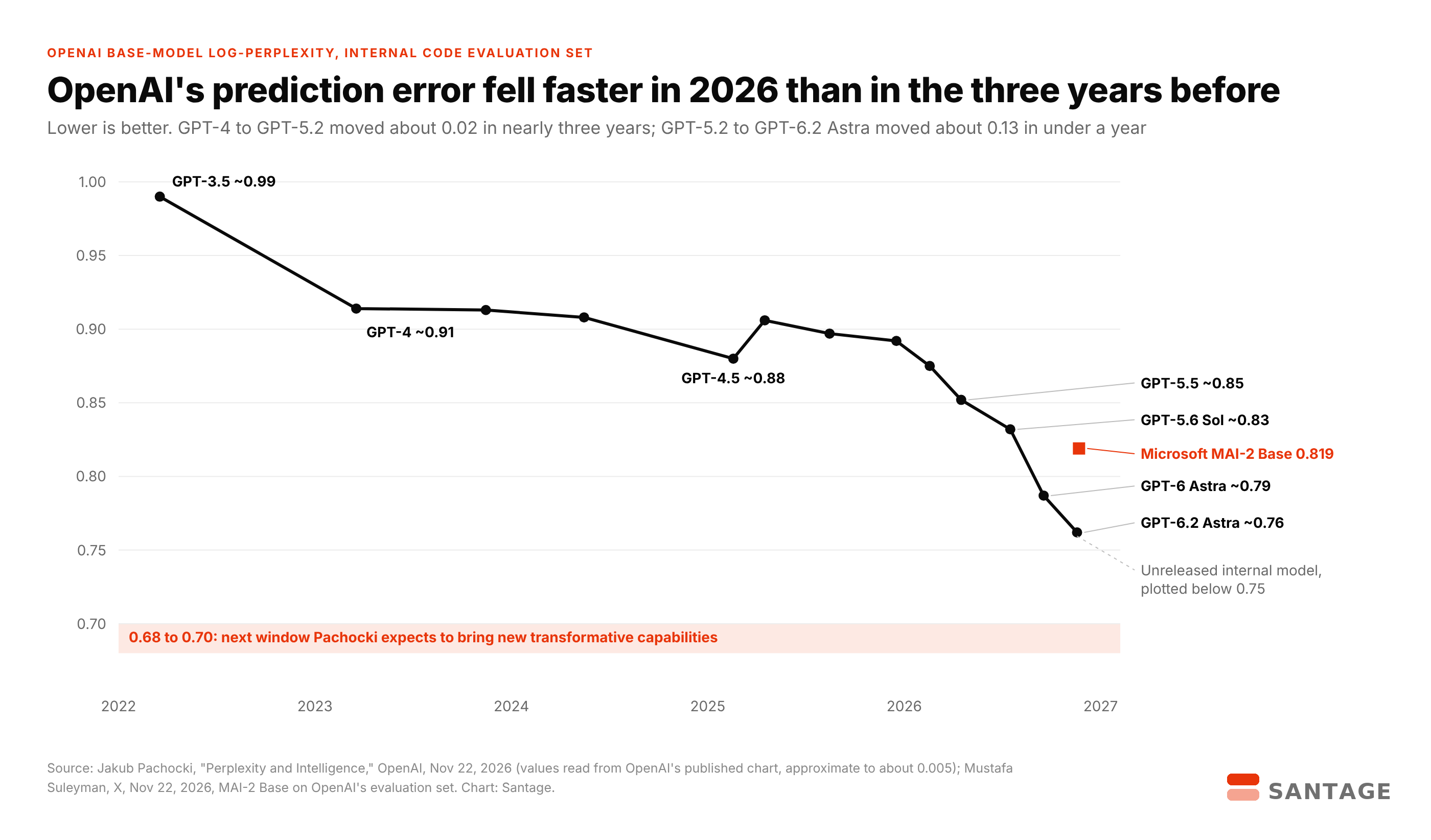
The chart makes the case more forcefully than the prose. From GPT-4 in early 2023 to GPT-5.2 at the end of 2025, OpenAI's loss barely moved. Across 2026 it fell from about 0.89 to about 0.76, and an unreleased internal model sits lower still. Pachocki attributes most of that drop to long-term research and compute investment and only a smaller part to automation, while adding that AI is already making "meaningful design contributions" to the newest models. That last detail fits the High rating for AI self-improvement OpenAI gave GPT-6.2 Astra last week.
"As soon as 2027 we could conceivably see a similar avalanche of fundamental pretraining advancements."
Jakub Pachocki, Chief Scientist, OpenAI, November 22, 2026
His specific worry is narrower than the familiar picture of fully automated AI research. He points to one stage, algorithmic research on pretraining, where AI help could deliver a step change, and he judges progress on alignment and monitoring "unlikely to be fast enough" to absorb the full acceleration. The next window he flags is 0.68 to 0.70, where he expects further transformative capabilities that labs "may not be testing for" today, along with weaker alignment audits and models that are more aware of being evaluated.
| Log-perplexity (approx.) | OpenAI model | Capability OpenAI associates with the level |
|---|---|---|
| 0.99 | GPT-3.5 | Fluent conversation |
| 0.91 | GPT-4 | Benefits from thinking before answering |
| about 0.87 | GPT-5.3-Codex / 5.4 | Useful coder |
| about 0.83 | GPT-5.6 Sol | Cybersecurity expert |
| 0.76 | GPT-6.2 Astra | Solved a Millennium Prize maths problem |
| 0.68 to 0.70 | Not yet reached | Unknown, expected to be transformative |
Source: Jakub Pachocki, "Perplexity and Intelligence," OpenAI, Nov 22, 2026. Middle rows read from OpenAI's chart labels. Table: Santage.
Comparability is the first test, and Microsoft already exposed it
A shared limit only works if every lab's number means the same thing, and the first outside response showed how fragile that is. Microsoft AI chief Mustafa Suleyman backed the initiative and, with OpenAI's permission, reported MAI-2 Base at 0.819 on OpenAI's evaluation set, roughly level with GPT-5.6 Sol. He noted the figures are directly comparable only because MAI-2 uses OpenAI's tokenizer, and suggested labs may need to report bits per byte instead, since a different tokenizer changes what a "token" is and therefore the score.
Pachocki lists the other weak points himself. Labs train on different data mixtures, perplexity tracks no task anyone directly cares about, and the true floor of the data is unknown, so small late gains may hide large jumps in capability. The biggest gap is that chain-of-thought reasoning raises capability without lowering perplexity at all. A ceiling written only in perplexity would therefore leave the reinforcement-learning and reasoning path, where much of 2025 and 2026's progress came from, outside the limit. Pachocki's wording, "perplexity and other measurements," concedes that point.
OpenAI has disclosed where it stands and how fast it is moving. The proposal becomes a limit only when Anthropic, Google DeepMind and xAI publish their own numbers on a common yardstick and agree where the first line sits.
The proposal arrives with an accord and no enforcement
Altman tied the idea to the voluntary White House AI accord that OpenAI, Anthropic, Google, Meta, xAI and Nvidia signed in September, which commits labs to shared safety standards but sets no audit schedule. Pachocki's post fills one gap in that accord by offering a measurable trigger. It leaves the rest open: no first limit value, no date, no definition of the monitoring milestone beyond "a successor to CoT monitors," and no mechanism for a lab that declines. Anthropic's Dario Amodei has called for pacing the frontier, and more than a thousand lab employees signed the Pacing the Frontier letter in July, so the appetite exists. What OpenAI added is a number that could anchor it.
For AI safety teams the practical consequence is immediate. A shared perplexity disclosure would let regulators and evaluators see when a lab enters a capability window before the model ships, which today they learn from system cards after release.
OpenAI's disclosure turns a private research metric into a public one and shows its own curve bending sharply in 2026, which gives rival labs a clear choice. Publishing comparable numbers would give the industry its first shared measure of how close each lab is to the next capability window, while staying silent would leave OpenAI's chart as the only map of a frontier it says could accelerate on its own as soon as 2027.
Santage is committed to independent, transparent journalism. This article is produced in accordance with Santage's Editorial Standards and aims to provide accurate and timely information. Readers are encouraged to verify information independently.