

- OpenAI reports up to 14% power, performance and area (PPA) gains on AMD's flagship GPU IP from model-written circuit code, plus single-digit gains AMD verified on blocks of its next flagship CPU.
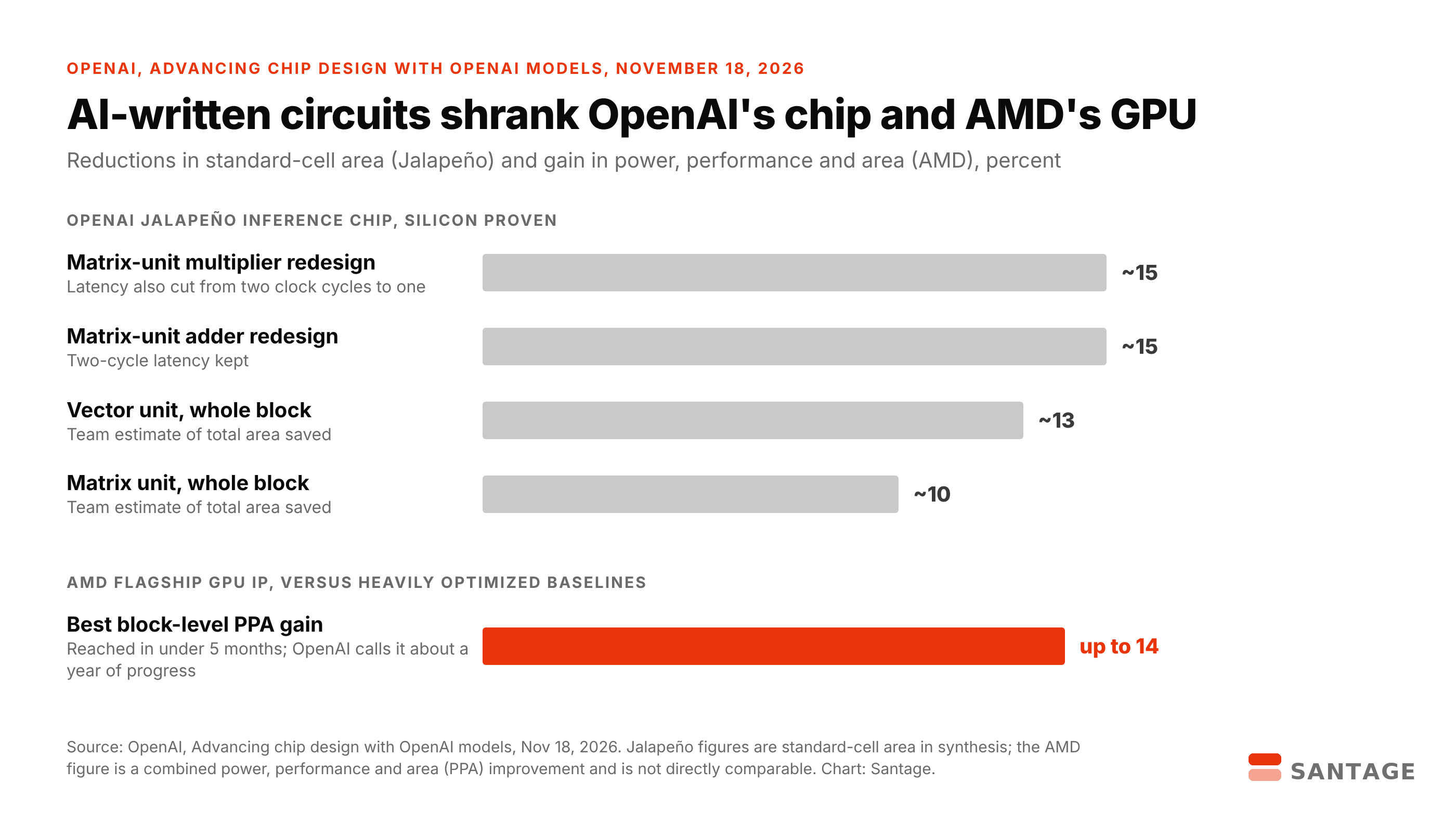
- On OpenAI's own Jalapeño inference chip, model-proposed changes cut standard-cell area by about 13% in the vector unit and 10% in the matrix unit, and those changes are proven in silicon.
- Chip design is now a measured loop in which AI improves the hardware that runs AI, and the only check on it is verification tools from vendors such as Synopsys, which OpenAI is training a dedicated model to operate.
OpenAI says its models rewrote parts of AMD's flagship GPU design and found improvements of up to 14% in power, performance and area over AMD's own heavily optimized baselines, work it describes as about a year of chip engineering progress done in under five months, and AMD has already put some of those changes into a chip sent for manufacturing.
OpenAI's models rewrote circuits inside Jalapeño and AMD's next chips
OpenAI's November 18 post is the first time OpenAI has put numbers on how much its models contribute to chip design. The work began in early 2025, when the team building Jalapeño, OpenAI's first custom inference chip, started using an o3-mini model to propose design changes. The gains came from arithmetic hardware. One redesigned multiplier in the matrix unit used about 15% less cell area while cutting its latency from two clock cycles to one, and a separate adder redesign saved about 15% of area at the same latency. Across the whole design, the team estimates model-proposed changes reduced standard-cell area by about 13% in the vector unit and 10% in the matrix unit, and those savings held up when the physical chip came back from the fab.
AMD is the larger signal because the design was already mature. OpenAI says its model rewrote the SystemVerilog RTL, the code that describes a chip's circuits, for AMD's flagship GPU IP and found gains of up to 14% against baselines AMD had already optimized heavily. AMD also verified single-digit percentage gains on key blocks of its upcoming flagship CPU using designs the model wrote.
AMD has already sent model-written changes to manufacturing
A research claim becomes an industrial fact when a chipmaker ships it. OpenAI says AMD has included some of the model's changes in a recent design it sent for manufacturing and added others to its production design files for future chips. The figures come from OpenAI's post, and Santage did not find a separate AMD statement on the results at the time of writing.
"This represents roughly a year of progress achieved in less than 5 months."
OpenAI, Advancing chip design with OpenAI models, November 18, 2026
The partnership gives the claim weight. AMD is one of OpenAI's two main GPU suppliers under a six-gigawatt deployment agreement announced in October 2025, so faster AMD design cycles feed straight back into the hardware OpenAI plans to train and serve its models on.
| How the AI chip design loop has moved | |
|---|---|
| Early 2025 | Jalapeño team starts using o3-mini to propose design changes |
| June 2026 | OpenAI and Broadcom unveil Jalapeño, taken from design to tape-out in nine months |
| August 25, 2026 | OpenAI publishes Jalapeño's first measured results |
| September 30, 2026 | OpenAI and Synopsys sign a multiyear deal to build GPT-Synopsys |
| November 18, 2026 | OpenAI reports up to 14% gains on AMD GPU IP and silicon-proven Jalapeño savings |
Each new OpenAI model designs better processor cores
To track progress across model generations, OpenAI tested its models on two open-source 32-bit RISC-V processor cores, PicoRV32 and the Ibex core used in OpenTitan, and scored each design on throughput in instructions per second, with zero for any design that failed simulation checks or grew past 16 times the original area. Across 9,881 scored runs at a budget of about 112,000 tokens per run, GPT-6.2 Astra had the highest average score on both cores, and on PicoRV32 its score was about twice that of GPT-6 Astra, released only two months earlier. Every model scored higher when designing a core from written requirements than when improving an existing one, though OpenAI notes that designing from a specification lets models drop features such as performance counters, which flatters the result.
The most important number in OpenAI's post is the doubling between two Astra models released two months apart, on a task that turns AI capability straight into better AI hardware.
Chip design closes a loop that OpenAI says it is now measuring
The chip work arrived on the same day as OpenAI's second research acceleration report, which tracks indicators of recursive self-improvement, the process by which AI speeds up the development of later AI. That report says agents now complete 46% of two-to-four-hour research tasks without human help, up from 23% in March. Chip design extends the same loop from software into silicon. Santage reported on November 18 that GPT-6.2 Astra is the first OpenAI model rated High for AI self-improvement, and this post shows that model producing the best processor designs OpenAI has measured.
The safeguard in this loop is verification. OpenAI says its model used Synopsys tools to confirm that each rewrite preserved a block's behavior and to weigh the trade-offs in power, performance and area. It is now training GPT-Synopsys to run those electronic design automation tools the way expert engineers do. That puts the trusted checker and the AI being checked inside the same commercial partnership, a structure worth watching as more of a chip's design is written by models and fewer engineers read every line. Researchers quoted in OpenAI's own report still say agents have poor research taste and need close review, which is a reminder that the gains so far are concentrated in narrow, well-scored tasks.
Chipmakers have used software to automate design for decades, and the shift here is in who proposes the change. Frontier models are now writing circuit code that a top GPU maker sends to manufacturing, and each model generation does it measurably better than the last. With AMD's next chips carrying model-written circuits and labs now publishing measurements of how fast AI speeds up its own development, the speed of AI hardware progress is starting to depend on the speed of AI itself.
Santage is committed to independent, transparent journalism. This article is produced in accordance with Santage's Editorial Standards and aims to provide accurate and timely information. Readers are encouraged to verify information independently.