
- Anthropic's new invisible watermark marks any text Claude touches, but the company itself says the mark shows only that Claude may have processed the content, not that Claude authored it.
- The detection tool that would let schools, employers, or platforms verify a watermark has not shipped, so the mark exists everywhere while no outsider can yet read it.
- Within days, developers published open-source removal tools, one drawing more than 4,600 stars on GitHub, arguing that a statistical text mark cannot reliably prove origin.
The gap between processing and authorship is the whole story
On August 11 Anthropic said it would embed an invisible watermark into all Claude text output, and attach C2PA provenance metadata to image files, worldwide and with no opt out, to satisfy the EU AI Act's Article 50 transparency rules that took effect on August 2. The most important sentence in that rollout is not the announcement that Claude will now mark everything it writes. It is the quiet admission, in the company's own help documentation, of what the mark does not mean. Anthropic is not claiming the watermark proves Claude wrote a piece of text. It is claiming only that the text may have passed through Claude at some point. Those are very different statements, and the distance between them is where every real consequence of this policy lives.
Consider how people actually use the product. A non-native English speaker runs a cover letter through Claude to fix grammar. A lawyer pastes a contract clause in to have it summarized. A novelist asks for a tighter version of a paragraph she already wrote. In each case the ideas, the structure, and most of the words are human. The output still carries the mark. The watermark cannot tell the difference between text Claude invented and text Claude merely touched, because it was never designed to.
A mark means content may have been processed by Claude. Claude may not be the original author, for example if Claude was used to proofread, translate, or summarize existing content. A mark does not confirm complete provenance, that Claude generated all of the content, or that the content has not been modified.Anthropic, How Claude marks AI-generated content
Why a missing detection tool makes the mark dangerous, not just weak
A watermark that no one can read is harmless. A watermark that everyone assumes they can read is not. Anthropic has shipped the mark across its entire product line while describing the ability for third parties to detect it as still in development. That sequence, mark first and reader later, is the problem. It creates a window in which the signal is everywhere and the correct way to interpret it is nowhere.
The predictable failure is institutional. A school, an employer, or a platform that eventually gets a detection tool will be tempted to treat a positive result as a verdict: an AI wrote this. Anthropic's documentation says plainly that this inference is not supported, yet the incentive to draw it will be enormous. The history of AI detection is a warning here. Before watermarking existed, Stanford researchers found that one widely used detector falsely flagged more than half of essays written by non-native English speakers as machine generated. Watermark based detection removes some of that guesswork, but it introduces a subtler trap, because a confident technical signal invites confident misreading. The green-list style scheme also needs roughly 100 tokens to return a meaningful result, so a short answer, a paraphrase, or a translation can carry the mark faintly or lose it entirely, which means both false alarms and quiet misses are built in.
The backlash Anthropic invited by shipping the mark before the reader
The public reaction, loud on X within hours, split along exactly this fault line. Writers who use Claude only to polish their own prose objected that their words would now carry an AI mark they cannot remove, because there is no opt out. Developers worried about signatures riding along in generated code. And a philosophical fight broke out over credit, between users who feel they authored the work Claude refined and those who argue the model did the writing. The anger is not really about the ink. It is about a mark that asserts involvement without measuring it, applied to work where the human did most of the thinking.
The builder response was faster and more concrete. Within days, open-source projects to strip the watermark appeared and drew a crowd.
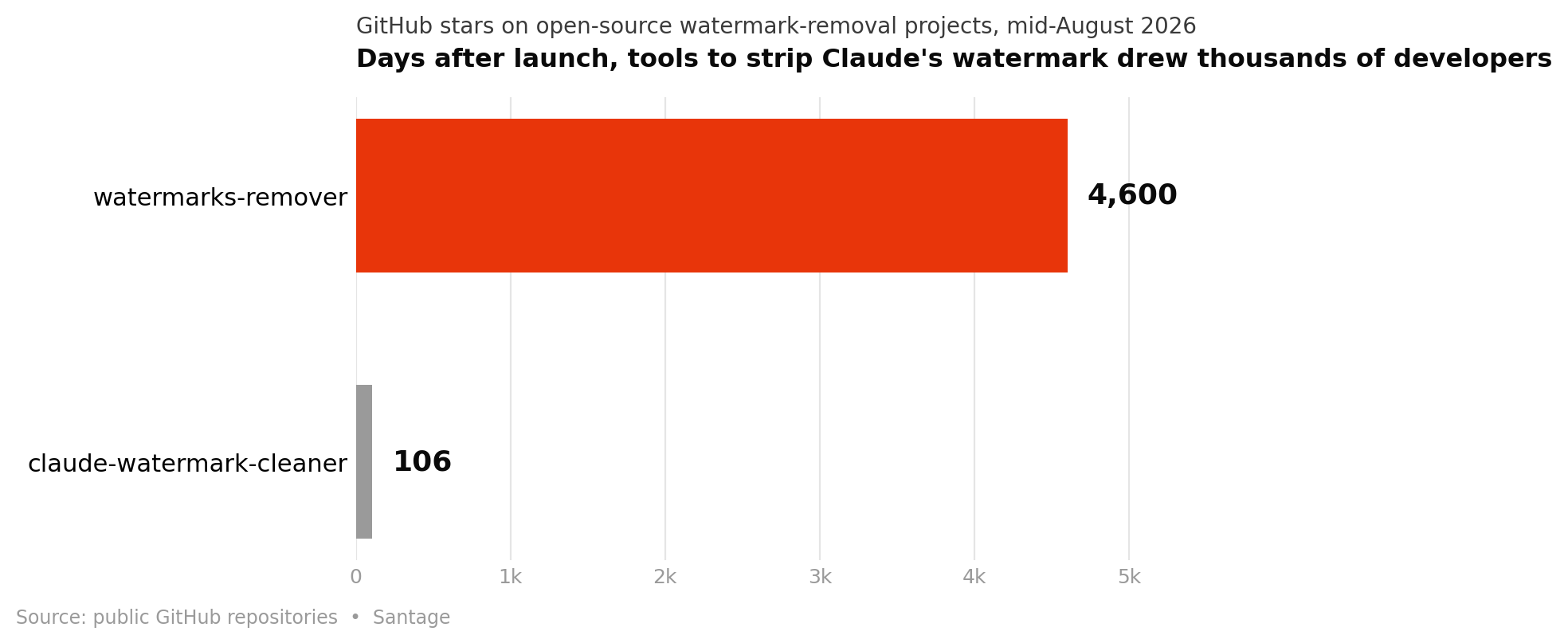
The projects do not just delete invisible characters. The larger one advertises removal of Claude's text mark alongside C2PA and SynthID class signals across image, document, and PDF formats, and its authors make the core technical argument out loud: a statistical text mark is not a reliable way to prove origin. Privacy critics added a sharper memory. Earlier in 2026, Anthropic quietly removed hidden Unicode markers from Claude Code that had tracked user location and proxy use, the same quiet marking technique now returning as official policy. To a skeptical audience, that history reframes the watermark from a transparency feature into a tracking one.
Anthropic built a mark that says Claude was here. It has not yet built the tool that says what that means, and that gap is where the damage happens.
What a processing mark, not an authorship mark, means for everyone downstream
For the people who will actually encounter these marks, the honest way to read a Claude watermark is as a smoke signal, not a fingerprint. It tells you the model was somewhere in the vicinity of this text. It does not tell you who wrote it, how much was changed, or whether the human or the machine did the work that matters. Teachers, editors, and hiring managers who forget that distinction will punish the wrong people, and the students and workers most likely to be caught in the crossfire are the ones who used Claude exactly as intended, to help with language rather than to replace their own.
For the industry, Anthropic has set a marker others will follow. It is the first major lab to watermark text at scale, while competitors have concentrated their compliance work on images and audio, and the same EU rule that pushed Anthropic will push everyone selling into Europe. That makes Anthropic's framing, presence rather than authorship, the template the whole sector may inherit. The framing is admirably honest. It is also the vulnerability, because a standard that refuses to claim authorship is a standard whose most important users will keep hearing authorship anyway.
A watermark that proves only that Claude passed through the text is honest engineering and a governance trap at the same time. Honest, because Anthropic refuses to assert more than the signal can carry. A trap, because the people who will act on the mark, the teacher grading an essay and the manager reviewing an application, will read authorship into a signal that was never built to hold it, and Anthropic has released that signal into the world before releasing the one thing that could keep it from being misread.
Santage is committed to independent, transparent journalism. This article is produced in accordance with Santage's Editorial Standards and aims to provide accurate and timely information. Readers are encouraged to verify information independently.