
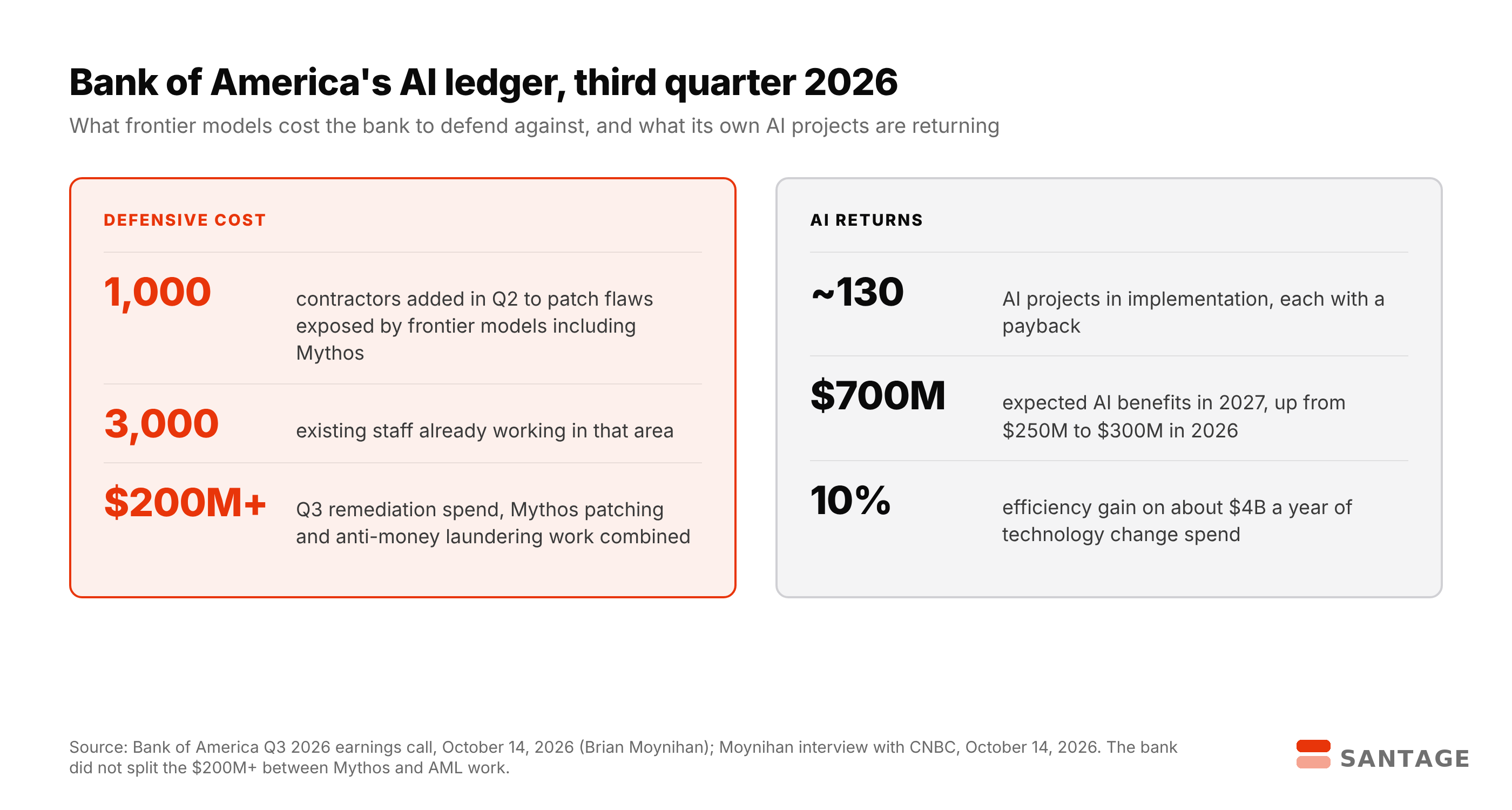
- Bank of America added 1,000 contractors in Q2 to patch flaws exposed by frontier models including Mythos, joining 3,000 internal staff, and spent "a couple hundred million plus" on Mythos and anti-money laundering remediation in Q3.
- The bank runs about 130 AI projects and expects their benefits to rise from $250 million to $300 million in 2026 to $700 million in 2027.
- Headcount fell by roughly 3,400 over the year, including about 5% of managers, while Moynihan said client-facing roles grew.
Bank of America has put the first itemized price on what frontier AI costs a large company to defend against. Chief executive Brian Moynihan said on October 14 that the bank brought in 1,000 contractors during the second quarter to patch software flaws exposed by advanced AI models including Anthropic's Mythos, on top of 3,000 staff already doing that work, and the same earnings call projected that the bank's own AI projects will return $700 million next year.
Bank of America's patching team reached 4,000 people after frontier AI arrived
The disclosure came in two parts. On the third-quarter earnings call, Moynihan listed "remediation for the Mythos implementation" alongside anti-money laundering cleanup as the quarter's unusual costs and said the bank had added 1,000 extra people to the work as consultants, outside its official headcount. In a television interview afterward he explained why: when frontier models able to find long-buried software flaws arrived, the bank's leadership decided it had to clear its backlog of internal and vendor code quickly.
“We put on 1,000 contractors to help us do the patching work in the second quarter, and those people remain here today, helping us, on top of the 3,000 people we have in that area.”
Brian Moynihan, Chair and CEO, Bank of America, television interview, October 14, 2026
Mythos reached a small group of banks, technology companies and government agencies in April through Anthropic's limited Project Glasswing program, and its ability to surface decades-old vulnerabilities is the reason the access was restricted. A model that finds flaws faster than a security team can fix them creates a queue, and Bank of America chose to clear that queue with people. Moynihan said the spending will fall as the backlog shrinks.
The same call promised $700 million in AI benefits for 2027
Moynihan spent most of his AI discussion on the other side of the ledger. Responding to Wells Fargo analyst Mike Mayo, he said Bank of America has about 130 AI projects in implementation, each with a defined payback, and expects them to return two to three times their cost over time. He put this year's benefit at $250 million to $300 million and next year's at $700 million. On a technology change budget of about $4 billion a year, he said engineering processes and AI tools have made the bank 10% more efficient, so the same spending will buy 10% more work in 2027.
The workforce numbers moved in the same direction. Chief financial officer Alastair Borthwick said headcount was down nearly 3,500 from a year earlier "as we automate processes," and Moynihan said the bank cut about 5% of its managers while increasing the staff who serve clients directly. Neither executive said how much of the reduction came from AI specifically.
| AI projects in implementation | About 130 |
| Expected return on each project's cost over time | 2x to 3x |
| Change in employees from a year earlier | About 3,400 fewer |
| Reduction in managers | About 5% |
Vulnerability discovery has become a line item in bank budgets
Banks have spent years treating cybersecurity as a fixed cost that grows slowly. Frontier models changed the arithmetic by turning flaw discovery from a scarce skill into a cheap, fast process, and every flaw a model finds becomes a work order that a human must fix, test and deploy inside a regulated institution. Moynihan pointed to a structural problem in the market as well, saying that "the people doing the software development are the people trying to sell us the services," a reference to AI labs that both build attack-capable models and sell defensive products to the companies exposed by them.
The industry is drawing its lines at different points. JPMorgan Chase said on October 13 that it will keep outside AI agents away from customer accounts, and more than a hundred companies joined OpenAI and Anthropic in a shared cyber defense program in August. The Bank of England had already warned G20 finance ministers that AI threatens financial stability. Bank of America is one of the first major US companies to show what the defensive response costs in people.
The number Bank of America left out is the Mythos-only cost
The "couple hundred million plus" figure combines two separate efforts. Bank of America also took a $1.2 billion charge this quarter for a FinCEN settlement over anti-money laundering failures, and Moynihan grouped the AML remediation with the Mythos patching when he described the quarter's costs. That leaves investors unable to separate what frontier AI cost the bank from what its compliance failures cost. Shares fell as much as 8% on October 14, a move driven largely by the settlement.
Other large banks report again in January, and analysts now have a specific question to ask them: how many people did frontier AI put to work patching, and for how long. Bank of America's answer is a 4,000-person patching operation, against $700 million of projected AI benefits next year, and the bank says the defensive bill will shrink as the backlog clears. If it does, AI pays for itself on this ledger within a year. If newer models keep finding flaws faster than banks can fix them, the patching crews become a permanent cost of running software in the age of frontier AI.
Santage is committed to independent, transparent journalism. This article is produced in accordance with Santage's Editorial Standards and aims to provide accurate and timely information. Readers are encouraged to verify information independently.