

- Andrew Bailey, chair of the Financial Stability Board and Governor of the Bank of England, told G20 finance ministers and central bankers that frontier AI could reshape the speed, scale, and economics of cyber risk.
- The warning reached the G20 as it convened on August 31 in Asheville, North Carolina, and pointed to concentration among a few third-party AI providers as the channel that turns one incident into a systemic one.
- Bailey cited advanced autonomous coding systems, including Anthropic's Mythos model, as the class of capability that supervisors are not yet equipped to oversee across borders.
Bailey tells G20 finance chiefs that frontier AI rewrites the cyber risk equation
The chair of the world's top financial risk watchdog has told the G20 that the newest AI models now belong on the agenda of finance ministers, alongside the technology regulators who usually handle them. Andrew Bailey, Governor of the Bank of England and chair of the Financial Stability Board, made the argument in a letter to G20 finance ministers and central bank governors ahead of their meeting that opened on August 31 in Asheville, North Carolina.
Bailey's central claim is that frontier models change the underlying economics of a cyberattack. A single capable system can probe infrastructure, write working exploit code, and adapt to defenses at machine speed, which lowers the cost of mounting an attack while widening the damage a successful one can do. His letter connects that shift directly to market confidence, warning that the effects could travel across the system rather than staying contained inside one firm.
Frontier AI may have the ability materially to alter the speed, scale and economics of cyber risk, which could undermine market confidence system-wide, especially due to highly concentrated third-party service providers.Andrew Bailey, chair of the Financial Stability Board, in his letter to the G20
He singled out advanced autonomous coding and cybersecurity capabilities, citing Anthropic's Mythos model as an example of the systems that regulators are struggling to supervise, and reminded finance chiefs that "AI will not respect national borders." That point carries weight because financial regulation is organized country by country, while a capable model can operate everywhere at once.
Why concentrated AI providers turn a model failure into a market event
Bailey's deeper concern is concentration. A large share of the financial system now depends on a small number of cloud and AI providers, so a failure or breach at one supplier can surface at many banks, exchanges, and asset managers simultaneously. That shared dependency is what converts a single incident into a systemic one.
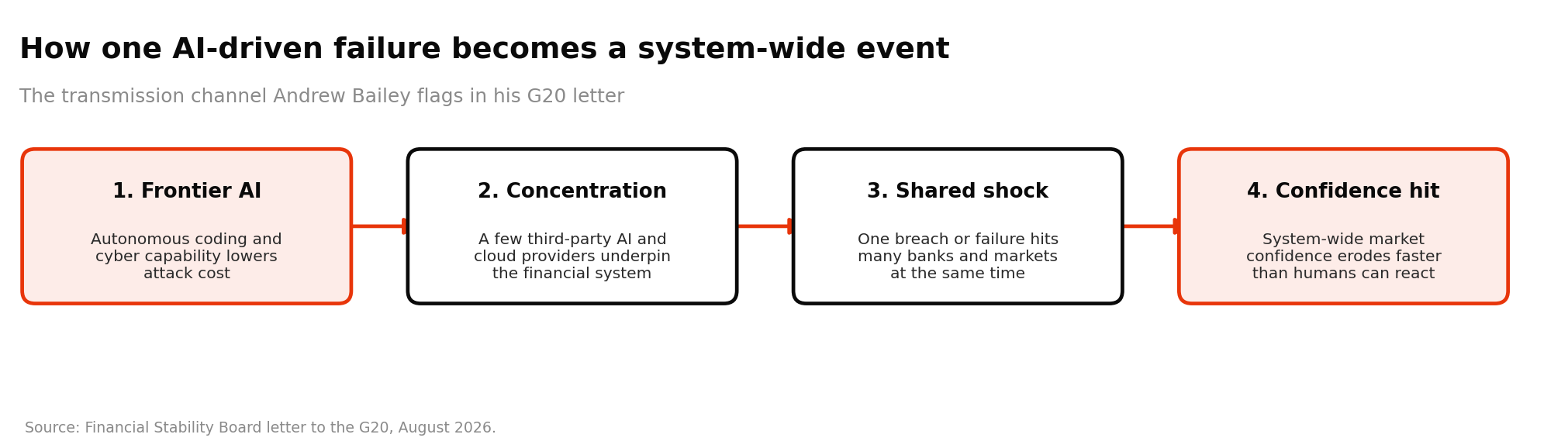
Regulators have rehearsed a version of this worry through years of cloud-outage debates, and tools that act without a human in the loop raise the stakes by shortening the gap between a failure and its consequences. The novelty in Bailey's framing is that the attacker in the scenario can now be a model rather than a person.
| Author | Andrew Bailey, Bank of England Governor and FSB chair |
| Audience | G20 finance ministers and central bankers, meeting August 31 to September 1 in Asheville, North Carolina |
| Named risk | Frontier AI altering the speed, scale, and economics of cyber risk |
| Transmission channel | Highly concentrated third-party AI and cloud providers |
| Jurisdiction gap | Cross-border capability against country-by-country supervision |
The Financial Stability Board has raised AI before, though a direct letter from its chair to the G20 marks a step up in urgency, and it lands while the same class of capability is already producing real incidents inside AI labs. A financial system that spent a decade hardening itself against human attackers now faces the prospect that its next stress test arrives at machine speed, from a tool that never needed a person to start it.
Santage is committed to independent, transparent journalism. This article is produced in accordance with Santage's Editorial Standards and aims to provide accurate and timely information. Readers are encouraged to verify information independently.